


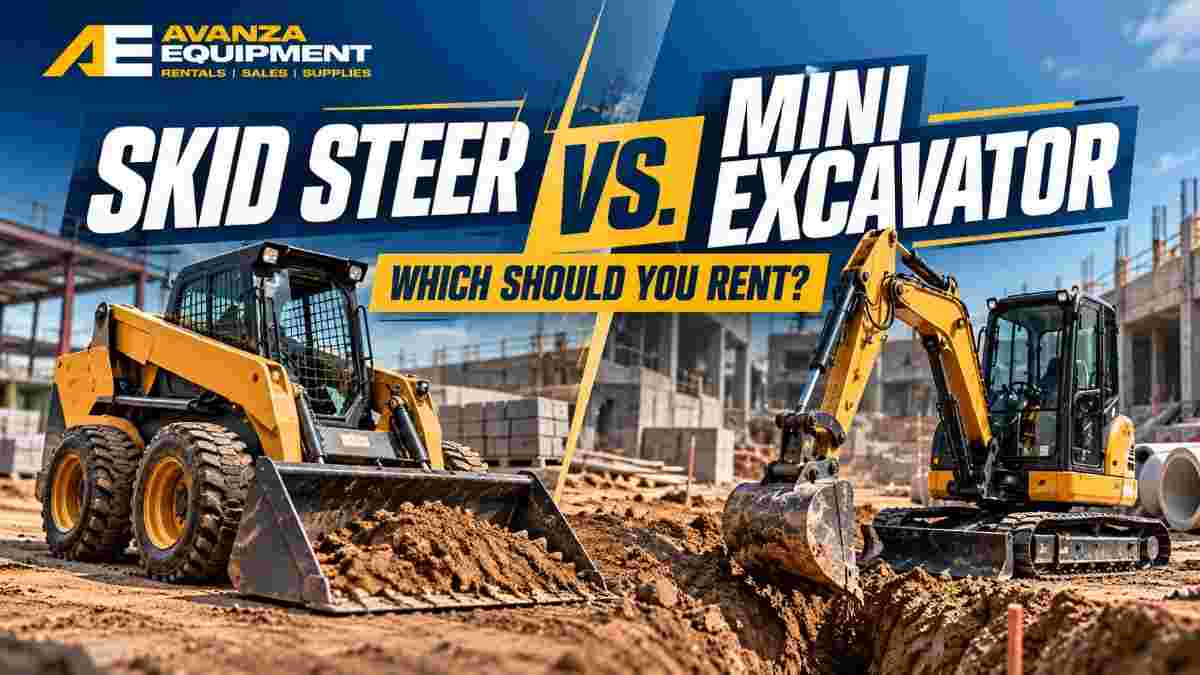
A skid steer and mini excavator can both handle construction and landscaping work, but they serve different primary purposes. A wheeled skid steer is generally better for loading, moving materials, grading, and jobsite cleanup, while a mini excavator is designed for digging, trenching, and precision excavation below ground level.
The better rental depends on your project requirements, not simply which machine is larger or more powerful.
For Houston contractors comparing compact construction equipment, understanding these differences can help avoid unnecessary rental time, equipment limitations, and jobsite delays.
Skid Steer vs. Mini Excavator: Quick Comparison
Before choosing a machine, compare how each one handles common construction applications.
| Comparison Factor | Skid Steer | Mini Excavator |
| Primary strength | Material handling and surface work | Digging and excavation |
| Undercarriage | Wheels | Typically tracks |
| Main working mechanism | Front-mounted loader arms and bucket | Boom, arm, bucket, and rotating upper structure |
| Digging | Possible, depending on task and attachment | Primary machine function |
| Trenching | Attachment-dependent; generally less suited to conventional excavation | Common application |
| Moving dirt and gravel | Often a strong choice | Better suited to excavating and placing material |
| Loading materials | Strong use case | Possible, but less suited to repeated loading and carrying |
| Grading | Common surface-work application | More specialized grading and finishing applications |
| Tight spaces | Depends on width, turning room, and work area | Depends on width, tail swing, and working clearance |
| Attachments | Various loader attachments | Various excavation attachments |
| Terrain | Performance depends on wheels, tires, and ground conditions | Tracks affect traction and surface loading |
| Best choice | Material movement, loading, cleanup, and surface grading | Digging, trenching, drainage, and precision excavation |
Quick takeaway: If your job requires moving material around the site, start by considering a skid steer. If your job requires digging below grade, start by evaluating a mini excavator.
If your project involves both, renting two machines may be worth considering.
Start With the Work Your Project Requires
The most useful way to compare a skid steer vs. mini excavator is to identify the work your project actually involves.
A machine that works well for loading gravel may be poorly matched to a deep utility excavation. Similarly, an excavator designed for trenching may not be the most practical choice for repeatedly transporting materials across a jobsite.
Before selecting equipment, answer these questions:
- What is the primary task? Are you digging, trenching, loading, grading, clearing debris, or moving materials?
- How deep must you dig? Below-ground excavation requires checking digging depth and reach.
- How much material needs to move? Consider volume, loading requirements, and material travel distances.
- What must the machine lift? Check the actual machine’s rated lifting or loading capabilities, working height, and intended attachments.
- How much operating space is available? Account for gates, structures, turning room, and obstacles.
- What are the ground conditions? Firm ground, mud, soft soil, and uneven terrain can affect machine suitability.
- Which attachments are needed? Not every attachment works with every machine.
- How long will the project take? Rental duration and equipment productivity both affect total cost.
- How will the equipment reach the site? Operating weight, transport arrangements, and unloading access matter.
The goal is to select equipment around your work requirements rather than forcing the job to fit a familiar machine.
People searching “skid steer vs mini excavator Reddit” are often looking for practical, project-specific experiences instead of specifications alone. The questions above provide a useful framework for evaluating those experiences against your own jobsite.
When a Skid Steer Makes More Sense
A skid steer is a compact, wheeled loader commonly used for material handling, loading, surface preparation, and cleanup.
Its front-mounted loader arms allow compatible buckets and other attachments to move materials around a construction site.
For projects with substantial surface-level work, a skid steer may be more practical than a mini excavator.
Moving Dirt, Gravel, and Topsoil
A skid steer is often a strong fit when a project requires repeatedly moving loose materials.
Common applications include:
- Transporting gravel or topsoil around a jobsite
- Moving excavated dirt to a designated location
- Loading loose material into containers or trucks when machine capabilities permit
- Distributing fill material
- Moving construction debris
- Preparing areas for landscaping
The advantage comes from the loader’s design and ability to carry material while traveling.
However, actual loading capacity, lift height, traction, and productivity depend on the specific machine and site conditions.
Surface Grading and Site Preparation
Skid steers are commonly used for surface-level grading and preparation work.
Examples include spreading aggregate, distributing fill, cleaning work areas, and preparing surfaces for subsequent construction activities.
The required finish quality matters. A skid steer may be useful for rough grading, while some projects require specialized grading equipment, attachments, or additional finishing work.
Pallet and Material Handling
With compatible pallet forks, a skid steer may also help move palletized construction materials around a site.
This can be useful when contractors need to relocate supplies, equipment, or other loads.
However, not every skid steer has the same lift capacity, operating height, or attachment compatibility. Verify the machine’s rated capabilities and approved attachments before selecting it for pallet handling.
A skid steer generally makes more sense when the majority of the project involves moving, loading, spreading, or cleaning up material rather than excavating below ground.
When a Mini Excavator Makes More Sense
A mini excavator is a compact excavation machine built around a boom, arm, bucket, and rotating upper structure.
Unlike a skid steer, its primary working function is to dig, reach below the machine’s ground level, and place excavated material.
That makes it a strong option for construction activities requiring controlled digging.
Digging and Foundation-Related Excavation
Mini excavators are commonly used for:
- Footing and foundation-related excavation
- Landscaping excavation
- Drainage installations
- Small construction excavations
- Removing soil from designated areas
- Digging around project features where machine access and site conditions allow
The correct excavator depends on the required depth, width, reach, ground conditions, and working room.
A machine’s compact appearance does not establish that it can complete a particular excavation.
Trenching and Utility Installation
Trenching is one of the clearest applications where a mini excavator may have an advantage over a conventional skid steer.
Its boom and bucket allow an operator to excavate a trench and place spoil alongside the work area, subject to safe site planning.
Typical projects include drainage lines, irrigation systems, and underground utility installations.
Before selecting a machine, consider:
- Required trench depth and width
- Length and alignment of the excavation
- Ground conditions and underground obstructions
- Space for placing excavated material
- Access for the machine and supporting equipment
- Existing underground utilities
A dedicated trencher may also be appropriate for certain trenching projects. Contractors can explore trencher rental options in Houston when that equipment better matches the application.
Excavation safety reminder: Before breaking ground, contact Texas811 to arrange underground utility locating and follow applicable requirements. Texas811 advises submitting the request at least two business days before excavation and confirming required utility responses before digging.
Precision Excavation
Mini excavators can be useful where soil must be removed from a defined area rather than pushed or carried across the ground.
For example, a contractor excavating for a drainage installation may need controlled bucket placement and an appropriate digging reach.
That work aligns more closely with a mini excavator’s design than with the primary function of a front-loader bucket.
A mini excavator generally makes more sense when the project centers on digging, trenching, below-grade excavation, or placing excavated material within the machine’s working range.
Skid Steer vs. Mini Excavator Pros and Cons
Neither machine is universally more versatile or productive. Each has advantages and limitations based on the work involved.
| Factor | Skid Steer: Pros and Limitations | Mini Excavator: Pros and Limitations |
| Material handling | Well suited to carrying and loading loose materials; lift limits must be checked | Can relocate excavated material locally, but not designed primarily for carrying loads across a site |
| Digging | Can dig with a bucket or compatible attachment; conventional excavation is not its primary function | Designed for digging and below-grade excavation; capability depends on model |
| Trenching | May use compatible trenching attachments | Commonly suited to digging trenches with a bucket |
| Grading | Useful for spreading and surface grading | Can perform some grading tasks, including with suitable buckets or blades |
| Attachments | Multiple potential loader applications | Multiple specialized excavation applications |
| Tight spaces | Compact footprint may help, but turning and working clearance are important | Compact configurations can help, but tail swing and working radius matter |
| Surface impact | Tires and steering can disturb surfaces depending on conditions | Tracks distribute machine weight differently, but can still damage surfaces |
| Transportation | Depends on operating weight, dimensions, attachments, and transport setup | Depends on operating weight, dimensions, attachments, and transport setup |
| Overall versatility | Often useful across loading, cleanup, and site-preparation phases | Often useful across digging, trenching, and excavation phases |
The strongest advantage of either machine is its suitability for the task.
If a project is mostly excavation, using a skid steer simply because it is familiar may reduce efficiency. If the work involves moving material across a site, relying on a mini excavator for every phase may be equally impractical.
Skid Steer vs. Mini Excavator for Digging
Can a Skid Steer Dig Like a Mini Excavator?
A skid steer can dig, but it approaches digging differently from a mini excavator.
A skid steer generally uses its front bucket to scrape, scoop, or remove material. Compatible attachments may expand its capabilities.
A mini excavator uses its boom, arm, and bucket to reach into the ground, remove soil, and position excavated material.
This distinction matters when working below grade.
For shallow surface removal or excavation-related cleanup, a skid steer may be useful. For digging a defined trench, excavating a footing, or reaching below ground level, a mini excavator is generally the more appropriate starting point.
The actual result depends on the machine, attachment, soil, excavation geometry, and available operating space.
Can a Skid Steer Replace a Mini Excavator?
Sometimes, but only for certain tasks.
If the project involves minor ground removal, loading loose dirt, or leveling an excavated area, a skid steer may complete the required work.
If the project needs substantial digging depth, reach, or controlled below-grade excavation, a skid steer may not be a practical substitute.
Similarly, adding a specialized attachment does not automatically give a skid steer the same digging characteristics as a mini excavator.
Compare the work requirements and verified machine capabilities before treating one as a replacement for the other.
Which Is Better for Material Handling and Grading?
For projects centered on moving gravel, topsoil, dirt, or jobsite debris, a skid steer is often the stronger choice.
The distinction is especially important when materials need to travel repeatedly between different parts of the site.
A skid steer is designed to scoop, carry, and place loose material using a front-mounted loader system.
A mini excavator can excavate material and deposit it within its reach, but traveling around a site with repeated loads is not its primary function.
Consider a Houston landscaping project involving excavation for drainage followed by spreading topsoil.
The mini excavator may be better suited to removing soil for the drainage installation. A skid steer may then be more practical for distributing topsoil and cleaning up the surrounding area.
Project-Type Comparison
| Project Need | Skid Steer | Mini Excavator |
| Moving gravel and topsoil | Often a strong fit | Secondary capability |
| Loading debris | Common application | Useful for certain tasks and configurations |
| Surface grading | Common use | More specialized application |
| Digging trenches | Attachment-dependent | Strong use case |
| Foundation excavation | Not primary role | Generally better aligned |
| Utility digging | Depends on attachment and excavation requirements | Common application |
| Backfilling | Strong material-handling role | Can assist with placing material |
| Landscaping | Depends on the work | Depends on the work |
| Land clearing | Useful for surface cleanup and debris movement | Useful for digging and root-related excavation |
| Tight-space construction | Model and layout dependent | Model and tail-swing dependent |
A project involving both excavation and grading may require equipment selection for separate phases rather than one machine for every activity.
Excavator or Skid Steer for Land Clearing?
Choosing an excavator or skid steer for land clearing depends on what actually needs to be removed.
Land clearing may involve brush, vegetation, roots, debris, accumulated soil, or surface preparation. These activities place different demands on equipment.
When a Mini Excavator May Be Better for Land Clearing
A mini excavator may be appropriate when clearing work involves digging around root systems, excavating soil, or removing below-ground obstructions.
Its ability to dig below grade can be useful when the project requires controlled excavation rather than surface cleanup alone.
However, excavation requirements, machine capabilities, attachments, and site hazards must all be evaluated. Not every mini excavator is appropriate for every vegetation-removal task.
When a Skid Steer May Be Better for Land Clearing
A skid steer may be better aligned with projects requiring:
- Gathering and moving loose debris
- Relocating previously cut vegetation
- Loading cleared material
- Spreading soil after clearing
- Cleaning and preparing accessible ground surfaces
Depending on the machine and compatible attachments, skid steers may also support additional vegetation-management work.
Specialized brush cutters or other vegetation-clearing equipment may be necessary for particular tasks.
Which Should You Rent for Clearing Land?
If you’re comparing a skid steer vs. mini excavator for clearing land, divide the project into its actual work phases.
A root-removal or excavation-heavy phase may favor a mini excavator. A debris-loading and surface-preparation phase may favor a skid steer.
For mixed projects, both machines—or different specialized equipment—may be justified.
The vegetation type, terrain, site access, machine configuration, and scale of the work should determine the decision. Neither machine should automatically be selected based solely on the description “land clearing.”
Attachments Can Change the Comparison
Attachments expand what compact construction equipment can do, but compatibility is critical.
Not every attachment works with every skid steer or mini excavator. Hydraulic requirements, mounting systems, machine capacity, and approved configurations must be checked.
Common Skid Steer Attachment Categories
Depending on the equipment and application, skid steer attachments may include:
- Buckets: Loading, handling, and distributing material
- Pallet forks: Moving compatible palletized loads
- Augers: Drilling holes for posts, piers, and similar applications
- Grapples: Handling certain types of debris and irregular material
- Brush cutters: Vegetation management
- Trencher attachments: Specialized trench excavation
These are general equipment-category examples, not confirmation that every attachment is included in or available with an Avanza skid steer rental.
For projects involving fence posts, foundation piers, or similar boring work, contractors may also consider auger rental in Houston.
Common Mini Excavator Attachment Categories
Depending on compatibility, mini excavator attachment categories may include:
- Digging buckets: General excavation and trenching
- Hydraulic thumbs: Gripping and handling suitable objects
- Hydraulic breakers: Breaking certain materials
- Compaction wheels: Specialized trench backfill compaction
- Tilt buckets: Grading and shaping applications
Some applications require particular hydraulic connections or other machine-specific provisions.
Before renting, confirm that the attachment is suitable for the machine, job requirements, and intended operating conditions.
Need help comparing equipment? Review Avanza Equipment’s skid steer rental options in Houston and mini excavator rental options, or contact the team to discuss your project and available configurations.
Skid Steer vs. Mini Excavator Size: Which Fits Your Jobsite?
When comparing skid steer vs. mini excavator size, overall dimensions matter more than general equipment-category labels.
A mini excavator is not automatically smaller than a skid steer. Both categories include machines with different dimensions and configurations.
Important Dimensions to Compare
Overall width: Determines whether the machine can pass through gates, entrances, and narrow access points.
Overall length: Affects positioning, storage, transport, and available operating room.
Overall height: Matters around low structures, branches, and restricted entrances.
Machine footprint: Influences how much ground area the equipment occupies.
Turning and working space: A skid steer needs room for maneuvering and loader work. A mini excavator needs appropriate clearance for its upper structure, boom, arm, and bucket.
Tail swing: Some excavators require additional clearance behind the machine as the upper structure rotates.
Why Machine Configuration Matters
A compact or zero-tail-swing mini excavator may offer advantages in certain restricted environments.
Zero-tail-swing generally refers to an excavator configuration designed to reduce or eliminate rear overhang beyond the track footprint during upper-structure rotation. That does not eliminate the need for safe working clearance around the boom, attachments, or entire machine.
Not every mini excavator has this configuration.
For either machine, compare the actual model dimensions against your jobsite layout before renting.
Skid Steer vs. Mini Excavator Weight: Which Is Heavier?
There is no universal answer to the skid steer vs. mini excavator weight comparison.
A particular skid steer may weigh more than a particular mini excavator, while another comparison may produce the opposite result.
Operating weight depends on the model, configuration, installed equipment, and manufacturer specifications.
Why Equipment Weight Matters
Machine weight can influence several rental decisions.
Ground conditions: Weight distribution, undercarriage design, soil conditions, and surface strength affect how the machine interacts with the ground.
Transportation: The machine and attachments must be considered together when arranging suitable transport.
Jobsite access: Weight can matter when crossing surfaces or structures with load restrictions.
Equipment selection: A heavier machine does not automatically provide the digging, lifting, or loading capability needed for a particular application.
The correct approach is to compare verified operating weights and applicable load ratings for the exact equipment being considered.
Tight Spaces and Jobsite Access
Tight-space work is not simply about renting the narrowest machine.
Construction sites may contain fences, buildings, utility equipment, landscaping features, stored materials, and other obstacles.
A machine must be able to enter the site and complete its work within the available operating area.
When a Skid Steer May Fit Better
A skid steer may be practical where the project involves front-loader work and the site provides sufficient turning and operating space.
Its compact footprint can be useful, but the operator must also account for the loader arms, bucket, load, and surrounding obstacles.
When a Mini Excavator May Fit Better
A mini excavator may be practical when excavation must occur in a defined area with limited room for larger equipment.
Its rotating upper structure allows digging and material placement without moving the entire machine for every bucket cycle.
However, tail swing, boom reach, attachment movement, and surrounding structures still affect suitability.
Check More Than the Entrance Width
Before selecting either machine, evaluate the complete route and work area, including narrow gates, low-clearance structures, overhead utilities, buried services, and space for loading or spoil placement.
An excavator that fits through an entrance may still lack the working clearance required for the job.
Likewise, a skid steer that reaches the site may not have enough room to load, turn, or position materials effectively.
Wheels, Tracks, and Ground Conditions
An important terminology distinction affects this comparison:
- Skid steer: A wheeled compact loader
- Compact track loader (CTL): A loader with a tracked undercarriage
- Mini excavator: A compact digging machine, typically with tracks
A compact track loader is a separate loader category. It should not be confused with either a conventional wheeled skid steer or a mini excavator.
Wheeled Skid Steers
Wheeled skid steers may be well suited to firm, prepared working surfaces and projects requiring repeated material movement.
Traction, tire selection, surface condition, load, and turning requirements can all influence performance.
On sensitive surfaces, skid-steer turning can cause disturbance, especially under unfavorable conditions.
Tracked Mini Excavators
Mini excavators commonly use tracked undercarriages that distribute machine weight across the track contact area.
This can influence traction, mobility, and surface loading, but performance still depends on machine design, soil conditions, and operating requirements.
Tracks do not guarantee that turf, pavement, or finished surfaces will remain undamaged.
What About Compact Track Loaders?
If your project involves substantial loader work on soft or uneven ground, a compact track loader may be another equipment category worth considering.
Avanza Equipment has a separate track loader rental page for Houston where contractors can compare loader options.
The main equipment-selection question remains whether the project needs a loader for material handling or an excavator for digging.
A Note About Slopes and Uneven Terrain
Neither wheels nor tracks make a machine automatically safe on slopes.
Suitability depends on manufacturer operating limits, site conditions, load position, machine configuration, operator training, and applicable safety procedures.
Do not select equipment or operating methods based on assumed slope capability.
Transportation and Rental Logistics
Before renting either machine, consider how it will get to the jobsite and where it will operate.
Verify Transport Requirements
Important factors include:
- Machine operating weight
- Attachment and accessory weight
- Trailer load capacity
- Tow vehicle capability
- Hitch and towing-system ratings
- Applicable transport requirements
- Equipment loading and unloading arrangements
- Available jobsite access
Neither machine category is universally easier to transport.
The actual equipment dimensions, weight, attachments, and transportation method determine the requirements.
Plan Around the Entire Rental Period
Equipment rental planning should also consider the project schedule.
A machine may only be needed during excavation, while another machine may be required later for backfilling or cleanup.
Renting equipment for the actual work phases can help contractors avoid paying for unnecessary idle periods, provided the schedule and rental terms allow.
Confirm rental dates, equipment availability, attachment requirements, and transportation arrangements before finalizing the project plan.
Skid Steer vs. Mini Excavator Cost: Which Costs More to Rent?
The skid steer vs. mini excavator cost comparison depends on the specific machines and rental requirements.
There is no reliable universal rule that one equipment category always costs less.
Rental pricing may vary based on:
- Machine type and model
- Equipment size and configuration
- Daily, weekly, or longer rental duration
- Attachment requirements
- Equipment availability
- Transportation and other applicable rental logistics
- Project-specific needs
An online skid steer vs. mini excavator price comparison can be misleading if it compares machines with different capabilities or rental terms.
Daily Rental Price vs. Total Project Cost
The lowest daily equipment rate does not necessarily produce the lowest overall project cost.
Consider two examples.
Project A: Excavating a drainage trench
If a mini excavator completes the required excavation more effectively, it may reduce the time spent performing work that is poorly matched to a loader.
Project B: Moving several loads of gravel around a site
If a skid steer is better suited to the material-handling task, selecting it may reduce the amount of time needed to relocate and distribute material.
Neither outcome is guaranteed. Actual results depend on site conditions, machine capabilities, operators, project organization, and the volume of work.
Think About Total Project Economics
A more useful comparison considers:
Total project cost = Equipment rental + Labor + Attachments + Transportation and applicable charges + Other project operating costs
Productivity, project duration, machine utilization, and downtime influence the final amount.
A higher daily rental rate may be justified when the machine is better suited to the work and reduces overall project time. Conversely, renting more equipment than the project requires can increase costs without improving results.
Ask for a project-specific quote rather than choosing solely by an advertised rate.
When Renting Both Machines Makes Sense
Some construction projects involve distinct excavation and material-handling phases.
In those situations, a skid steer and mini excavator may complement one another.
Example 1: Utility Installation
Mini excavator: Digs the required trench and places excavated material in an appropriate location.
Skid steer: May assist with moving suitable bedding material, relocating backfill, and cleaning up the work area.
Example 2: Residential Construction
Mini excavator: Performs excavation for designated foundation-related or drainage work.
Skid steer: Assists with loose material movement, surface preparation, and grading.
Example 3: Landscaping and Site Preparation
Mini excavator: Handles digging for drainage features, trenches, or other below-ground requirements.
Skid steer: Moves topsoil, distributes material, and supports surface cleanup.
Should You Rent Both at the Same Time?
Not necessarily.
If excavation and material handling are scheduled for different phases, separate rental periods may be appropriate.
If both activities must occur alongside each other and the site can support the work safely, having both machines available may be useful.
Evaluate scheduling, labor availability, machine utilization, site space, and total rental cost before deciding.
Common Mistakes When Choosing Between a Skid Steer and Mini Excavator
The wrong rental decision often comes from overlooking one important project requirement.
1. Choosing Based Only on Familiarity
An operator may prefer a skid steer because they have used one before.
But familiarity does not mean it is the right machine for below-grade excavation.
Select equipment based on the task and use properly trained operators.
2. Ignoring Required Digging Depth
A mini excavator must be selected with adequate digging capability for the actual project.
Do not assume that every compact excavator can reach the required depth.
3. Overlooking Loading and Lift Requirements
If material handling is a major part of the job, verify machine capacity, lift height, attachments, and intended load characteristics.
4. Forgetting Attachment Compatibility
The attachment you need may not be compatible with the selected machine or included in the rental.
Confirm approved configurations and actual availability.
5. Ignoring Site Dimensions
A machine must fit the access route and have enough space to work safely.
Check gates, overhead restrictions, turning room, and excavation clearance.
6. Overlooking Ground Conditions
Soft ground, mud, unstable surfaces, and uneven terrain can affect machine mobility and suitability.
7. Selecting the Lowest Daily Price
The least expensive machine per day may not be the most economical choice for the completed project.
8. Forgetting Transportation
Equipment weight, trailer capacity, towing capability, and loading access should be planned before the rental begins.
9. Confusing a Skid Steer With a Compact Track Loader
A wheeled skid steer and compact track loader are different categories, even though they can perform similar loader applications.
Check which type of machine you are actually comparing.
Read also: Track Loader vs. Skid Steer
Choosing Between a Skid Steer and Mini Excavator for a Houston Jobsite
Houston contractors handle a variety of residential, commercial, utility, landscaping, and site-preparation projects.
Equipment selection should reflect the specific work, available access, and physical conditions of each site.
For example, a contractor preparing a commercial work area may primarily need loading and grading equipment.
A landscaping crew installing underground drainage may have a stronger need for controlled excavation.
A residential construction project may require one machine for excavation and another for material movement and cleanup.
The correct choice depends on the work—not simply the project category or location.
Houston Equipment Rental Decision Checklist
Before contacting a rental provider, confirm:
- Primary construction or landscaping task
- Required excavation depth and width
- Approximate volume of material to move
- Lift and loading requirements
- Jobsite dimensions and access restrictions
- Soil and surface conditions
- Required attachments and compatibility
- Overhead and underground hazards
- Equipment transportation arrangements
- Expected rental duration
- Project sequence and equipment utilization
- Total estimated project cost
Which Machine Should You Choose?
Choose a mini excavator when: The project primarily requires digging, trenching, drainage excavation, or other below-grade work, and the selected excavator meets the project’s specifications.
Choose a skid steer when: The project primarily involves moving material, loading, cleanup, backfilling, or surface grading, and the selected loader meets the site’s requirements.
Consider renting both when: Excavation and material handling are substantial separate parts of the project, and the combined equipment use is justified.
Avanza Equipment provides construction equipment rentals in Houston for contractors, landscaping crews, businesses, and construction projects.
The company also serves surrounding communities, including Cypress, Katy, Spring, The Woodlands, Tomball, Sugar Land, Pearland, Pasadena, and other Greater Houston service areas.
Before renting, discuss your project requirements and confirm the appropriate equipment options.
Frequently Asked Questions
Is a Skid Steer or Mini Excavator Better for Digging?
A mini excavator is generally better suited to digging, particularly when the project requires trenching or excavation below ground level.
A skid steer can perform some digging-related tasks using its bucket or compatible attachments. However, conventional excavation is not its primary function.
The required depth, excavation dimensions, and jobsite conditions determine which machine is appropriate.
Which Is Better for Moving Dirt: a Skid Steer or Mini Excavator?
A skid steer is often better suited to repeatedly moving loose dirt, gravel, and other materials around a jobsite.
A mini excavator is useful for digging soil and placing it within the machine’s reach.
If the work primarily involves moving excavated material from one location to another, a skid steer may be the more practical option.
Can I Use a Mini Skid Steer to Dig?
Yes, a mini skid steer or mini loader may perform limited digging and excavation-related tasks depending on its design and compatible attachments.
However, a mini skid steer is a separate compact-loader category and should not be confused with a full-size wheeled skid steer, compact track loader, or mini excavator.
Some small loaders have tracked undercarriages, but that does not make them excavators.
A mini loader should not automatically replace a mini excavator for projects requiring substantial digging depth, reach, or controlled trench excavation.
Which Is More Profitable, a Skid Steer or Excavator?
Neither machine is automatically more profitable.
For an equipment owner or contractor, profitability depends on the type of work, machine utilization, customer demand, operating costs, maintenance, labor, attachments, and revenue.
For a rental customer, the more useful question is which machine can complete the required work efficiently without unnecessary rental time or labor.
A mini excavator may be more economically appropriate for an excavation-heavy project, while a skid steer may be a stronger choice for material-handling work.
Do Skid Steers Flip Over Easily?
A skid steer’s risk of tipping or rollover depends on operating conditions and how the equipment is used.
Factors that can increase risk include unsuitable slopes, uneven ground, unstable or raised loads, exceeding rated limits, improper operation, and sudden movements.
Operators should follow manufacturer instructions, rated operating limits, jobsite safety procedures, and applicable training requirements.
No skid steer should be assumed safe on a slope or with a particular load without checking its approved operating conditions.
Is a Skid Steer Heavy Enough to Compact Dirt?
A skid steer’s weight and movement can cause some surface compaction, but that does not automatically make it a substitute for specialized compaction equipment.
Proper compaction depends on soil type, moisture, material lift thickness, required density, and the equipment used.
Projects with specified compaction requirements may need a plate compactor, rammer, roller, or another suitable machine.
Contractors should select equipment based on the project specifications rather than assuming that driving a skid steer over the soil provides adequate compaction.
Which Is Better for Land Clearing, a Skid Steer or Mini Excavator?
It depends on the work involved.
A mini excavator may be better suited to root-related digging and below-ground excavation.
A skid steer may be more practical for moving cleared material, loading debris, and preparing ground surfaces.
Some land-clearing projects also require specialized vegetation-management equipment or a combination of machines.
Which Is Better for Trenching?
A mini excavator is generally the stronger choice for conventional trench excavation because its boom, arm, and bucket are designed for digging below ground level.
However, a specialized trencher may be more appropriate for certain trenching applications.
The choice depends on trench dimensions, soil conditions, utility locations, and available working space.
Is a Skid Steer or Mini Excavator Better for Tight Spaces?
Neither machine is automatically better.
A skid steer may fit confined loader applications, while a mini excavator may suit controlled digging within a defined work area.
The actual machine width, length, height, turning requirements, working reach, and excavator tail swing determine suitability.
Which Weighs More: a Skid Steer or Mini Excavator?
There is no universal rule.
Both equipment categories include different sizes and configurations.
Compare the verified operating weights of the specific machines, especially when planning transportation or working on surfaces with load limitations.
Which Costs More to Rent: a Skid Steer or Mini Excavator?
Rental rates depend on the machine, size, configuration, rental duration, attachments, availability, and applicable rental terms.
Neither category is always more expensive.
For an accurate comparison, request quotes for machines capable of performing your actual job.
Can a Skid Steer Replace a Mini Excavator?
A skid steer can replace a mini excavator for certain limited tasks, such as minor ground removal, material cleanup, or surface preparation, when the machine and attachments are appropriate.
It may not be a suitable replacement for work requiring substantial excavation depth, reach, or controlled trench digging.
Can I Rent Both a Skid Steer and Mini Excavator for the Same Project?
Yes, using both machines may make sense when a project has significant excavation and material-handling requirements.
For example, a mini excavator may dig a drainage trench while a skid steer supports material movement and subsequent cleanup.
Contact the rental provider to confirm machine availability, rental periods, and whether the combined equipment arrangement fits the project.
Where Can I Rent a Skid Steer or Mini Excavator in Houston?
Avanza Equipment provides construction equipment rentals in Houston, Texas, including relevant compact equipment rental categories for excavation and material-handling projects.
You can compare skid steer rentals in Houston and mini excavator rentals in Houston, then contact the team to confirm the machines available for your rental dates.
Find the Right Equipment for Your Houston Project
The skid steer vs. mini excavator decision comes down to what your job requires.
For loading, material handling, cleanup, and surface grading, a skid steer may be the better fit.
For digging, trenching, drainage, and controlled excavation, a mini excavator may be more appropriate.
When your project involves both types of work, compare the cost and practicality of renting both machines.
Avanza Equipment has served Houston contractors and project owners since 2018, providing construction equipment and tool rentals for jobsites throughout the Greater Houston area.
Share your project details, required work, site access, and rental dates with the Avanza team.