


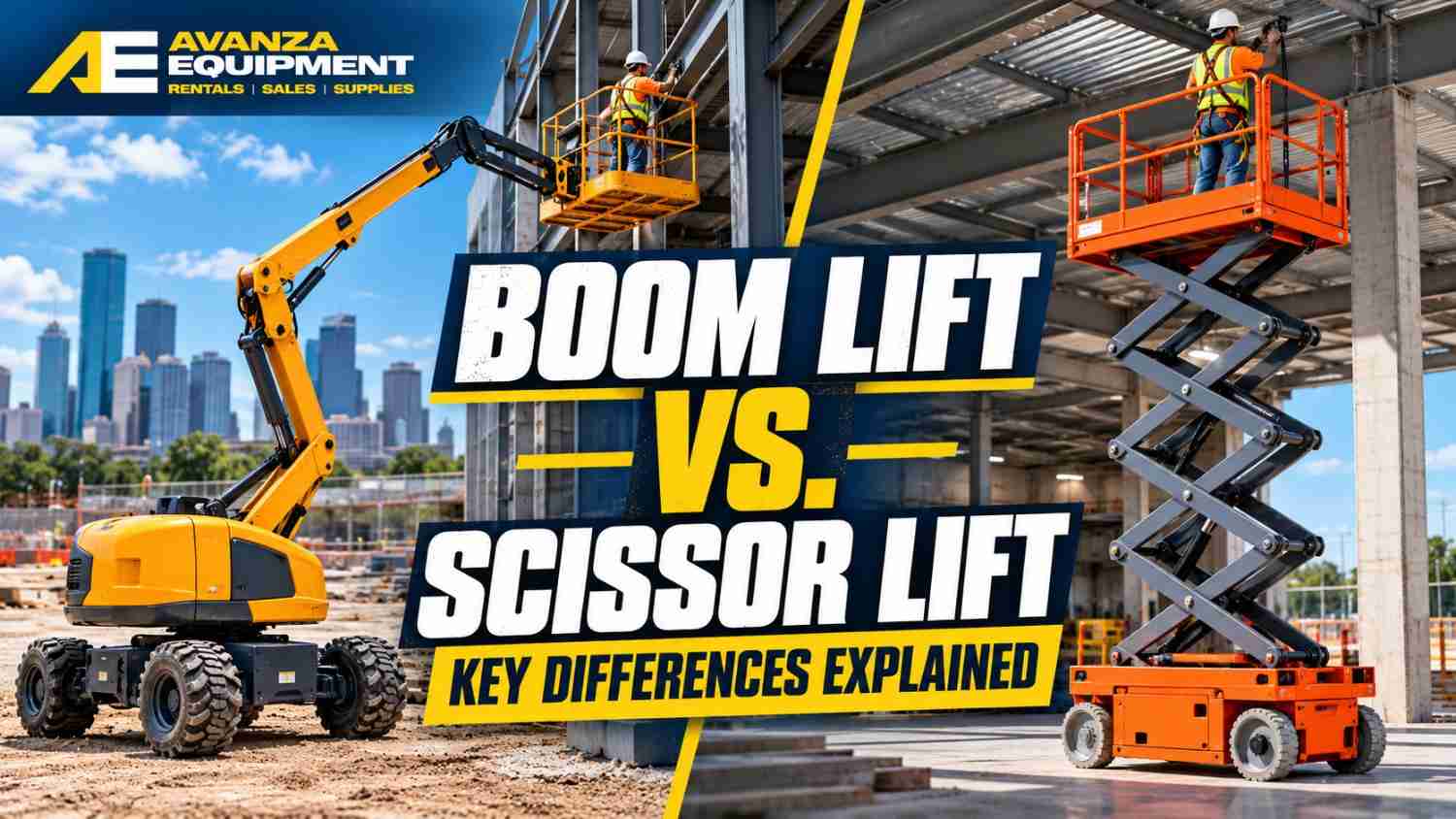
The main difference between a boom lift and a scissor lift is how they position workers at height. A scissor lift primarily raises its work platform vertically, while a boom lift can provide both vertical elevation and horizontal outreach. Scissor lifts are often useful when workers need a larger platform and direct access above the machine. Boom lifts may be more appropriate when the work area is offset or workers need to reach over or around an obstacle.
For Houston contractors, construction crews, and maintenance teams, choosing the right aerial lift depends on more than height. Horizontal reach, platform capacity, jobsite access, ground conditions, and rental requirements all affect equipment selection.
This scissor lift vs boom lift guide explains the key differences, common applications, safety considerations, and rental factors to help you decide which equipment fits your project.
Scissor Lift vs. Boom Lift: Quick Comparison
Both boom lifts and scissor lifts provide elevated access for construction, installation, and maintenance work. However, their platform movement, working configurations, and access requirements differ.
| Comparison Factor | Boom Lift | Scissor Lift |
| Primary movement | Vertical elevation and horizontal outreach | Primarily vertical elevation |
| Main structure | Boom or arm supporting a work platform | Scissor-style lifting mechanism supporting a platform |
| Horizontal reach | Available depending on boom configuration | Limited; some models have platform extensions |
| Work positioning | Can access certain areas away from the machine base | Usually positioned directly beneath or near the work |
| Obstacles | May reach over or around obstacles | Requires a suitable direct-access position |
| Platform space | Often a more compact basket or platform | Often a larger work platform |
| Worker and tool capacity | Depends on the machine’s rated capacity | Depends on the machine’s rated capacity |
| Indoor applications | Depends on the model, power source, and environment | Depends on the model, power source, and environment |
| Outdoor applications | Depends on terrain and machine configuration | Depends on terrain and machine configuration |
| Ground conditions | Must meet the specific machine’s operating requirements | Must meet the specific machine’s operating requirements |
| Rental cost | Depends on equipment and rental terms | Depends on equipment and rental terms |
| Primary selection question | Do you need horizontal outreach? | Do you mainly need vertical access and platform space? |
Quick takeaway: If your work is directly above an accessible operating position, a scissor lift may be the better starting point. If workers must reach outward or navigate an obstruction, a boom lift may be worth considering.
Neither lift category is universally better. The right choice depends on where the platform must be positioned and what the specific machine can safely accomplish.
What Is a Boom Lift?
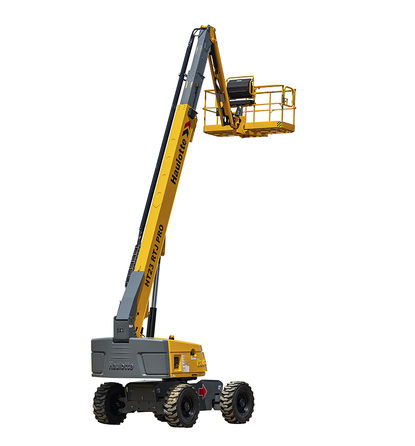
A boom lift is a type of elevated-access machine that uses an extendable boom or arm to position a work platform.
Unlike equipment designed primarily for straight vertical movement, a boom lift can position its platform outward from the machine’s base, depending on its configuration and operating limits.
This makes boom lifts relevant for jobs where workers cannot position the equipment directly below the work area.
For example, an exterior maintenance crew may need to access an elevated building feature beyond a ground-level obstruction. A suitable boom lift configuration could provide the required approach, provided the reach, clearance, platform capacity, and ground conditions meet the machine’s operating requirements.
Read also: How Much Does It Cost to Rent a Boom Lift?
How Does a Boom Lift Work?
A boom lift positions an elevated platform using a boom-supported lifting system.
The platform can be raised and extended or repositioned according to the machine’s design.
Its main advantage is the ability to access certain elevated locations at a horizontal distance from the base.
However, the actual movement range, platform height, horizontal reach, and working envelope depend on the specific machine.
A boom lift’s maximum elevation does not automatically establish that it can reach every position below that height.
Common Types of Boom Lifts
Two common boom lift configurations are:
Articulating Boom Lifts
An articulating boom uses hinged boom sections to create different platform-positioning paths. This can be useful where workers need to approach a work area around or above certain obstacles.
Telescopic Boom Lifts
A telescopic boom extends outward along a relatively straight boom structure. It may be considered when a project requires an extended approach toward an elevated work area.
Both are general equipment configurations. Their actual reach, movement, and capacity must be verified for the specific machine.
For boom lift rental in Houston, review the available options and contact Avanza Equipment to confirm current configurations, specifications, pricing, and availability.
Common Boom Lift Applications
Boom lifts may be considered for:
- Exterior building maintenance
- Elevated construction work
- Installation around building features
- Accessing equipment or structures beyond obstacles
- Suitable façade-related work
- Maintenance tasks requiring horizontal outreach
- Other elevated applications where direct vertical access is impractical
The work area, machine configuration, and manufacturer restrictions determine whether a boom lift is appropriate.
What Is a Scissor Lift?
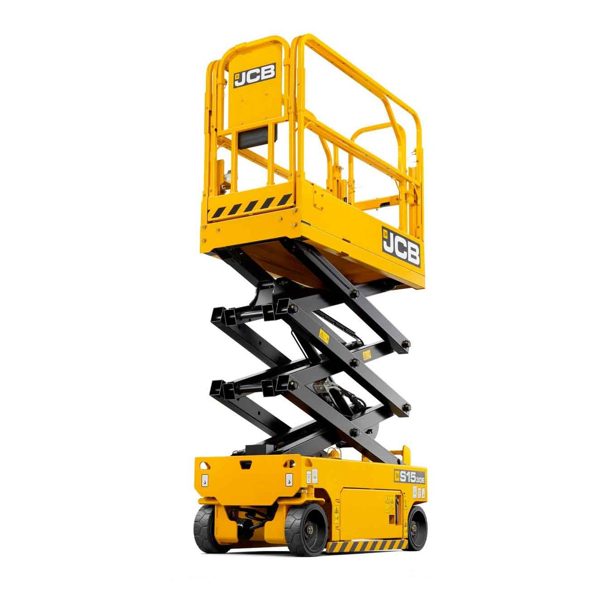
A scissor lift is an elevated work platform designed primarily to move vertically.
It uses a lifting mechanism made of connected, crossing supports that extend as the platform rises and retract as it lowers.
A scissor lift is often considered when workers can position the machine beneath or close to the area where elevated work must be performed.
Unlike a boom lift, its primary function is not to provide substantial horizontal outreach.
How Does a Scissor Lift Work?
A scissor lift raises a platform using its expanding lifting mechanism.
Workers and permitted tools or materials remain within the platform’s rated capacity and approved operating conditions.
Depending on the model, the platform may offer additional workspace through a manufacturer-designed deck extension.
That extension does not make the machine equivalent to a boom lift with a horizontally extending arm.
Why Platform Space Matters
Scissor lifts are often associated with larger working platforms than many boom lift baskets.
This can be useful when a task requires adequate space for personnel, tools, and materials.
For example, an installation team working across an accessible overhead area may benefit from the workspace offered by a suitable scissor lift.
However, platform dimensions and load ratings differ by machine.
A larger platform does not automatically mean every scissor lift can safely accommodate more workers or heavier materials.
Always confirm the machine’s rated platform capacity and approved occupancy.
Electric Scissor Lift Rental Options
Avanza Equipment lists electric scissor lifts in its Houston rental catalog.
Listed equipment labels include:
- 19′ Scissor Lift – Electric
- 26′ Scissor Lift – Electric
- 32′ Scissor Lift – Electric
These are equipment listing labels. They should not be interpreted as verified working heights, platform heights, or maximum reach specifications without checking the specific machines.
Visit Scissor Lift Rental in Houston, TX to review the category, then confirm the appropriate machine specifications and current availability.
Common Scissor Lift Applications
Scissor lifts may be useful for:
- Overhead installation work
- Suitable warehouse maintenance tasks
- Ceiling-related construction activities
- Electrical and mechanical installations
- Elevated inspection and maintenance
- Work where direct vertical access is available
- Jobs requiring suitable platform space for workers and tools
The specific lift must be appropriate for the location, surface, access route, and operating environment.
Key Differences Between a Boom Lift and Scissor Lift
The most important differences involve movement, reach, platform space, positioning, and jobsite conditions.
1. Movement and Horizontal Reach
Movement is the clearest difference in a boom lift vs scissor lift comparison.
A boom lift uses a boom-supported platform that can move vertically and outward within the machine’s permitted working range.
This creates access possibilities when the platform must be positioned away from the machine’s ground-level location.
A scissor lift primarily moves straight up and down.
Some scissor lifts have extendable platform decks, but their primary lifting mechanism remains vertical.
Consider a boom lift when:
- Workers need horizontal outreach.
- The machine cannot stand directly beneath the work.
- Obstacles affect the platform’s approach.
- The task requires positioning beyond the equipment’s base.
Consider a scissor lift when:
- The work is mainly above an accessible operating position.
- Straight vertical movement meets the access requirement.
- A suitable work platform is more useful than significant outreach.
Neither category automatically reaches every required position. Check the actual machine’s working envelope before selecting it.
2. Required Elevation and Working Height
Both equipment categories include machines designed for different elevations.
The important question is not simply how high a lift is advertised to reach.
Contractors should distinguish between:
- Platform height: The elevation of the work platform under specified conditions.
- Working height: A stated measure of the accessible work height, based on the manufacturer’s definition.
- Horizontal reach: The outward distance a boom lift can reach under specified conditions.
- Machine height: The physical height of the equipment, which can affect passage through doors and other low-clearance areas.
These measurements are not interchangeable.
A lift with a suitable maximum platform height may still be inappropriate if the required work position falls outside its permitted operating range.
Before renting, describe the actual elevation of the work and where the machine can be positioned.
3. Platform Space and Rated Capacity
Platform size is another important consideration.
A boom lift often uses a relatively compact basket or work platform.
A scissor lift often provides a larger platform surface for suitable work involving tools and personnel.
However, actual dimensions and rated capacities are machine-specific.
For example, a crew installing overhead mechanical components may need room for workers and equipment.
The machine must support the intended combination of people, tools, and materials without exceeding its rated limits.
When comparing lifts, confirm:
- Platform dimensions
- Rated platform capacity
- Permitted number of occupants
- Required tools and materials
- Applicable load restrictions
- Suitability at the required work position
Never use general equipment-category assumptions in place of manufacturer specifications.
4. Work Area and Obstacles
Jobsite layout can determine which equipment category makes sense.
A scissor lift is often practical when the machine can be positioned directly beneath or near the work.
A boom lift may be more suitable when a structure, fixed equipment, or another obstacle prevents direct access.
Consider two examples.
Example: Overhead Installation
A crew installing fixtures along an accessible overhead area may be able to position a scissor lift beneath the work.
Example: Exterior Maintenance Beyond an Obstacle
A maintenance team working on a building feature beyond a ground-level obstruction may need a boom lift with suitable outreach.
The actual approach must still be checked for clearance, platform position, machine movement, and hazards.
A boom lift’s ability to reach outward does not mean it can safely navigate every obstacle.
5. Jobsite Access and Maneuverability
The lift must be able to reach its working location and operate within the available space.
Important considerations include:
- Entrance and doorway widths
- Gates and corridors
- Low overhead clearances
- Structures and fixed obstacles
- Available machine positioning space
- Platform movement clearance
- Ground-level traffic
- Nearby workers and equipment
A machine that fits through an entrance may still lack the clearance needed to perform the job.
Likewise, a boom lift that provides sufficient horizontal outreach must also have an appropriate operating position and working envelope.
Compare the complete access route and work area rather than relying on a single width or height measurement.
6. Ground and Surface Conditions
Both boom lifts and scissor lifts depend on suitable supporting surfaces.
Ground conditions affect machine positioning, stability, and safe operation.
Before choosing a lift, evaluate the worksite for:
- Firm or soft supporting surfaces
- Uneven ground
- Slopes
- Potholes and depressions
- Surface load limitations
- Obstacles
- Conditions that could affect stability
Do not assume that every boom lift can operate on rough ground or that every scissor lift is suitable for uneven terrain.
A machine designed for a particular environment may have different restrictions from another model in the same category.
The appropriate surface conditions must be verified against the specific machine’s manufacturer requirements.
7. Indoor vs. Outdoor Work
The work environment also affects equipment selection.
Some lift models are configured for particular indoor applications, while others are designed for different operating environments.
Power source, ventilation requirements, surface conditions, available access, and site restrictions may all matter.
Electric scissor lifts are a relevant equipment category for consideration, but the word “electric” alone does not establish that a particular model is suitable for every indoor or outdoor jobsite.
For indoor work, confirm dimensions, access, floor conditions, ventilation-related requirements, and applicable operating restrictions.
For outdoor work, evaluate the supporting ground, wind and weather limitations, surrounding structures, and the machine’s approved operating conditions.
The correct choice depends on the exact equipment and environment.
When Should You Rent a Boom Lift?
A boom lift may be worth considering when the project requires more than straight vertical access.
Choose Boom-Style Access When Horizontal Reach Matters
If the work area is located away from the machine’s available ground position, a boom lift configuration may provide a suitable access path.
For example, exterior installation work may require personnel to reach toward an elevated surface while avoiding an obstruction below.
Consider a Boom Lift When Obstacles Affect Positioning
A boom lift may be useful when workers must reach around or over certain structures.
The suitability depends on the boom configuration, available outreach, permitted platform position, and surrounding clearance.
Evaluate the Complete Working Envelope
Do not select a boom lift based only on advertised height.
Confirm the required vertical elevation, horizontal distance, operating position, platform load, and available movement clearance.
For Houston boom lift rental, compare the actual configuration and contact Avanza Equipment to check specifications, rental pricing, and availability for your dates.
When Should You Rent a Scissor Lift?
A scissor lift may be the more practical starting point when the work requires direct vertical access.
Consider a Scissor Lift for Overhead Work
If a suitable machine can be positioned directly beneath the task, a scissor lift may provide the required elevated work area.
This can be relevant to ceiling-related installation, accessible overhead construction, or appropriate maintenance work.
Consider Platform Space
A scissor lift may offer useful working space for personnel and tools, depending on the machine’s platform dimensions and rated load.
Confirm that the specific lift can accommodate the intended work arrangement.
Check Site Compatibility
A scissor lift must fit through the access route and operate on a suitable surface.
Confirm the required platform height, machine dimensions, rated capacity, and operating environment before renting.
Avanza Equipment’s listed electric scissor lift options provide a starting point for scissor lift rentals in Houston.
Boom Lift vs. Scissor Lift for Common Jobsite Needs
Different elevated-access tasks call for different equipment characteristics.
| Jobsite Requirement | Lift Category to Consider | Reason |
| Straight vertical access | Scissor lift | Primarily vertical platform movement |
| Significant horizontal outreach | Boom lift | Boom-supported platform positioning |
| Reaching beyond a fixed obstacle | Boom lift | Suitable configurations may provide the required approach |
| Larger platform workspace | Scissor lift | Often offers more platform area, depending on model |
| Exterior maintenance at an offset location | Boom lift | Outreach may be required |
| Accessible overhead installation | Scissor lift | Direct vertical access may be appropriate |
| Work in a restricted entrance | Either, depending on model | Actual dimensions and operating clearance determine suitability |
| Uneven or challenging ground | Suitable verified model | Manufacturer requirements govern surface suitability |
| Multiple workers and tools | Compare rated platforms | Capacity and workspace are model-specific |
| Uncertain elevation or reach | Confirm specifications before selecting | Equipment category alone is not enough |
The appropriate machine should be selected around the work requirements, not the equipment category alone.
How to Choose the Right Aerial Lift for Your Project
Before renting elevated-access equipment, define the task and identify the physical conditions that will affect the lift.
Step 1: Identify the Required Elevation
Determine the elevation of the work area.
Ask for the selected machine’s verified platform height and working-height specifications rather than relying on a listing name.
Step 2: Determine Whether Horizontal Reach Is Needed
Can the lift stand directly beneath the work?
If not, estimate the necessary outward reach and describe the obstacle or restriction.
This helps determine whether a boom lift should be evaluated.
Step 3: Identify the Platform Requirements
Consider how many people, tools, and materials will be on the platform.
Check platform space, rated capacity, and applicable occupancy restrictions.
Step 4: Evaluate the Work Area
Assess the available space for positioning and movement.
Identify walls, overhead structures, equipment, entrances, and nearby activities.
Step 5: Check Ground and Surface Conditions
Explain whether the work is on a finished floor, prepared outdoor surface, or another type of ground.
Confirm that the proposed lift is approved for the specific supporting conditions.
Step 6: Confirm the Operating Environment
Identify whether the work will take place indoors, outdoors, or across different work areas.
Discuss any power-source restrictions, ventilation considerations, and manufacturer operating limitations.
Step 7: Plan the Rental Duration
Estimate how long elevated access will be needed.
A project with several phases may require different equipment or rental periods.
Step 8: Compare Current Pricing and Availability
Request equipment-specific rental pricing for the appropriate dates.
Confirm the machine category and relevant rental terms before making a decision.
Quick Lift Selection Decision Guide
Do you mainly need straight vertical access?
Start by evaluating a scissor lift.
Do you need significant horizontal outreach?
Start by evaluating a boom lift.
Is an obstacle between the machine and work area?
Compare the working envelope of a suitable boom lift.
Do you need more platform workspace?
Compare the actual platform dimensions and rated capacities of the available lifts.
Are there challenging ground or access conditions?
Confirm a suitable machine configuration rather than assuming either lift category will work.
Unsure about elevation, capacity, or reach?
Describe your project to Avanza Equipment before selecting the equipment.
Boom Lift vs. Scissor Lift Rental Cost
Boom lift rental cost and scissor lift rental cost depend on the specific equipment and rental requirements.
There is no universal rule that one lift category always costs less than the other.
A rental quote may be influenced by:
- Equipment type and model
- Lift configuration
- Required elevation and reach
- Platform size and rated capacity
- Rental duration
- Current equipment availability
- Transportation arrangements
- Other applicable rental requirements
Does Rental Duration Affect Lift Pricing?
Rental companies may offer daily, weekly, or longer-term pricing structures for different equipment.
However, not every lift has identical rental terms.
A project’s scheduled work phases can affect how long the equipment is needed and the total rental expense.
Before selecting a rental period, confirm the actual rates and conditions for the specific machine.
Should You Choose the Lower-Priced Lift?
Not if it cannot perform the required work.
For example, a scissor lift may appear suitable based on elevation alone, but if the work area requires horizontal outreach, the machine could be inappropriate.
Likewise, a boom lift is not automatically the better choice when direct vertical access and platform workspace are the project’s primary needs.
Compare the complete work requirements before evaluating price.
How to Get Accurate Lift Rental Pricing in Houston
For current rental pricing, provide:
- Project location
- Required elevation
- Horizontal reach requirements
- Work-area obstacles
- Number of workers and tools
- Surface and access conditions
- Rental dates
- Expected project duration
Review Avanza Equipment’s boom lift rental options and scissor lift rentals, then contact the team to confirm the specific machine and current rates.
Get Rental Pricing: Contact Avanza Equipment.
Aerial Lift Safety Considerations
Both boom lifts and scissor lifts introduce elevated-work hazards that must be assessed before use.
The equipment should be selected and operated according to the actual machine’s manufacturer instructions, applicable safety requirements, and site conditions.
Operator Training and Authorization
Workers need appropriate training for the equipment and its hazards.
Employers should ensure that personnel meet applicable training and authorization requirements before operating a lift.
Operating a scissor lift and operating a boom lift should not be treated as identical tasks simply because both provide elevated access.
Rated Platform Capacity
The manufacturer’s rated limits must not be exceeded.
Consider the combined weight of workers, tools, materials, and other permitted loads.
Platform occupancy and load restrictions should be confirmed for the exact machine.
Fall Protection and PPE
Fall hazards must be addressed using the protection measures required for the equipment and work.
Boom-type aerial lifts and scissor lifts can fall under different OSHA provisions, depending on the equipment and work context.
Personnel should follow applicable fall-protection requirements, equipment instructions, and jobsite safety procedures.
Do not assume that identical fall-protection arrangements apply to every lift.
Ground Stability and Tip-Over Hazards
Inspect and assess the worksite for conditions that could affect machine stability, including unsuitable surfaces, slopes, openings, and other hazards.
Do not assume a boom lift or scissor lift is inherently more stable because of its category.
Manufacturer operating limits and the actual work environment govern safe use.
Electrical and Overhead Hazards
Power lines, overhead installations, structural elements, and other elevated obstructions can create serious risks.
Electrical hazards may exist even without direct contact.
Work near electrical systems requires appropriate hazard assessment, applicable safety procedures, and qualified personnel where required.
Equipment and Work-Area Inspections
Follow applicable inspection and pre-use requirements.
Controls, protective systems, mechanical components, and the work area must be evaluated according to the equipment and relevant requirements.
Equipment with identified unsafe defects should not be used until the issue has been properly addressed.
Follow OSHA and Manufacturer Requirements
OSHA provides separate guidance for scissor lifts and boom-type aerial lifts.
For applicable U.S. construction work, relevant resources include:
These resources do not replace the requirements and instructions for the specific machine or the employer’s responsibility to manage jobsite hazards.
Boom Lift and Scissor Lift Rental in Houston, TX
Houston contractors and maintenance teams use elevated-access equipment for projects involving construction, installations, building maintenance, and other approved work at height.
The right lift depends on the work area and the required access—not simply the project location.
For example, a crew performing suitable overhead installation in an accessible interior work area may start by evaluating an electric scissor lift.
A contractor performing exterior work where the machine cannot be positioned directly beneath the task may need to evaluate boom-style access.
In both cases, equipment specifications, platform requirements, and jobsite conditions must be confirmed.
Compare Aerial Lift Rental Options With Avanza Equipment
Avanza Equipment has served Houston since 2018, providing construction equipment and tool rentals for contractors, crews, landscapers, and jobsite projects.
The business has verified electric scissor lift listings, while specific boom lift configurations, pricing, and availability should be checked against current rental listings and confirmed for your project dates.
Explore:
- Boom Lift Rental in Houston, TX
- Scissor Lift Rental in Houston, TX
- Aerial Lift Rental in Houston, TX
- Construction Equipment Rental in Houston
Customers in Houston and surrounding communities, including Cypress, Katy, Spring, The Woodlands, Tomball, Humble, Conroe, Sugar Land, Pearland, Pasadena, Baytown, Richmond, and Rosenberg, can contact Avanza to discuss their equipment requirements.
Frequently Asked Questions About Boom Lifts and Scissor Lifts
Is a Boom Lift the Same as a Scissor Lift?
No. A boom lift and scissor lift are different types of elevated-access equipment.
A boom lift positions its platform through a boom or arm, allowing vertical elevation and outward reach depending on configuration.
A scissor lift primarily raises a work platform vertically using an expanding scissor-style mechanism.
Is a Boom Lift More Stable Than a Scissor Lift?
Neither category is automatically more stable.
Stability depends on the specific machine, rated configuration, supporting surface, ground conditions, permitted load, operator actions, and manufacturer requirements.
Both types must be used within their approved operating limits and appropriate jobsite conditions.
What Is a Disadvantage of a Scissor Lift?
A major limitation is that its primary lifting movement is vertical.
If workers need significant horizontal outreach or must reach around an obstacle, a scissor lift may not provide the required access.
Some models have deck extensions, but these do not provide the same positioning functionality as a boom-supported work platform.
What Is Another Name for a Scissor Lift?
Scissor lifts may be described as vertical platform lifts or mobile elevating work platforms, depending on the terminology being used.
However, these broader terms can include other equipment categories and are not always exact synonyms.
A boom lift, cherry picker, or bucket truck should not automatically be treated as another name for a scissor lift.
Which Lift Is Better for Reaching Over Obstacles?
A boom lift is generally the category to evaluate when horizontal outreach or access around an obstacle is required.
The actual machine must have sufficient reach, clearance, and approved working capacity for the intended position.
Which Lift Has More Platform Space?
Scissor lifts often have larger work platforms than many boom lift baskets.
However, dimensions and rated capacities vary by model.
Always compare the actual platform measurements and load limits before selecting a machine.
Can a Scissor Lift Move Horizontally While Elevated?
A scissor lift primarily raises and lowers its platform vertically.
Some models have extendable decks, and certain machines are designed to permit travel while elevated under specified operating conditions.
However, a platform extension or permitted machine travel is not equivalent to a boom lift’s outward platform reach.
Follow the manufacturer’s restrictions for the particular machine.
How Do I Know What Lift Height I Need?
Identify the elevation of the work and the position from which the lift can operate.
Then confirm the machine’s actual platform height, working-height definition, and required outreach.
Do not treat the lift’s listing name as a substitute for verified manufacturer specifications.
Can Electric Scissor Lifts Be Used Indoors?
Some electric scissor lifts are designed for indoor applications, but suitability depends on the specific model and operating environment.
Confirm floor conditions, access, dimensions, ventilation-related requirements, platform capacity, and manufacturer restrictions.
Electric power alone does not make every machine suitable for every indoor location.
Can a Scissor Lift Be Used on Uneven Ground?
Only when the specific machine is designed and approved for the relevant ground conditions.
Do not assume a standard electric scissor lift can safely operate on uneven or unsuitable surfaces.
Evaluate the supporting ground and follow the manufacturer’s requirements.
How Much Does It Cost to Rent a Boom Lift?
Boom lift rental pricing varies according to the equipment, configuration, rental duration, availability, and applicable rental terms.
Contact Avanza Equipment to confirm the current rate for a suitable boom lift.
How Much Does It Cost to Rent a Scissor Lift?
Scissor lift rental cost depends on the selected unit, rental duration, and applicable terms.
Avanza has listed electric scissor lift options, but customers should confirm current pricing and availability for their required dates.
What Rental Duration Should I Choose?
Choose a rental duration that reflects the actual elevated-work schedule.
Daily, weekly, and longer-term rental arrangements may be available depending on the equipment.
Confirm the applicable terms before making a rental decision.
Where Can I Rent a Scissor Lift in Houston?
Avanza Equipment provides scissor lift rental options in Houston, including listed electric scissor lifts.
Visit its Scissor Lift Rental Houston page or contact the team to check the appropriate machine’s specifications, rates, and availability.
Where Can I Rent a Boom Lift in Houston?
Avanza Equipment has a dedicated Boom Lift Rental Houston page where customers can review current listings.
Contact Avanza to verify the configuration, working requirements, rental pricing, and availability for your project.
How Do I Check Boom Lift or Scissor Lift Availability?
Contact Avanza Equipment with your project location, required elevation, horizontal reach, platform requirements, site conditions, and rental dates.
The team can discuss current rental options and help you identify the equipment specifications that need to be confirmed.
Find the Right Aerial Lift for Your Houston Project
The boom lift vs scissor lift decision depends on how your crew needs to reach the work area.
A scissor lift may be appropriate when straight vertical access and platform workspace are the primary requirements.
A boom lift may be appropriate when the project requires horizontal outreach or access around obstacles.
Before renting, confirm the required elevation, working envelope, platform capacity, supporting surface, operating environment, and rental duration.
Avanza Equipment helps Houston contractors and construction crews compare relevant equipment rental categories and request current pricing.