


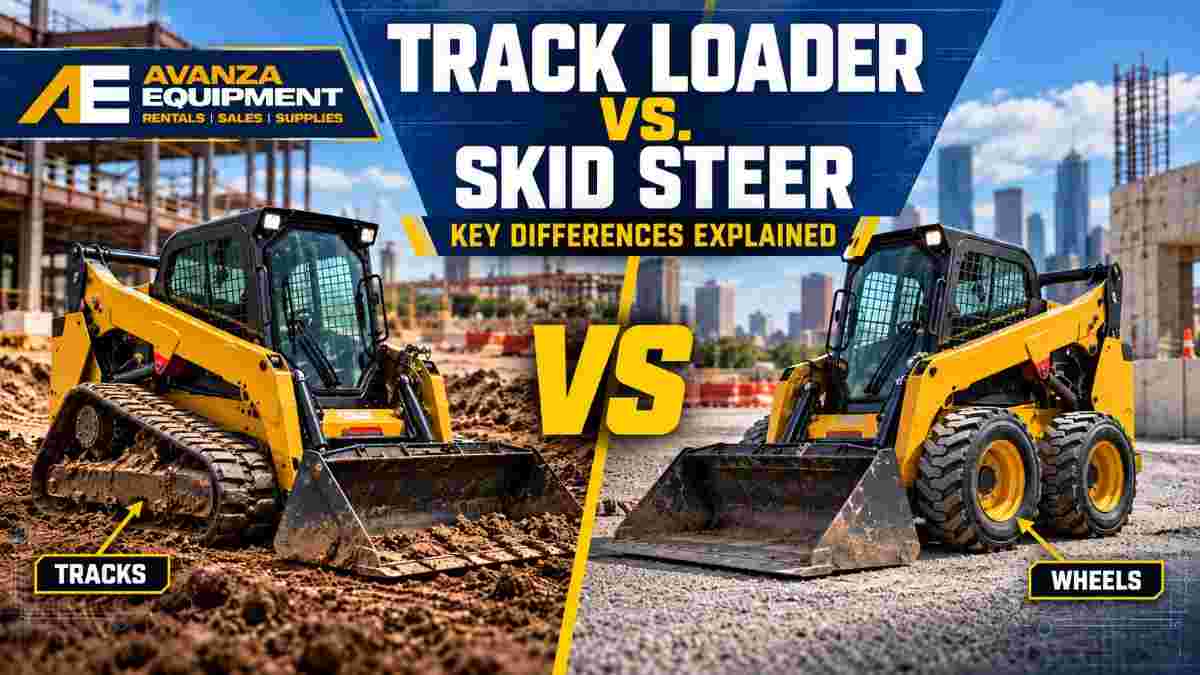
A skid steer runs on wheels, while a compact track loader runs on tracks. That basic difference influences traction, terrain suitability, machine weight, transport requirements, surface impact, maneuverability, maintenance considerations, and ultimately which machine makes more sense for a particular jobsite.
For work dominated by concrete, asphalt, or other firm surfaces, a wheeled skid steer may deserve stronger consideration. When a project involves soft soil, mud, or uneven terrain, a compact track loader (CTL) may be a better fit because its tracks create more ground contact.
Neither machine is automatically better. The right choice depends on the ground beneath the machine, the work being performed, attachment requirements, access, transport logistics, and project duration.
Track Loader vs. Skid Steer: Quick Comparison
The quickest way to understand the comparison is to start with the undercarriage.
| Factor | Skid Steer | Compact Track Loader |
| Undercarriage | Wheels | Tracks |
| Firm surfaces | Often well suited | Usable, but track wear matters |
| Soft ground | Can lose traction depending on conditions | Often better suited |
| Uneven terrain | Depends on conditions | Often a stronger fit |
| Mud and soil | May struggle in very soft conditions | Tracks can improve mobility |
| Machine weight | Often lighter comparatively | Often heavier comparatively |
| Transport | May require less transport capacity comparatively | Greater weight can affect transport planning |
| Maneuverability | Strong on firm surfaces and in confined areas | Highly maneuverable, but surface conditions matter |
| Undercarriage wear | Tires are a primary wear consideration | Tracks and undercarriage components require attention |
| Attachments | Broad range, compatibility must be verified | Broad range, compatibility must be verified |
| Cost | Model-dependent | Model-dependent |
| Best choice | Depends on project requirements | Depends on project requirements |
The important point is that wheels vs. tracks affects much more than how the machine moves. It changes how the equipment interacts with the ground, which can influence productivity and logistics throughout a project.
What Is a Skid Steer?
A skid steer is a compact wheeled construction machine commonly used for loading, material movement, grading, cleanup, site preparation, landscaping, and other jobs that benefit from a maneuverable carrier with front-mounted attachments.
Its wheels are one of its defining features.
Because of its compact body and steering design, a skid steer can maneuver effectively in tight jobsites, around structures, and in areas where larger construction equipment may be impractical.
A bucket is one of the most recognizable tools used with a skid steer, but these machines can support many other attachments when the carrier, coupler, hydraulic requirements, and attachment specifications are compatible.
Wheeled skid steers are often attractive on firm surfaces such as:
- Concrete
- Asphalt
- Compacted ground
- Paved commercial sites
- Hard construction surfaces
That does not mean a skid steer cannot operate on dirt or soil. Surface moisture, tire condition, terrain, load, machine configuration, and operator practices all influence how well the machine performs.
Houston contractors comparing machines for a firm-surface project can also review Avanza’s skid steer rental in Houston options.
What Is a Compact Track Loader?
A compact track loader, commonly abbreviated CTL, is a compact loader that travels on tracks instead of wheels.
People also frequently refer to a CTL simply as a track loader, although the term “track loader” can describe other, larger tracked equipment in different construction contexts. This article specifically focuses on compact track loaders.
The tracked undercarriage gives the machine a larger contact area with the ground than a typical wheeled skid steer.
That characteristic can make a compact track loader well suited to many jobs involving:
- Soil
- Soft ground
- Mud
- Uneven terrain
- Site preparation
- Landscaping
- Unpaved construction areas
Many compact track loaders use rubber-track systems, but track design and machine specifications vary by manufacturer and model.
The presence of tracks does not guarantee that a machine will avoid rutting, ground disturbance, slipping, or becoming stuck. Moisture, slope, material conditions, machine weight, track condition, operating technique, and the individual model all matter.
For local rental research, contractors can review Avanza’s track loader rental in Houston page for current rental options.
What Do Skid Steers and Track Loaders Have in Common?
Skid steers and compact track loaders are different machines, but they overlap significantly in their applications.
Both are compact construction equipment designed to perform useful work in areas where maneuverability matters. Depending on the machine and compatible attachment, either category may be used for tasks such as:
- Moving material
- Loading
- Site cleanup
- Grading
- Site preparation
- Landscaping
- Construction support
- Handling loose material
Both can also support front-mounted attachments.
The task alone does not always determine which machine is best. A skid steer and compact track loader may both be capable of completing the same general type of work, but jobsite conditions can make one more practical than the other.
For example, moving material across a paved commercial site creates a different equipment-selection problem than moving similar material across wet, exposed soil.
That is why surface and terrain should be evaluated alongside the application.
Wheels vs. Tracks: The Main Difference
The central difference in the track loader vs skid steer comparison is straightforward:
Skid steer → uses wheels
Compact track loader → uses tracks
That undercarriage difference affects several important jobsite characteristics.
Ground Contact
A compact track loader distributes contact across a tracked undercarriage rather than four tires.
The larger contact area can improve suitability for many soft-ground applications, although actual ground pressure and performance vary by machine.
A skid steer’s tires create a different contact pattern that can work particularly well on hard, firm surfaces.
Traction
Ground conditions strongly influence traction.
Tracks may provide an advantage in many situations involving soft soil, loose material, mud, or uneven ground because more of the undercarriage remains in contact with the surface.
However, a CTL should not be treated as having superior traction under every possible condition. Slope, moisture, surface material, track condition, machine configuration, load placement, and operator technique all affect traction.
Surface Suitability
A wheeled skid steer is often a practical choice when the project is dominated by concrete, asphalt, or another hard surface.
Compact track loaders can also operate on firm surfaces, but extended operation on abrasive pavement can make track and undercarriage wear a more important ownership or operating consideration.
Machine Weight
Compared with a broadly similar wheeled skid steer, a compact track loader is often heavier because of its tracked undercarriage.
The exact difference cannot be assumed without comparing specific models.
Maneuverability
Both machine categories are highly maneuverable.
A skid steer may be particularly attractive for repeated turning and positioning on firm surfaces. A CTL also works effectively in confined areas, but terrain and surface disturbance should be considered when making frequent turns.
Undercarriage Wear
With a skid steer, tires are an important wear component.
With a compact track loader, tracks and other undercarriage components introduce additional wear considerations.
The practical question is not simply which system lasts longer. It is which undercarriage is better suited to the surfaces where the machine will spend most of its operating time.
Skid Steer vs. Track Loader on Concrete and Asphalt
For a jobsite dominated by concrete, asphalt, or other firm surfaces, a wheeled skid steer is often a strong candidate.
Its wheeled undercarriage can be well suited to applications such as material handling, cleanup, loading, and general jobsite support on firm ground.
Frequent movement and turning on hard surfaces may also favor a wheeled machine when compared with putting unnecessary wear on a tracked undercarriage.
That does not mean compact track loaders cannot work on pavement. They can.
The issue is whether a tracked machine’s terrain advantages are actually needed for the project. If most of the work occurs on abrasive paved surfaces, track and undercarriage wear may deserve additional consideration.
For contractors working across both paved and unpaved areas, the decision becomes less obvious. The machine should be selected according to where it will spend most of its time and which ground conditions are most likely to limit productivity.
Skid Steer vs. Track Loader on Mud, Soil, and Uneven Ground
Soft or uneven ground often shifts the comparison toward a compact track loader.
Tracks provide a larger ground-contact area, which can improve machine mobility and traction in many conditions involving:
- Exposed soil
- Soft ground
- Mud
- Loose material
- Uneven terrain
- Landscaping areas
A wheeled skid steer can still work on dirt and soil, but traction may become more limiting as conditions become softer or wetter.
The severity of the difference depends on the actual jobsite.
A relatively firm dirt surface may present little difficulty for a suitable skid steer, while saturated or loose ground may make a compact track loader significantly more practical.
Tracks do not eliminate the possibility of getting stuck or disturbing the surface. Operators still need to evaluate terrain, moisture, slopes, machine setup, loads, and manufacturer guidance.
Ground conditions → influence traction → influence equipment choice
Track Loader vs. Skid Steer Weight and Transport
Track loader vs skid steer weight matters because operating weight affects both jobsite behavior and transportation planning.
Comparable compact track loaders are often heavier than wheeled skid steers because the CTL includes a tracked undercarriage and related components.
That is a general comparison, not a specification.
Actual operating weight depends on the individual machine, configuration, attachment, and manufacturer specifications.
Weight may influence:
- Transport planning
- Trailer and hauling requirements
- Jobsite access
- Loading logistics
- Storage
- Fleet scheduling
- Ground impact
A contractor should never select a transport setup based only on whether a machine is called a skid steer or compact track loader.
Before transporting either machine, verify the equipment’s actual operating weight and the rated capacity of the complete transport setup.
Does Lower Weight Always Make a Skid Steer Better?
No.
A lighter machine may simplify some transportation situations, but transport is only one part of the decision.
Choosing a machine that is easier to haul but poorly suited to the ground conditions can create a different productivity problem once it reaches the jobsite.
The better approach is to balance:
Terrain + application + machine weight + transport requirements
rather than treating weight as the only selection factor.
What About Travel Speed and Maneuverability?
Many wheeled skid steers may travel faster than comparable compact track loaders, but actual travel speed is model-specific.
Top speed is also rarely the most important factor in selecting between these machines.
For many projects, contractors should give greater weight to:
- Ground conditions
- Traction
- Distance traveled on the site
- Access
- Turning requirements
- Attachment needs
- Material being handled
Both skid steers and compact track loaders are designed to work in relatively tight spaces compared with much larger loaders.
A wheeled skid steer may be especially attractive when frequent maneuvering is required on firm ground. A CTL may become more attractive when the same maneuverability is needed on softer or less consistent surfaces.
No universal turning-radius or travel-speed advantage should be assumed without comparing specific models.
Track Loader vs. Skid Steer Pros and Cons
When evaluating track loader vs skid steer pros and cons, the advantages and limitations are usually connected to the undercarriage.
Skid Steer — Potential Advantages
A skid steer may offer:
- Strong suitability for many firm-surface jobs
- Wheeled mobility on concrete and asphalt
- Excellent maneuverability in confined areas
- Potentially lower operating weight than a comparable CTL
- Potentially simpler transport depending on machine weight
- Broad attachment capability when compatibility is confirmed
- Potentially lower acquisition or rental cost in some model comparisons
Skid Steer — Potential Limitations
Depending on conditions, a skid steer may face:
- Reduced traction on very soft ground
- Greater difficulty in mud
- More concentrated ground contact through the tires
- Possible rutting or surface disturbance on softer terrain
- Tire wear or damage depending on the surface and operating environment
Compact Track Loader — Potential Advantages
A compact track loader may provide:
- Better suitability for many soft-ground jobs
- Stronger traction in many soil and mud conditions
- A larger ground-contact area
- Improved mobility across some uneven terrain
- Practical performance for site preparation and landscaping applications where surface conditions vary
Compact Track Loader — Potential Limitations
A CTL may involve:
- Greater operating weight than a comparable skid steer
- Additional transportation considerations
- Track and undercarriage wear
- Greater concern about prolonged work on abrasive paved surfaces
- Potentially higher purchase or rental cost in some model comparisons
None of these points should be treated as universal rules. Machine size, configuration, manufacturer specifications, jobsite conditions, and project requirements can change the comparison.
Track Loader vs. Skid Steer Price
There is no useful universal dollar answer for track loader vs skid steer price.
Purchase and rental pricing can vary based on:
- Brand
- Model
- Machine size
- Capacity
- Age
- Condition
- Configuration
- Attachments
- Rental duration
- Local market
- Availability
A compact track loader may cost more than a comparable skid steer in some purchase or rental situations, but that should not be assumed for every machine or supplier.
More importantly:
Purchase price is not the same as rental price.
A machine that costs less to purchase is not automatically the least expensive option for a particular project.
If one machine is poorly matched to the terrain, lower acquisition or rental cost may be offset by reduced productivity or other jobsite complications.
Rental customers should compare current pricing for the specific machine required rather than relying on general skid-steer-versus-CTL assumptions.
Attachments: Can Skid Steers and Track Loaders Use the Same Tools?
Skid steers and compact track loaders can support a broad range of attachments, but compatibility should never be assumed.
Buckets are common, and other attachment types may be available depending on the machine and rental provider.
Before pairing any attachment with either carrier, confirm factors such as:
- Carrier compatibility
- Coupler compatibility
- Hydraulic requirements
- Attachment specifications
- Machine capacity
- Manufacturer requirements
An attachment that works with one skid steer does not automatically fit every skid steer or compact track loader.
The same applies in reverse.
If the project depends on a particular attachment, identify that requirement before choosing the carrier machine. In some cases, the attachment requirement may narrow the equipment choice more quickly than the wheels-versus-tracks comparison.
Maintenance and Undercarriage Considerations
Maintenance matters most to equipment owners, but rental customers can also benefit from understanding why the two machine types have different wear considerations.
Skid Steer Maintenance Considerations
A wheeled skid steer introduces tire-related wear considerations.
Operating surface, debris, tire condition, turning behavior, and jobsite environment can all affect tire wear.
Like other construction equipment, a skid steer also relies on systems such as the engine and hydraulics that require appropriate maintenance.
Compact Track Loader Maintenance Considerations
A compact track loader has additional tracked-undercarriage components.
Tracks and the supporting undercarriage experience wear based on factors such as terrain, debris, operating technique, and time spent on abrasive surfaces.
CTL ownership decisions therefore involve more than simply comparing engine or hydraulic maintenance. The undercarriage is an important part of the operating-cost equation.
No universal maintenance interval or cost should be assumed across different models.
Renting vs. Buying a Skid Steer or Track Loader
Once you determine which type of machine fits the job, the next question may be whether renting or buying makes more sense.
Renting May Make Sense When:
- The equipment is needed for a specific project.
- Jobsite terrain changes from project to project.
- Equipment needs are seasonal or occasional.
- A contractor needs a particular machine category without committing to ownership.
- The business wants to avoid long-term storage and ownership responsibilities for occasional use.
Renting can also allow a contractor to choose a skid steer for one project and a compact track loader for another rather than forcing one owned machine into every application.
Buying May Make Sense When:
- The machine is used frequently.
- It supports recurring work.
- Utilization can justify ownership.
- The business has appropriate storage.
- The business is prepared to manage maintenance and other ownership responsibilities.
Neither route is automatically less expensive.
Usage frequency, financing, maintenance, downtime, storage, transport, resale considerations, and project requirements can all influence the decision.
Which Is Better for Your Job: Skid Steer or Track Loader?
Instead of asking which machine is universally better, ask which one better matches the project.
Evaluate these factors:
1. Primary Ground Surface
Will the machine spend most of its time on concrete, asphalt, compacted ground, dirt, or another surface?
Firm paved surfaces may strengthen the case for a skid steer.
2. Soft vs. Firm Terrain
If the machine must regularly cross soft soil, a compact track loader may deserve stronger consideration.
3. Mud and Soil Conditions
Very soft or wet conditions can reduce wheeled-machine traction.
A tracked undercarriage can improve mobility in many of these conditions, although site conditions still need to be evaluated.
4. Jobsite Access
Consider entrances, working space, structures, corners, gates, and the areas where material must be moved.
Machine dimensions are model-specific, so verify the exact equipment before assuming it will fit.
5. Maneuverability
Both categories are compact and maneuverable.
If frequent turning occurs mainly on hard surfaces, a wheeled skid steer may be particularly attractive.
6. Application
Determine whether the machine will primarily load, grade, move material, prepare a site, perform landscaping work, support cleanup, or handle another task.
Then match that application with the ground conditions.
7. Attachment Requirement
Identify the attachment before finalizing the carrier when specialized work is involved.
Confirm coupler, hydraulic, and manufacturer compatibility.
8. Machine Weight
Verify actual operating weight rather than assuming based only on machine category.
9. Transport Requirements
Confirm machine weight and the rated capacity of the planned transport setup.
10. Project Duration
A short-term job may create a different equipment decision than recurring or continuous use.
11. Rental vs. Ownership Needs
Consider whether the machine is needed for one project, periodic work, or regular long-term use.
The practical summary is:
Mostly firm or paved surfaces → a skid steer may deserve stronger consideration.
Mostly soft, muddy, or uneven ground → a compact track loader may deserve stronger consideration.
The final decision still depends on the specific machine and jobsite.
Choosing Equipment for Houston Jobsites
Houston contractors can encounter very different operating surfaces from one project to another.
A commercial project may involve significant work on pavement or concrete, while site preparation, landscaping, or early-stage construction can place equipment on exposed soil.
Conditions can also change during a project. Ground that was workable during one phase may become softer after wet conditions.
For a Houston project dominated by firm surfaces and frequent maneuvering, a skid steer may be worth considering.
For projects involving softer soil, uneven ground, site preparation, or similar conditions where traction becomes more important, a compact track loader may be a stronger candidate.
Contractors can compare Avanza’s skid steer rental in Houston and track loader rental in Houston options before deciding which machine category fits the project.
For jobs that require loaders alongside excavators, trenchers, compaction equipment, concrete equipment, or other machines, browse Avanza’s broader construction equipment rental in Houston selection.
Avanza Equipment serves Houston as well as Cypress, Katy, Spring, The Woodlands, Tomball, Humble, Conroe, Sugar Land, Pearland, Pasadena, Baytown, Richmond, and Rosenberg.
Track Loader vs. Skid Steer FAQs
What is the main difference between a track loader and a skid steer?
The main difference is the undercarriage.
A skid steer uses wheels, while a compact track loader uses tracks.
That difference influences traction, ground contact, hard-surface suitability, soft-ground performance, machine weight, transportation, undercarriage wear, and other equipment-selection factors.
Is a track loader better than a skid steer?
Not universally.
A compact track loader may be better suited to many jobs involving soft soil, mud, or uneven terrain. A wheeled skid steer may be more practical when work is concentrated on concrete, asphalt, or other firm surfaces.
The better machine depends on the actual jobsite and project requirements.
Which is better for mud, a skid steer or track loader?
A compact track loader may deserve stronger consideration for muddy or soft conditions because tracks provide a larger ground-contact area and can improve mobility and traction.
That does not mean a CTL cannot become stuck or lose traction. Moisture, soil conditions, slope, machine setup, track condition, and operator practices all matter.
Which is better for concrete or asphalt?
A wheeled skid steer is often an attractive choice for projects dominated by concrete, asphalt, or other hard surfaces.
Compact track loaders can operate on paved surfaces, but track and undercarriage wear may become a more important consideration when substantial operating time is spent on abrasive pavement.
Is a track loader heavier than a skid steer?
A comparable compact track loader is often heavier than a skid steer because of its tracked undercarriage.
Actual operating weight is model-specific, so always compare the specifications of the exact machines being considered.
Are track loaders more expensive than skid steers?
They can be in some comparisons, but there is no universal pricing rule.
Purchase and rental costs depend on brand, model, machine size, age, configuration, attachments, rental duration, market conditions, and availability.
Compare the specific machines rather than assuming one category will always cost more.
Can skid steers and track loaders use the same attachments?
Some attachments may work with both machine categories, but compatibility must be verified.
Carrier type, coupler, hydraulic requirements, machine capacity, attachment specifications, and manufacturer requirements all matter.
Do not assume that an attachment that fits one machine automatically fits another.
What is another name for a track loader?
In the compact-equipment context, a compact track loader is commonly abbreviated CTL, and people may informally call it a track loader.
However, “track loader” can also refer to larger tracked loader equipment, so the terminology should be interpreted in context.
This article focuses specifically on compact track loaders.
Do skid steers flip over easily?
A skid steer should not be described as either “easy” or “impossible” to tip over.
Skid steers are designed to operate within specified limits, but rollover or tip-over risk can increase when equipment is overloaded, operated improperly, driven on unsuitable slopes or terrain, used with loads in unsafe positions, or operated outside manufacturer guidance.
Operators should follow applicable load limits, attachment instructions, terrain guidance, training requirements, and manufacturer operating procedures.
Which track loader is better, Bobcat or Kubota?
Neither Bobcat nor Kubota is automatically better for every project.
The useful comparison is between specific models.
Factors may include:
- Operating requirements
- Machine dimensions
- Hydraulic requirements
- Attachment compatibility
- Operator preference
- Jobsite conditions
- Service and support considerations
- Rental availability
Without verified specifications for the exact models being compared, there is no responsible universal winner.
What is the most reliable track loader?
There is no single track loader that can responsibly be labeled the most reliable without objective evidence and a defined comparison method.
Reliability depends on factors such as:
- Specific model
- Maintenance history
- Operating hours
- Previous operating conditions
- Operator practices
- Undercarriage condition
- Service history
For a rental customer, a more useful question is whether the available machine is appropriate for the project and properly maintained.
Is a wheel loader the same as a skid steer?
No.
A wheel loader and a skid steer are separate construction-equipment categories.
Both can perform material-handling and loading work, but they differ in machine design, steering, size, operating characteristics, and typical applications.
The wheel loader vs skid steer comparison is therefore a separate topic from the skid-steer-versus-compact-track-loader comparison covered in this article.
Should I rent a skid steer or compact track loader?
Start with the jobsite.
A skid steer may deserve stronger consideration when firm surfaces dominate the work, while a compact track loader may be more appropriate when soft or uneven terrain makes traction particularly important.
Then compare the actual machine’s weight, dimensions, attachment compatibility, project duration, and rental requirements.
Read also: Skid Steer vs. Mini Excavator
Rent the Right Equipment for Your Houston Project
Choosing between a skid steer and compact track loader starts with the surface beneath the machine.
Wheels can make a skid steer a practical choice for many firm-surface jobs, while tracks can make a compact track loader better suited to many soft-ground and uneven-terrain applications.
Before renting, evaluate the terrain, access, attachment requirements, machine weight, transport plan, and expected project duration.
Avanza Equipment has served Houston since 2018 with construction equipment and tool rentals for contractors, crews, landscapers, and jobsite projects.
Avanza Equipment
14500 Hempstead Rd
Houston, TX 77040
1-346-531-0470
Hours: Monday-Friday, 6:00 AM-4:30 PM
Saturday-Sunday: Closed