


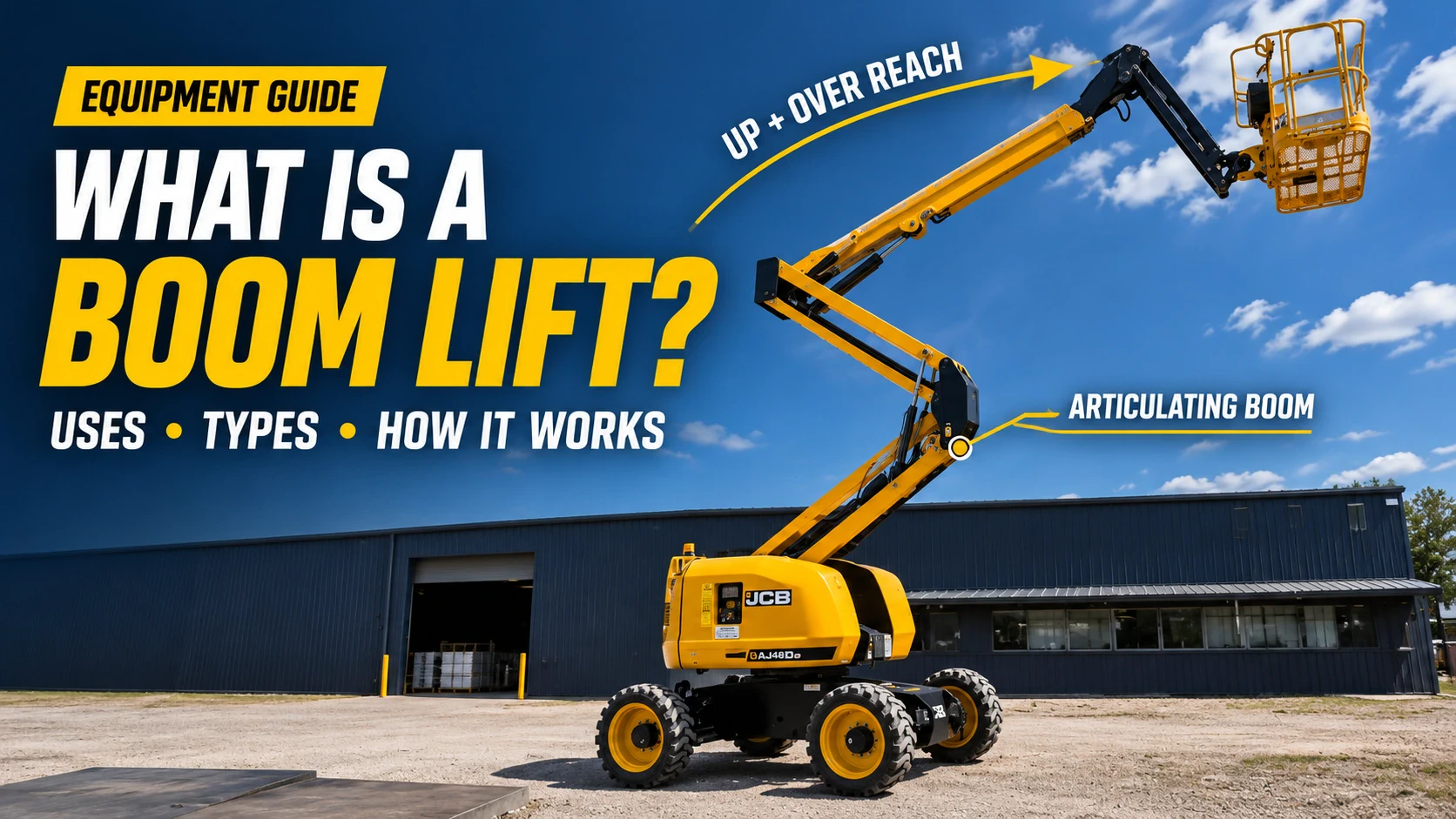
A boom lift is a mobile elevated work platform that raises workers and their tools on a platform at the end of a powered boom. Unlike equipment designed mainly for straight-up access, a boom lift can position the platform both upward and outward, making it useful when workers must reach over obstacles or work some distance from where the machine is parked.
Boom lifts are used for construction, building maintenance, sign work, electrical installation, structural work, and other elevated-access tasks.
What Is a Boom Lift and How Does It Work?
A boom lift combines a mobile chassis with an extending structure and work platform. In current access-industry terminology, boom lifts fall within the broader category of mobile elevating work platforms, or MEWPs. “Cherry picker,” “aerial lift,” and “manlift” are also commonly used terms, although they do not always describe exactly the same equipment category.
The main parts of a typical self-propelled boom lift include:
- Chassis: The mobile base supporting the machine.
- Turntable: Allows the boom structure to rotate relative to the chassis.
- Boom sections: Raise and extend the platform toward the work.
- Hydraulic cylinders or other actuators: Move the boom according to the machine’s design.
- Platform: Carries workers, tools, and materials within the rated capacity.
- Jib: An additional short boom section on some models that provides extra positioning flexibility.
- Platform controls: Allow the operator to position the machine and boom within approved operating limits.
- Ground controls: Provide lower-level control. OSHA’s construction standard requires extensible and articulating boom platforms to have both upper and lower controls, with lower controls able to override the upper controls.
Some machines also include platform leveling, load sensing, auxiliary lowering, envelope control, tilt sensing, or other systems. These features are model-specific and should be confirmed from the operator manual.
Articulating vs. Telescopic Boom Lifts
The two main self-propelled boom configurations solve different access problems.
| Boom Lift Type | Boom Movement | Best-Fit Site Layout | Common Uses | Key Specification to Check |
| Articulating Boom Lift | Multiple hinged sections provide up-and-over positioning | Obstacles between machine and work | Façades, canopy work, maintenance, congested sites | Up-and-over clearance and horizontal outreach |
| Telescopic Boom Lift | Sections extend along a relatively straight path | Open setup area with work farther away | Structural steel, exterior construction, direct outreach | Maximum horizontal outreach |
An articulating boom lift, also called a knuckle boom, uses hinged boom sections. Those joints allow the platform to rise and move over or around an obstruction.
A telescopic boom lift, sometimes called a straight boom, extends through telescoping boom sections. It is often considered where direct horizontal outreach is more important than reaching over an obstacle.
For example, Genie’s current Z-40/23N articulating model publishes a maximum horizontal reach of 22 ft 8 in and maximum up-and-over clearance of 21 ft 3 in. Its S-40 XC telescopic model publishes 31 ft 1 in of maximum horizontal reach. Those specifications illustrate the different reach patterns; they are not universal figures for either lift type.
Electric vs. Diesel Boom Lifts
Power source is separate from boom geometry.
Both articulating and telescopic equipment can exist in different power configurations. Current manufacturer fleets include electric, engine-powered, and hybrid machines.
Electric equipment may be considered where exhaust, charging, noise, or indoor work conditions influence selection. Diesel machines are common on outdoor construction sites where the specific model is designed for those conditions.
Do not select by fuel type alone. Also evaluate:
- Indoor or outdoor rating
- Ventilation
- Tire configuration
- Ground conditions
- Charging or fueling requirements
- Machine dimensions
- Required reach
- Platform capacity
Common Boom Lift Uses
Boom lifts are useful when elevated work cannot be reached effectively by positioning the machine directly underneath it.
Common applications include:
- Exterior building maintenance
- Façade repairs
- Sign installation
- Electrical and lighting work
- Warehouse or facility maintenance
- Structural steel work
- Roofing-edge access where the equipment and work plan allow
- Mechanical installation
- Construction inspection
- Appropriate tree or property-maintenance work
The application alone does not determine the correct machine. A façade repair behind a canopy creates a different reach problem from installing steel on an open construction site.
Can the Boom Lift Actually Reach the Work?
Consider this job:
A crew needs to replace an exterior light above a loading canopy. The lift cannot park directly beneath the light because the canopy extends out from the building.
Choosing equipment by “height” alone could result in the wrong lift.
Start With the Actual Work Position
The renter needs to know:
- Elevation of the light
- Height and projection of the canopy
- Distance from the machine’s available setup point to the building
- Any parapet or obstruction above the canopy
- Combined weight of workers, tools, and materials
Then compare those requirements with the manufacturer’s reach diagram.
Platform Height
Platform height is the maximum published elevation of the platform itself.
For example, Genie’s 2026 S-40 XC specification lists a maximum platform height of 39 ft 6 in.
Working Height
Working height is a manufacturer-defined estimate of the height at which work can be performed.
On that same Genie specification, the S-40 XC has a maximum working height of 45 ft 6 in. Genie states that its imperial working-height figure adds 6 ft to platform height. Other manufacturers or markets may use different conventions, so preserve the source’s terminology.
Horizontal Outreach
Horizontal outreach describes how far the platform can reach horizontally from the machine under the manufacturer’s measurement method.
For the canopy job, this can matter as much as vertical height.
Up-and-Over Clearance
On articulating machines, up-and-over clearance helps show whether the boom can rise above an obstacle and position the platform beyond it.
For example, the Genie Z-40/23N’s 2026 specification lists 21 ft 3 in of maximum up-and-over clearance.
Read the Working Envelope, Not Just the Maximum Numbers
A boom lift’s working envelope, or range-of-motion chart, shows which combinations of height and outreach are actually available.
Maximum height and maximum horizontal outreach usually do not mean the platform can achieve both maximum values at the same time.
Capacity can also change the available envelope.
Genie’s S-40 XC illustrates this clearly. It publishes 660 lb unrestricted capacity and 1,000 lb restricted capacity. The manufacturer’s range diagram shows a larger maximum-outreach zone at the lower load and a smaller high-capacity zone when carrying the higher rated load.
For the loading-canopy job, the crew should therefore plot the required position against the manufacturer’s reach chart after calculating the combined platform load.
Finish With the Setup Requirements
Before booking, also confirm:
- Stowed width and height for the access route
- Stowed length
- Tail swing
- Turning space
- Ground or floor support
- Wheel loads where relevant
- Surface conditions
- Manufacturer operating-slope limits
Do not confuse gradeability with permission to operate elevated on the same slope.
Genie’s S-40 XC specification, for example, explicitly labels its 45% gradeability as a stowed driving specification and directs users to the operator manual for slope ratings.
How Much Does It Cost to Rent a Boom Lift?
Current boom lift rental prices vary by boom type, size, market, rental duration, power configuration, and availability.
Here are current published examples checked November 20, 2026:
| Provider / Market | Equipment Listing | Daily | Weekly | Longer Term |
| Summit Rentals — Phoenix, AZ | 40 ft Straight Boom | $350 | $890 | $1,970 / 4 weeks |
| Summit Rentals — Phoenix, AZ | 45 ft Articulating Boom | $377 | $980 | $2,240 / 4 weeks |
| Avanza Equipment — Houston, TX | 48 ft Articulating Boom Lift | $550 | $1,220 | $3,195 / 4 weeks |
| Avanza Equipment — Houston, TX | 65 ft Telescopic Boom Lift | $650 | $1,750 | $3,995 / 4 weeks |
Summit’s published Phoenix prices exclude items including delivery and tax, demonstrating why the advertised machine rate may not equal the total rental cost.
The Avanza figures above are Houston-specific published examples, not national averages. The 48 ft and 65 ft descriptions are listing labels; they do not independently establish platform height, working height, outreach, capacity, or machine weight.
When asking how much it costs to rent a boom lift, confirm:
- Exact equipment class
- Rental dates
- Daily, weekly, or four-week term
- Transportation and pickup
- Taxes
- Fuel or charging requirements
- Rental-protection terms where applicable
- Other contract-specific charges
For deeper national pricing research, see Avanza’s dedicated Boom Lift rental cost guide.
Boom Lift vs. Scissor Lift
A boom lift provides vertical elevation plus horizontal positioning.
A scissor lift primarily raises a larger work platform vertically.
That makes a Scissor Lift worth considering when workers can position the machine directly beneath or close to the work. A Boom Lift becomes more relevant when an obstacle, setback, or horizontal distance separates the machine from the work area.
For vertical-access rental options, Houston customers can also review scissor lift rentals in Houston.
What to Know Before Operating or Renting a Boom Lift
Learning how to operate a boom lift requires training and familiarization with the specific machine.
For construction work, OSHA §1926.453 states that only authorized persons may operate an aerial lift, lift controls must be tested each day before use, manufacturer boom and basket load limits cannot be exceeded, and extensible and articulating boom platforms must have both upper and lower controls.
Before operation, a trained worker should address:
- Model-specific familiarization
- Pre-use inspection
- Work-area assessment
- Platform load
- Ground or floor conditions
- Overhead obstructions
- Electrical hazards
- Fall protection
- Manufacturer-designated anchorage
- Wind and environmental limits
- Emergency lowering arrangements
- Machine-specific slope and travel limitations
OSHA’s aerial-lift guidance also directs employers to assess the worksite, properly maintain equipment, follow manufacturer instructions, provide training and required PPE, and control fall, positioning, and stabilization hazards.
Boom Lift Rental Checklist
Before requesting a quote, provide:
- Required work elevation
- Required horizontal outreach
- Obstacle dimensions
- Combined worker, tool, and material load
- Narrowest access point
- Available setup area
- Surface or ground conditions
- Jobsite location
- Rental dates
Houston-area contractors can review Avanza’s boom lift rental page and share those job requirements to check machine suitability, current pricing, and availability.
Frequently Asked Questions
What are cherry pickers called?
“Cherry picker” is an informal term commonly used for boom-type access equipment. Other terms include boom lift and aerial lift. MEWP, or mobile elevating work platform, is broader: it includes boom lifts as well as other mobile platforms such as scissor lifts.
How heavy is a 40ft boom lift?
It depends on the exact model. Genie’s 2026 S-40 XC telescopic boom weighs 13,945 lb in its standard tire configuration and has a published platform height of 39 ft 6 in. The Z-40/23N electric articulating boom weighs 15,230 lb and has a 40 ft 5 in platform height. Options can change actual weight.
So “40 ft” should be treated as a model/class description until the exact platform-height specification is checked. Verify actual machine weight for transportation and floor or wheel-loading decisions.
Why do they call cherry pickers cherry pickers?
The nickname comes from the equipment’s association with orchard work. Early boom-platform vehicles were used to place workers at elevated positions around fruit trees, and the name cherry picker became attached to that type of elevated-access machine before spreading to construction, utilities, and maintenance work. A 1979 U.S. patent describing orchard boom-platform vehicles notes that this type of machine was commonly called a “cherry picker.”
Is a boom lift a forklift?
No. A boom lift is designed to position people and their tools at elevated work locations. A forklift is a powered industrial truck primarily designed to move, raise, lower, or stack materials and loads. The machines serve different purposes and have different operating and training requirements.