


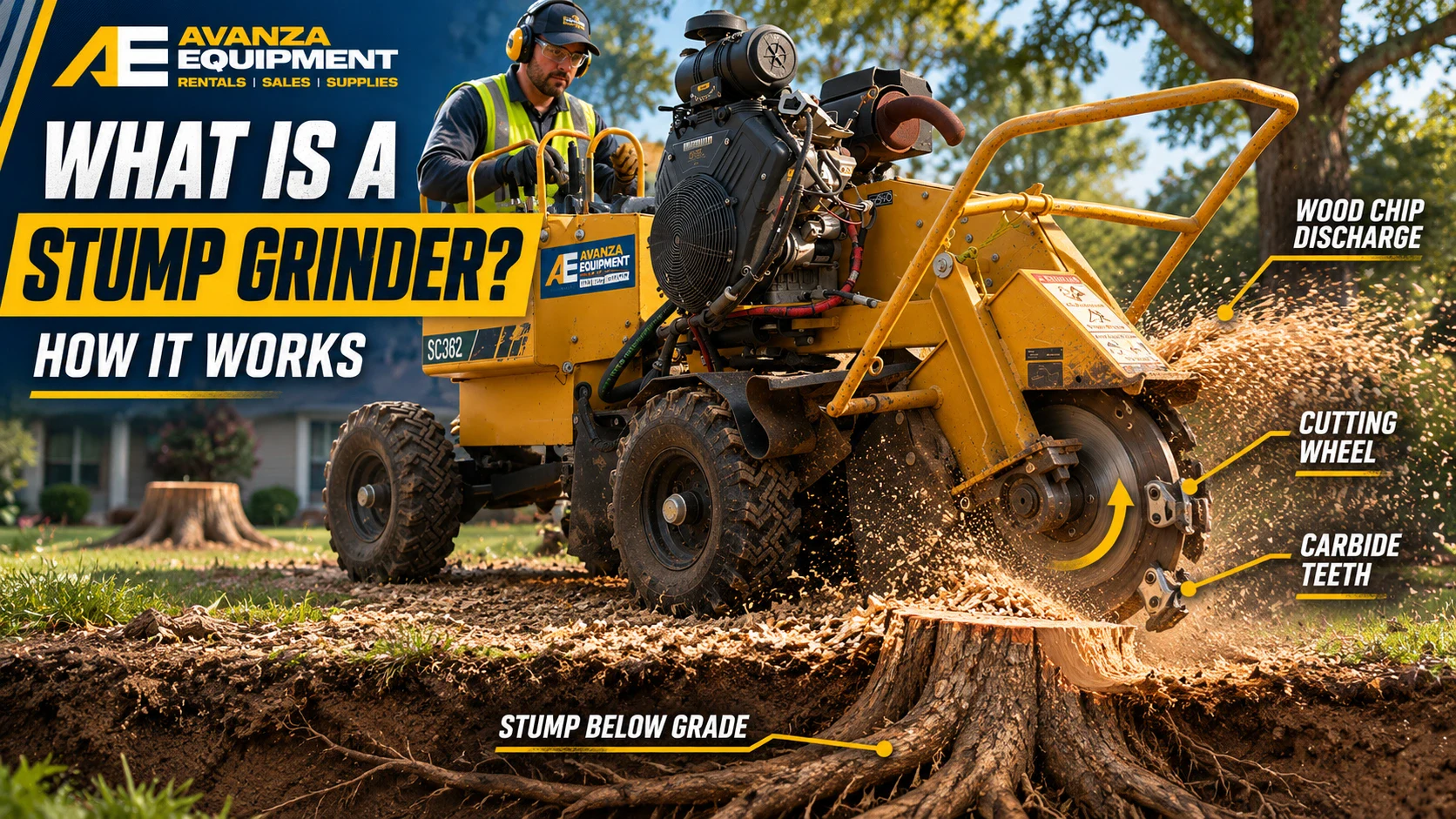
A stump grinder, also called a stump cutter, is a machine that uses a rotating cutting wheel fitted with hardened teeth to reduce a tree stump into wood chips. The cutter can work at or below ground level, depending on the machine’s rated grinding depth, making the site easier to restore or landscape.
Unlike complete stump excavation, grinding usually leaves a significant portion of the underground root system in place. Stump grinders range from compact walk-behind machines to tracked commercial units and tractor-mounted attachments.
What Is a Stump Grinder?
A stump grinder is specialized tree-care and landscaping equipment designed to mechanically reduce the wood left after a tree has been cut down.
Its defining component is the cutter wheel. Cutting teeth mounted around the wheel repeatedly contact the stump and chip away the wood as the wheel moves across the material.
Depending on the machine, power may come from:
- A gasoline engine
- A diesel engine
- A hydraulic drive
- A tractor’s power take-off, or PTO
- Another compatible carrier or power system
The resulting material is a mixture of wood chips and, often, soil.
“Stump grinder” and “stump cutter” are commonly used for overlapping equipment categories. Manufacturers such as Vermeer use the term stump cutter, while other suppliers commonly use stump grinder. Machine design and capability still vary significantly within either category.
Most importantly, grinding the visible stump does not mean the complete root system has been excavated.
How Does a Stump Grinder Work?
A stump grinder removes wood through repeated cutting rather than pulling the entire stump from the ground.
The basic mechanical process is:
- An engine, hydraulic system, PTO, or other compatible power source drives the cutter wheel.
- Hardened cutting teeth mounted on the rotating wheel contact the stump.
- Each pass removes relatively small amounts of wood.
- The cutting system moves across the stump according to the machine’s design and operating controls.
- The removed material accumulates as wood chips around the grinding area.
How the cutter wheel is driven varies. Some machines use belts, while others use hydraulic systems or a direct PTO-driven gearbox.
Grinding performance depends on more than engine horsepower. Cutter-wheel design, tooth condition, wood hardness, stump diameter, root flare, ground conditions, and the machine’s rated capabilities all matter.
Main Parts of a Stump Grinder
Although machines differ, common components may include:
- Engine or power source: supplies energy to the cutting system.
- Cutter wheel: rotating wheel that carries the cutting teeth.
- Cutting teeth: contact and chip away the stump wood.
- Drive system: may use belts, hydraulics, PTO components, or other mechanisms.
- Cutter-wheel guard: helps contain or shield rotating components.
- Debris deflector or chip guard: helps control material thrown during grinding.
- Operator controls: manage machine travel and cutter operation.
- Mobility system: may consist of wheels, tracks, a towable chassis, or tractor mounting.
Vermeer’s SC30TX, for example, uses a 16-inch cutter wheel and a hydraulic motor in its cutter-wheel drive system, while Toro offers both belt-driven compact grinders and hydraulically driven tracked machines. These are model-specific examples, not universal stump-grinder specifications.
What Is a Stump Grinder Used For?
If you’re researching what is a stump grinder used for, its primary purpose is reducing unwanted tree stumps after the tree itself has been removed.
Tree Removal and Tree Care
Tree-service crews can grind the remaining stump after cutting down a tree, reducing the aboveground obstruction without excavating the entire root system.
Landscaping and Lawn Restoration
Grinding can remove protruding stump material that interferes with lawn repair, planting areas, landscape renovation, or routine yard use.
Property Maintenance
Stumps can interfere with mowing, paths, landscaping equipment, and maintenance operations. Grinding reduces that obstruction.
Land Clearing
For selected stumps, grinding can support land-management or clearing work. Larger clearing projects may require different equipment or full excavation depending on the intended use of the site.
Fence and Landscape Projects
A stump located along a future fence line, planting area, or other landscape feature may need to be reduced or removed before work proceeds.
Grinding alone should not automatically be considered adequate preparation for a building foundation, pavement, or other structural work. Remaining roots and organic material may require additional removal and site preparation.
Different Types of Stump Grinders
Stump grinders are classified by mobility, power source, size, and operating configuration. Categories can overlap—a machine can be both tracked and self-propelled, for example.
| Stump Grinder Type | Main Characteristics | Typical Applications | Main Considerations |
| Walk-behind | Compact, operator-guided | Smaller jobs, restricted access | Physical handling, stump size, access |
| Self-propelled | Powered ground travel | Multiple stumps, property maintenance | Width, mobility, terrain |
| Tracked | Rubber-track undercarriage | Variable terrain, commercial work | Ground conditions, access, stability |
| Tow-behind | Trailer-style transport | Commercial tree work | Tow vehicle, setup area |
| Remote-controlled | Controls operated remotely | Commercial grinding | Training, visibility, work-zone control |
| Tractor-mounted/PTO | Attaches to compatible tractor | Farms, acreage, fence lines | PTO and hitch compatibility |
Walk-Behind Stump Grinders
Walk-behind grinders are among the more compact options. Toro’s current SGR models, for example, include compact machines designed for restricted-access applications. Machine width matters when the stump sits behind a gate or between structures.
Self-Propelled and Tracked Stump Grinders
Self-propelled machines use powered ground travel rather than relying entirely on manual movement.
Tracked designs can improve mobility in some jobsite conditions, but tracks do not make a machine immune to poor traction, instability, soft ground, or overturn hazards.
Machine width remains important. Vermeer’s SC362, for example, has a published transport width of 35 inches without its dual wheels specifically to improve access to tighter jobsites.
Tow-Behind Stump Grinders
Tow-behind grinders are transported behind a suitable vehicle and are commonly associated with larger commercial tree-care operations. Towing capacity, access, setup space, and machine specifications all need to be verified.
Remote-Controlled Stump Grinders
Some commercial machines offer remote controls that may allow different operator positioning compared with conventional control stations.
Remote operation does not eliminate hazards. Flying debris, rotating machinery, machine stability, visibility, underground utilities, and bystander control remain important.
What Is a Tractor Stump Grinder?
A tractor stump grinder is an attachment powered or carried by a compatible tractor, often through a three-point hitch and PTO system.
Compatibility cannot be assumed from tractor size alone.
For example, Woodland Mills’ WG24 is designed for tractors with 15–45 PTO horsepower and connects through a three-point hitch. Baumalight offers multiple PTO stump-grinder models with different recommended horsepower and PTO requirements.
When evaluating a tractor-mounted stump grinder, verify:
- PTO horsepower
- PTO speed requirements
- Three-point hitch compatibility
- Hydraulic requirements where applicable
- Tractor stability
- Attachment weight
- Working clearance
- Manufacturer compatibility requirements
How Deep Can a Stump Grinder Grind?
There is no universal stump-grinding depth.
Grinding depth is a model-specific specification determined by the cutter system and machine geometry.
Current manufacturer examples illustrate the variation:
- Toro SGR-6: up to 6 inches below grade
- Toro SGR-13: up to 11 inches below grade
- Vermeer SC30TX: up to 12 inches below grade
- Rayco RG37: published cutting depth of 17.5 inches
Those figures should not be generalized to other machines.
The required grinding depth depends on what happens next. Lawn restoration may have different requirements from planting, excavation, construction, or hardscape work.
Grinding farther below grade also does not mean every lateral or deep root has been removed.
Stump Grinding vs. Stump Removal: What’s the Difference?
The key difference is how much of the belowground tree structure is removed.
| Factor | Stump Grinding | Stump Removal / Excavation |
| Main method | Cuts stump into chips | Physically excavates stump/root mass |
| Underground roots | Significant roots usually remain | More roots can be removed depending on scope |
| Ground disturbance | Usually more localized | Typically creates a larger excavation |
| Cleanup | Chips, soil, remaining roots | Stump/root material plus excavation |
| Backfilling | Often required | Usually required |
| Landscape restoration | Common application | Possible but more disruptive |
| Structural-site preparation | May be insufficient alone | May be more appropriate depending on design |
South Dakota State University Extension notes that professional grinding commonly leaves the root system while reducing the stump below grade; excavation is a more extensive removal approach.
Grinding may therefore be practical when the objective is lawn or landscape restoration.
If a future foundation, pavement section, utility installation, or other structural element occupies the same location, remaining organic material may require further evaluation and excavation.
Does Stump Grinding Remove Roots or Prevent Regrowth?
Stump grinding generally does not remove the complete underground root system.
Many roots remain beneath and beyond the ground area where the grinder can reach. Over time, dead roots can decay, but the process can contribute to settlement as woody material loses volume.
Purdue Extension notes that remaining belowground wood can limit rooting depth and cause the ground to settle during decomposition.
Grinding also does not guarantee that a tree will never sprout again.
Colorado State University Extension explains that some tree species can produce shoots from roots and that removing a tree may stimulate suckering. University of Florida guidance similarly notes that some species can regrow from remaining stump or lateral-root tissue after grinding.
Regrowth potential therefore depends partly on species and the amount of living root tissue that remains.
How Much Does Stump Grinding Cost?
Three different costs are often confused:
- Hiring a professional stump-grinding service
- Renting a stump grinder
- Buying a stump grinder
They should be evaluated separately.
Professional Stump Grinding Costs
Angi’s October 2026 cost data reports a national average of about $250 for professional stump grinding, with most projects in its data falling between $120 and $400. Angi states that the figure is based on more than 16,000 verified projects.
HomeGuide currently reports a similar 120–400 range for the first stump, with cost affected by diameter, number of stumps, access, and job difficulty.
Professional pricing may depend on:
- Stump diameter and root flare
- Number of stumps
- Tree species and wood hardness
- Site access
- Required grinding depth
- Local labor market
- Chip hauling
- Backfilling or cleanup
- Minimum service charges
A professional quote should clarify whether cleanup and chip removal are included.
Tree Stump Grinder Rental Costs
There is no single national tree stump grinder rental rate. Current published examples show meaningful variation by machine and market.
| Current Rental Example | 4 Hours | Day | Week | Longer Term |
| Longenecker’s, PA — Toro STX-26 | $140 | $190 | $665 | — |
| Southwest Tool Rental, VA — stump grinder | $165 | $215 | $700 | $2,100 / 4 weeks |
| Summit Rentals, AZ — Dosko 620-20HE | — | $145 | $450 | $1,015 / 4 weeks |
| MB Rents, NH — self-propelled | — | $260 | $1,015 | $2,290 / month |
These are current provider examples, not a national average.
Rental cost also depends on transportation, rental duration, equipment class, location, fuel or return-condition requirements, and the rental agreement.
As a separate local example, Avanza Equipment currently publishes the following Houston-specific rate for its Stump Cutter listing:
- 4 Hours: $161.66
- 1 Day: $258.66
- 1 Week: $831.41
- 4 Weeks: $2,032.33
These Avanza rates are not presented as U.S. averages, and current availability should be confirmed.
Stump Grinder Purchase Prices
People searching for a stump grinder for sale will find a very broad market.
Current 2026 examples show why purchase pricing should be evaluated by machine category rather than one generic range:
- Toro’s fiscal-2026 U.S. pricing lists the compact SGR-6 at $4,005 MSRP and SGR-13 at $6,225 MSRP.
- The same Toro pricing document lists its tracked STX-26 at $28,140 MSRP.
- Woodland Mills currently lists the WG24 PTO tractor attachment at $1,895.
- Current used Vermeer SC30TX listings on MachineryTrader range approximately 12,900–22,000, with asking price varying by year, operating hours, condition, and included equipment.
These are manufacturer MSRP, advertised new-product pricing, and used-equipment asking prices—not completed sale prices.
| Option | Cost Basis | Main Cost Factors | Suitable Situations |
| Rental | Rental duration | Machine class, market, transport, duration | Occasional or project-specific work |
| Professional service | Per project/stump | Diameter, access, depth, cleanup | Limited operator experience or difficult sites |
| New purchase | MSRP/dealer price | Machine class, power, features | Frequent recurring use |
| Used purchase | Seller asking price | Age, hours, condition, cutter system | Buyers able to evaluate used equipment |
Can You Rent a Stump Grinder From Home Depot?
Yes. Home Depot stump grinder rental is currently available through participating Home Depot rental locations, subject to local inventory.
Home Depot’s official rental page currently lists the Barreto E30SGB stump grinder and specifies that inventory is subject to availability. The listing shows a 65-inch machine width, a maximum published grinding depth of 14 inches, and trailer-related transport information for that rental model.
Home Depot does not display one universal nationwide rate in the official page retrieved for this guide.
Before renting, verify:
- Participating location
- Current machine
- Machine width and access requirements
- Rental duration
- Local rental price
- Transportation options
- Deposit and rental-agreement requirements
- Current availability
Home Depot also maintains an official national chipper and stump-grinder rental category.
How to Use a Small Stump Grinder Safely
A stump grinder is not equipment that an inexperienced user should operate from a short written tutorial.
Before use, a trained operator should evaluate:
- Stump and root-flare size
- Gate and property access
- Soil and machine stability
- Rocks, wire, metal, and other hidden debris
- Buildings, vehicles, glass, and nearby property
- Underground utilities
- Bystanders
Contact 811 or the applicable state one-call service before soil-disturbing work and follow the jurisdiction’s required notice period. PHMSA identifies 811 as the nationwide call-before-you-dig service and notes that state laws determine required timing.
Model-specific guards, debris shields, controls, emergency systems, and cutter-wheel components should be inspected according to manufacturer instructions.
OSHA requires guarding and appropriate PPE in covered stump-cutting operations, and a 2024 OSHA investigation documented a fatal entanglement incident involving a rotating stump-grinder wheel—underscoring the seriousness of rotating-equipment hazards.
Appropriate PPE may include eye and face protection, hearing protection, protective footwear, and additional equipment required by the manufacturer or employer.
Never approach, inspect, or clear material from rotating components. The cutter wheel must be fully stopped and the machine secured according to its manual before servicing or inspection.
How to Choose the Right Stump Grinder
Start with the project rather than the horsepower number.
Consider:
- Stump diameter: larger stump and root-flare dimensions increase project scope.
- Number of stumps: one residential stump creates a different equipment decision than repeated commercial work.
- Required grinding depth: match the intended finished condition to a machine’s rated capability.
- Machine width: measure gates, paths, and other access restrictions.
- Ground conditions: evaluate slopes, soft soil, uneven areas, and machine positioning.
- Cutter system: verify that the machine is designed for the work.
- Transportation: account for machine weight and applicable trailer or vehicle requirements.
- Operator experience: larger or more complex projects may be better suited to professional crews.
A machine should never be selected only because it has a larger engine.
Should You Rent a Stump Grinder or Hire a Professional?
Renting may make sense when the project is manageable, the correct machine is available, and a competent operator can safely use it.
Professional service may make more sense when:
- The stump is large or difficult
- Access is restricted
- Several stumps must be processed
- Underground or surrounding hazards complicate the job
- Specialized machinery is needed
- The property owner does not have appropriate training
- Cleanup and restoration are part of the required scope
DIY is not automatically cheaper once transportation, fuel, rental duration, PPE, cleanup, and the operator’s time are considered.
Houston-area customers considering equipment rental can review Avanza’s stump grinder rental in Houston options before comparing the project with professional service.
What Can You Use Instead of a Stump Grinder?
Alternatives depend on why the stump needs to be removed.
Mechanical excavation with suitable equipment can remove more of the stump and root mass, but it creates a larger disturbed area and usually requires backfilling.
Manual digging may be realistic for appropriately small stumps but becomes labor-intensive as root size increases.
Natural decomposition avoids heavy machinery but can take years. University extension guidance generally discourages unsafe burning methods.
Hiring a qualified tree-care contractor is another option when access, size, hazards, or equipment requirements exceed a DIY project’s practical scope.
What Happens to the Wood Chips and Roots After Grinding?
Grinding leaves a mixture of chips, fine wood, soil, and remaining roots.
The site may require:
- Removing excess chips
- Adding suitable soil
- Re-establishing grade
- Monitoring settlement
- Restoring turf or landscaping
Purdue Extension warns that mixing large amounts of stump grindings into the replacement soil can reduce nitrogen availability and that remaining woody material may lead to settlement as it decomposes.
Wood chips can sometimes be reused as surface mulch, but their suitability depends on the tree, contamination, disease concerns, and intended landscape use. UC IPM notes that material from certain diseased root crowns or roots may require special handling rather than redistribution.
For foundations, paving, or engineered construction, stump grinding should not automatically be treated as complete removal of unsuitable organic material.
Frequently Asked Questions About Stump Grinders
What can I use instead of a stump grinder?
Alternatives include manual removal for suitably small stumps, mechanical excavation with appropriate equipment, natural decomposition, or hiring a tree-care contractor. Excavation can remove more of the root mass but usually creates a larger disturbed area. Avoid unsafe burning methods or using a chainsaw below the soil surface.
What does stump grinding usually cost?
For professional service, Angi’s 2026 data reports a national average near $250, with most projects around 120–400. Equipment rental is a separate cost: current provider examples reviewed for this guide range from roughly $145 to $285 per day for several walk-behind or self-propelled machines.
Is it difficult to use a stump grinder?
It can be. Stump grinders combine high-speed rotating cutters, flying debris, machine movement, underground hazards, and significant operator-control requirements. Difficulty also depends on the machine, stump, terrain, and access. Anyone renting one should receive appropriate training and follow the manufacturer-specific manual rather than relying on general online instructions.
Is it better to grind stumps or remove them?
Neither method is universally better. Grinding usually causes less excavation and is often practical for landscape restoration, but deeper roots remain. Mechanical removal disturbs more ground but may be appropriate when a project requires more complete removal of stump and root material, such as some construction or regrading work.
How deep does a stump grinder grind?
It depends entirely on the machine. Current manufacturer examples range from 6 inches below grade on a Toro SGR-6 to 17.5 inches on a Rayco RG37. The required depth should be matched to the project and the specific machine’s rated capability.
Does stump grinding remove tree roots?
Not completely. Grinding primarily reduces the stump and accessible root flare. Significant lateral and deeper roots generally remain underground, where they may decay over time.
Can a tree grow back after stump grinding?
Some species can produce shoots from surviving root tissue. Root suckering is species-dependent, and removing the stump does not guarantee that every living root has been eliminated.