


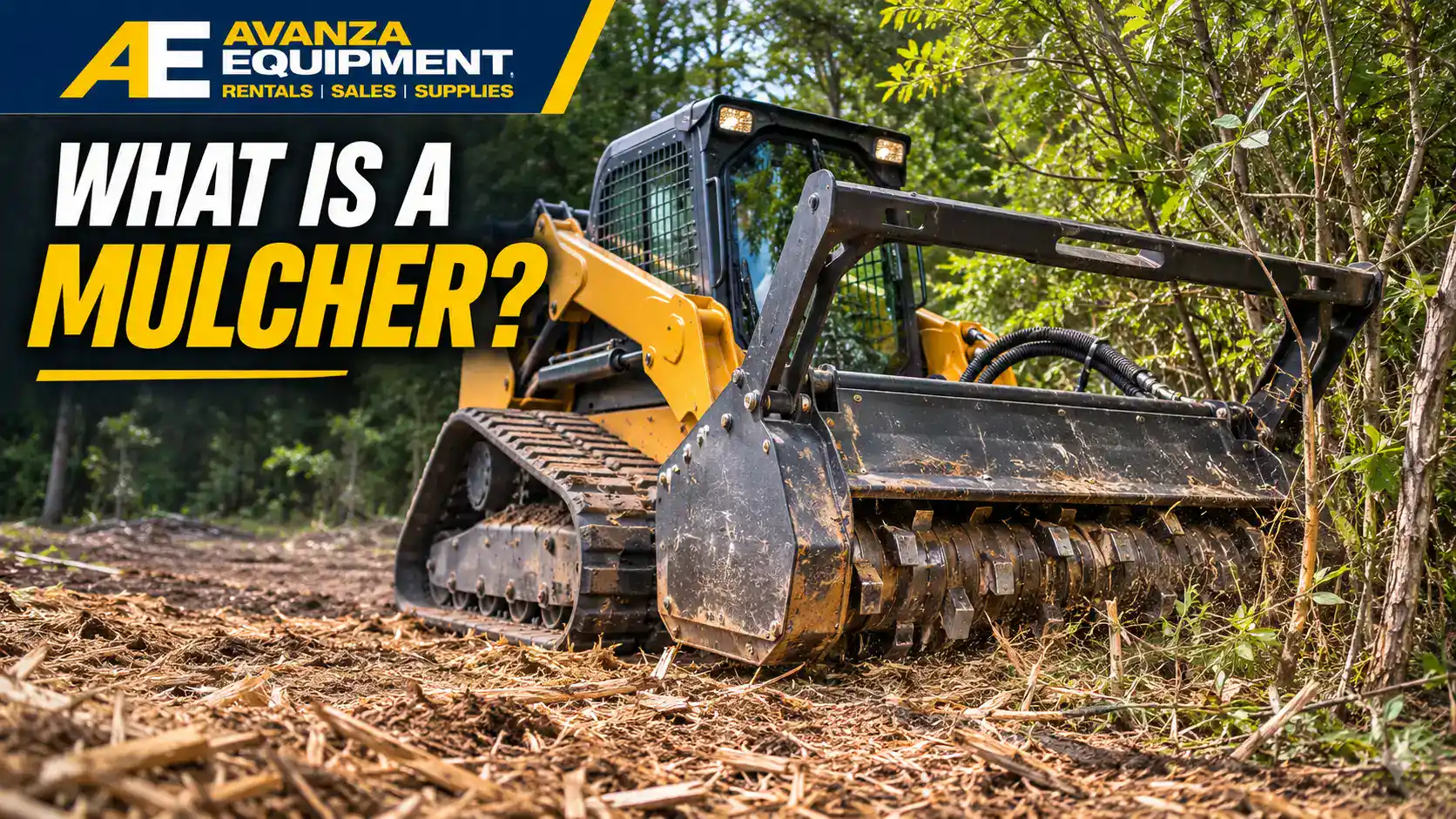
A mulcher is equipment designed to reduce vegetation or other organic material into smaller pieces. The term can describe everything from yard tools that shred leaves to heavy forestry attachments that process brush, saplings, and woody vegetation. For land clearing, a forestry mulcher typically uses a powered drum or disc fitted with cutting teeth or knives to process vegetation and leave the resulting material on the ground.
The right mulcher depends on what is standing, what finish you want, and which carrier can safely power the attachment.
What Does a Mulcher Do, and How Does It Work?
In forestry applications, the mulcher is usually an attachment mounted to a carrier—the skid steer, compact track loader, excavator, tractor, or other machine that carries and powers the cutting head.
A powered rotor or disc turns cutting teeth at high speed. As those teeth contact brush or wood, they cut, chip, and shred the material into smaller pieces.
A drum mulcher uses a horizontal rotating rotor. A disc mulcher uses a large rotating flywheel-style disc. Tractor-mounted brush mulchers may receive power mechanically through a PTO instead of a loader’s hydraulic system.
Forestry mulching often leaves the processed material in place rather than creating piles that must be loaded and hauled. Bobcat describes mulchers as the choice when the goal is to process vegetation into ground cover, while a chipper is more appropriate when cut material needs to become controlled chips that can be directed into a pile or collection area.
The finish is not identical from every machine. It can change with:
- Rotor or disc design
- Tooth or knife style
- Number of passes
- Vegetation density
- Stem diameter
- Ground contact
- Operator technique
- Machine power and hydraulic performance
- The manufacturer’s intended duty rating
That is why “forestry mulcher” describes an equipment category, not one universal machine.
Types of Mulchers and What They’re Used For
| Equipment Type | Best-Fit Material or Job | Typical Finish | Key Limitation |
| Drum mulcher attachment | Dense brush, saplings, fence lines, vegetation control | Often finer, more uniform mulch | Requires compatible carrier and hydraulics |
| Disc mulcher attachment | Aggressive clearing and suitable standing woody material | Fast reduction, potentially coarser material | Cutting and mulching ratings may differ |
| Compact excavator mulcher | Roadsides, banks, selective vegetation, hard-to-reach areas | Localized processing with added reach | Carrier flow, pressure, case drain, and guarding matter |
| Tractor-mounted mulcher | Farm, acreage, trails, recurring brush control | Processed vegetation left in place | PTO, hitch, weight, and tractor compatibility |
| Wood chipper | Cut limbs, pruning debris, stacked branches | Directed chips | Material generally must be fed to the machine |
Drum Mulcher Attachment
A drum mulcher attachment uses a horizontal rotor carrying cutting teeth or knives. The drum moves through vegetation and reduces material as the rotor turns.
Bobcat’s loader-mounted drum mulchers, for example, are designed for compatible skid steers and compact track loaders and are offered in several cutting widths. Its current 61-inch model publishes separate tree-diameter ratings for continuous use, intermittent removal, and occasional removal rather than one universal maximum.
That distinction matters. A diameter listed for occasional removal should not be interpreted as the material size a machine is designed to process continuously all day.
Drum heads are commonly considered for:
- Dense brush clearing
- Fence-line maintenance
- Right-of-way work
- Site preparation
- Vegetation management
- Selective clearing
Disc Mulcher Attachment
A disc mulcher uses a heavy rotating disc or flywheel equipped with knives or teeth.
Bobcat’s current 60-inch disc mulcher provides a useful example of why diameter labels must be read carefully: the company states that the attachment can cut trees up to 14 inches but mulch trees up to 6 inches. Those are two different ratings.
A machine’s ability to sever a standing stem therefore does not automatically mean it is rated to continuously process material of that diameter into finished mulch.
Compact Excavator Mulcher
A compact excavator mulcher changes the equipment decision because the boom can position the head away from the machine.
That can be useful along:
- Roadsides
- Banks
- Ditches
- Property edges
- Selective clearing areas
- Places where direct loader access is limited
Bobcat’s compact-excavator drum mulchers are offered for compatible 4- to 8-ton excavators and are tuned around the carrier’s hydraulic flow and pressure. Bobcat also specifies a case-drain kit and enclosed cab for these attachments.
Boom reach can improve positioning, but it does not make every slope or terrain condition suitable. Machine stability, attachment weight, visibility, manufacturer limitations, and ground conditions still govern the job.
Tractor-Mounted Mulcher
A tractor-mounted mulcher, sometimes searched as a “mulcher tractor,” typically connects through a three-point hitch and uses the tractor’s power take-off (PTO) to drive the cutting system.
The Baumalight MP330 brush mulcher is a useful real-world example. Baumalight publishes a 30-inch rotor width, 41.75-inch path width, Category 1 hitch, 540-rpm drive speed, 525-pound unit weight, minimum 15 engine horsepower, maximum 40 engine horsepower, and maximum 35 PTO horsepower.
Those are MP330 specifications—not universal tractor-mulcher requirements.
Before selecting any PTO brush mulcher, confirm:
- Tractor engine and PTO horsepower
- Required PTO speed
- Hitch category
- Implement weight
- Tractor lift capacity
- PTO shaft compatibility
- Hydraulic remotes if required
- Manufacturer-approved configuration
Wood Chipper
A chipper solves a different debris problem.
If a property cleanup already has cut limbs and branches stacked, a chipper may be more practical because it processes presented material and directs chips through a discharge chute. Bobcat specifically positions its chipper for pruning, tree removal, parks, municipalities, and property-maintenance debris.
Two Jobsite Examples
Brush-covered fence line: A landowner has saplings, vines, and brush growing along an existing fence corridor and wants the material processed and left on the property. A compatible forestry drum or disc mulcher may fit that objective because the desired result is vegetation reduction and on-site mulch.
Property cleanup with stacked limbs: A storm cleanup has already produced piles of cut branches. The vegetation does not need to be cut standing; it needs to be converted into manageable chips. A wood chipper may be a better match.
The material and desired finish should guide the machine choice.
How to Match a Mulcher to the Job and Carrier
Before requesting a skid steer mulcher rental, drum mulcher rental, or attachment quote, collect these details:
- Vegetation type
- Typical stem diameter
- Largest stems
- Vegetation density
- Desired finished condition
- Whether stump work, debris hauling, or grading will follow
- Gate clearance
- Full equipment width
- Working space
- Terrain and ground conditions
- Exact carrier model
- Mounting interface
- Approved attachment weight
- Auxiliary hydraulic flow in GPM
- Hydraulic pressure in PSI
- Case-drain requirements
- Manufacturer-required forestry guarding
Hydraulic attachments are not universal. Bobcat notes that carrier compatibility can depend on mounting, flow, pressure, high-flow approval, case drain, enclosed-cab requirements, and forestry protection.
Cutting Width vs. Overall Width
These specifications answer different questions.
Cutting width describes how much vegetation the attachment processes across its working path.
Overall width tells you how much physical clearance the attachment occupies.
Bobcat’s current 50-inch MX compact excavator drum mulcher has a 50-inch cutting width but a published overall width of 58 inches. Its operating weight is listed at 1,050 pounds.
A 50-inch cutting-width label therefore does not mean the attachment will pass through a 50-inch opening.
Keep the Duty Rating With the Diameter
Diameter ratings can also be easy to misread.
Bobcat’s 61-inch loader drum mulcher lists:
- 5 inches — continuous use
- 9 inches — intermittent removal
- 12 inches — occasional removal
Those labels are part of the specification. Removing the duty classification changes the meaning of the number.
Forestry Protection and Maintenance
Mulching creates serious thrown-debris hazards. Bobcat requires its Forestry Applications Kit on specified loader mulcher configurations; the kit includes operator and machine protection such as a polycarbonate forestry door and debris guarding.
Operators should be trained for the carrier and attachment, maintain appropriate bystander clearance, preserve visibility, and follow the machine’s operation and maintenance manual.
Cutting teeth and knives are also wear components. Inspecting them according to manufacturer requirements helps prevent damaged or badly worn cutting tools from turning into avoidable downtime.
How Much Does a Mulcher Cost?
The phrase mulcher price can describe three very different expenses:
- Buying a mulcher attachment or complete machine
- Renting an attachment or complete forestry package
- Hiring a forestry-mulching contractor
Do not compare those numbers as though they represent the same service.
Buying a Mulcher
A mulcher for sale listing may be for the attachment only or for a complete dedicated forestry machine.
Current asking-price examples show the spread.
A new 2026 FAE DML/SSL attachment was advertised at $31,450 in Washington, while current 2026 Denis Cimaf DAF150D dealer listings are around $42,000–$43,000 for the mulching attachment.
Used attachment asking prices also vary. A used 2022 Bobcat 72-inch forestry mulcher was listed at $22,250, while a pre-owned 2022 Fecon Blackhawk BK7618 was advertised at $28,995.
These are asking prices, not completed transaction prices or national averages.
When comparing new or used equipment, check:
- Attachment versus complete machine
- Rotor/disc type
- Teeth and wear condition
- Hydraulic motor
- Hoses and couplers
- Mounting interface
- Guarding
- Included accessories
- Service history
- Carrier requirements
Renting a Mulcher
A drum mulcher rental can mean attachment-only rental or a complete carrier-plus-head package.
Fisher’s Rental in Pennsylvania currently lists a Loftness forestry mulcher attachment at $1,000/day, $3,750/week, and $11,250/month, but explicitly requires the customer to rent its SVL95 carrier separately.
Atlas Bobcat currently lists a compact track loader with forestry cutter/drum mulcher package at $950/day, $3,800/week, and $11,000/month.
Those examples illustrate why renters should ask:
- Is the quote attachment-only or a complete package?
- Which carrier is included or required?
- Is forestry guarding included?
- What hydraulic configuration is supplied?
- Is transportation separate?
- What fuel/return requirements apply?
- Are wear items addressed in the agreement?
- What are the allowed machine hours?
- What exact period does “day,” “week,” “month,” or “four weeks” mean?
The advertised equipment rate is not automatically the total project cost.
Hiring a Forestry Mulching Contractor
Professional forestry mulching may be quoted by the hour, acre, day, or project.
Current 2026 research illustrates why scope matters. Angi reports approximately $150–$300 per hour and $1,000–$2,500 per acre in its current guide. HomeGuide publishes $125–$300 per hour and roughly $400–$800 per acre for typical brush, with higher costs for dense work.
Those per-acre figures differ substantially because providers and cost guides define vegetation density and scope differently.
A useful contractor quote should clarify:
- Mobilization
- Operator
- Equipment
- Acreage or hourly basis
- Vegetation assumptions
- Largest stem sizes
- Number of passes
- Stump treatment
- Cleanup
- Debris handling
- Finish expected when the contractor leaves
How Much Does a Mulcher Cost Per Hour?
A contractor’s hourly rate and the hourly cost of a rental are not the same thing.
A contractor hourly quote may include the machine, attachment, trained operator, fuel, maintenance, and business overhead.
A rental quote typically covers equipment under a defined rental agreement. If you want an internal planning cost per productive hour, divide your applicable rental and project costs by the productive hours you realistically expect to use the machine. That planning calculation is not the rental provider’s billing rate or engine-hour allowance.
When Should You Rent, Buy, or Hire a Contractor?
Renting can make sense for a one-time clearing job when you have a compatible carrier—or can rent the full package—and have an appropriately trained operator.
Buying becomes more relevant when vegetation management is recurring enough to justify attachment ownership, wear parts, maintenance, storage, transport, and carrier costs.
Hiring a contractor may make more sense when:
- You do not have a compatible carrier
- The property has difficult terrain or access
- Dense woody vegetation requires specialized equipment
- Operator experience is limited
- Transport and setup make rental impractical
- You want a defined finished scope rather than equipment access
For example, a one-time acre of brush may favor comparing contractor bids against a package rental. A property-management company maintaining rights-of-way or acreage every season may eventually find ownership worth evaluating.
Mulching also does not necessarily finish every land-clearing project. Roots, stumps, buried material, thick organic layers, or uneven grade may require additional stump removal, excavation, hauling, or finish grading before paving or construction.
Mulcher Rental in Houston
For Houston-area projects, Avanza Equipment currently lists a Bobcat T86 compact track loader with a 61-inch drum mulcher. Contractors and landowners can review forestry mulcher rentals in Houston and provide the jobsite location, vegetation type, representative stem sizes, access width, and rental dates so Avanza can discuss suitability and confirm current availability.
Frequently Asked Questions
What is a mulcher used for?
A mulcher processes vegetation or organic material into smaller pieces. Forestry mulchers are commonly used for brush clearing, sapling reduction, fence-line maintenance, right-of-way work, and vegetation control. Chippers serve a related but different purpose by processing cut limbs and branches into directed chips.
What is the difference between a shredder and a mulcher?
The terms can overlap, so the actual machine matters more than the label. A light-duty shredder may process leaves, grass, or garden debris, while a forestry mulcher is designed for brush and woody vegetation. Compare the manufacturer’s rated material, cutting system, carrier requirements, and expected output.
Is it worth buying a mulcher?
Buying may make sense when mulching is recurring work and you already have a compatible carrier. Consider purchase price, teeth or knives, hydraulic compatibility, maintenance, storage, transport, and utilization. For occasional projects, compare the total cost of rental and contractor bids before committing to ownership.
How much does a mulcher cost per hour?
Professional forestry-mulching guides currently report roughly $125–$300 or $150–$300 per hour, depending on source and scope. A rental’s hourly planning cost is different: divide your project-specific rental expenses by expected productive hours rather than treating a daily rental rate as a contractor hourly charge.
Sources Consulted
- Bobcat — Mulchers & Chippers: equipment categories, drum/disc terminology, applications, carrier compatibility, finish differences, and chipper comparison.
- Bobcat — MX 50″ Compact Excavator Drum Mulcher: cutting width, overall width, operating weight, attachment configuration, and excavator use.
- Bobcat — Loader Drum Mulcher: hydraulic requirements and continuous/intermittent/occasional tree-diameter ratings.
- Bobcat — Disc Mulcher: separate tree-cutting and mulching ratings.
- Bobcat — Disc Mulcher Safety: forestry guarding, approved configuration, inspection, and operator-safety context.
- Baumalight — MP330: PTO, horsepower, hitch, weight, path width, and rotor specifications.
- Fisher’s Rental and Atlas Bobcat: current attachment/package rental examples.
- Equipment Trader, MachineryTrader, ForestryTrader, Star Equipment: current new and used attachment asking-price examples.
- Angi and HomeGuide: current 2026 forestry-mulching contractor cost research.