


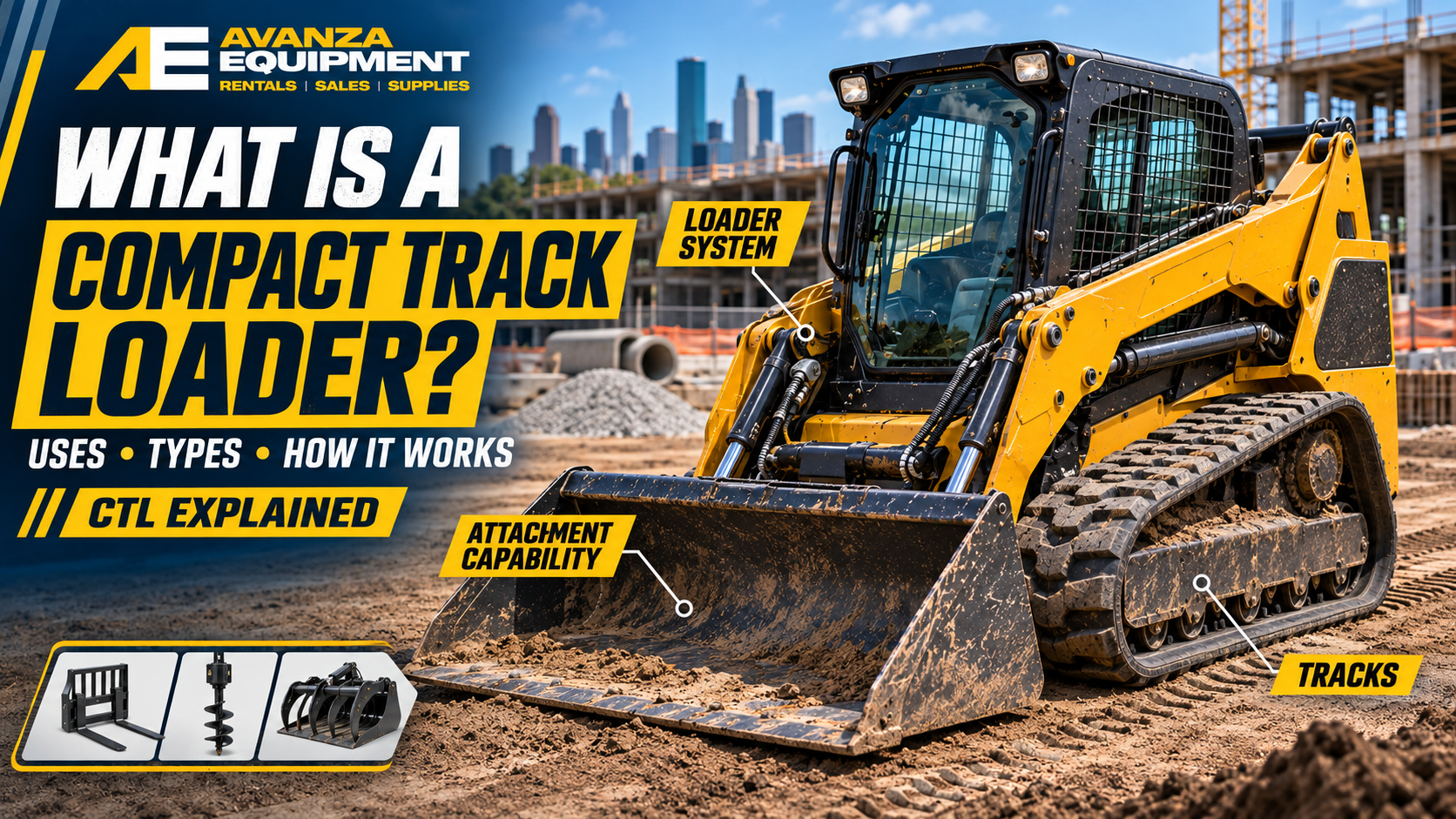
A compact track loader (CTL) is a versatile construction machine that moves on rubber tracks rather than wheels. It uses hydraulic loader arms and interchangeable attachments to perform earthmoving, grading, landscaping, material handling, and site preparation tasks. Its tracked undercarriage distributes machine weight across a larger contact area, helping improve traction and flotation on certain soft, muddy, or uneven surfaces.
Compact track loaders perform many of the same jobs as wheeled skid-steer loaders, but their different undercarriages affect ground pressure, maneuverability, maintenance, and operating costs. Understanding these differences, along with horsepower, operating weight, lifting capacity, and hydraulic performance, helps contractors select the right machine.
What Is a Compact Track Loader and How Does It Work?
A compact track loader combines a tracked undercarriage, hydraulic lifting system, and attachment-carrying front end into one maneuverable machine. Operators can move materials, lift loads, grade surfaces, and operate powered tools without switching between several pieces of equipment.
The machine relies on several interconnected systems:
- Engine or power source: Most conventional CTLs use diesel engines, although battery-electric models are also available.
- Hydraulic pumps: Convert engine power into hydraulic flow and pressure for travel, lifting, and attachment operation.
- Hydraulic drive motors: Power the left and right tracks, allowing controlled forward, reverse, and turning movements.
- Rubber-track undercarriage: Includes tracks, drive sprockets, rollers, and idlers that support the machine and transfer traction to the ground.
- Loader arms and hydraulic cylinders: Raise, lower, and tilt the bucket or other mounted attachment.
- Operator controls: Manage travel, steering, loader-arm movement, and auxiliary hydraulic functions.
- Quick-attach coupler: Connects compatible buckets, forks, and specialized attachments to the loader.
How Does a Compact Track Loader Move and Turn?
Most CTLs use hydrostatic travel systems that independently control the left and right tracks.
When both tracks move forward at similar speeds, the machine travels straight. Changing their relative speeds causes the loader to turn. Counter-rotating the tracks allows tight turns, although this can disturb the underlying surface.
The machine’s loader arms operate through hydraulic cylinders. Auxiliary hydraulics supply power to compatible attachments, such as augers, trenchers, brush cutters, and hydraulic breakers.
Unlike an excavator, a conventional compact track loader does not use a continuously rotating upper structure. Its primary functions are forward-facing loading, material movement, and attachment-powered work.
What Are Compact Track Loaders Used For?
Compact track loaders are commonly used on construction sites, landscaping projects, utility installations, and properties where maneuverability and attachment flexibility are important.
Construction and Site Preparation
CTLs support several earthmoving and site preparation operations, including grading soil, spreading aggregate, loading trucks, moving construction materials, and backfilling excavations.
A bucket-equipped loader can move loose material efficiently over short jobsite distances. A grading attachment can help prepare surfaces for concrete work, driveways, and other construction activities.
For deep or precision excavation, a mini excavator may be more appropriate.
Landscaping and Land Clearing
Landscaping contractors use compact track loaders to transport mulch, soil, gravel, landscape rock, and other bulk materials.
With suitable attachments, these machines can also support vegetation clearing, stump removal, soil preparation, and surface grading.
Their rubber tracks can be useful on uneven ground or certain softer surfaces, although repeated turning and travel may still damage lawns or disturb finished landscaping.
Roadwork and Utility Construction
Compact track loaders support roadwork and utility projects by moving aggregate, handling debris, preparing shoulders, and assisting with trench backfilling.
Compatible sweepers, grading attachments, and trenchers expand the range of work they can perform. However, trench depth, soil conditions, underground utilities, and hydraulic requirements must be considered before selecting an attachment.
Agriculture and Property Maintenance
Agricultural operators and property maintenance crews use CTLs for moving feed, handling bulk materials, cleaning work areas, maintaining access roads, and removing vegetation or debris.
For each application, productivity depends on the attachment, machine capacity, ground conditions, and available working space—not simply the loader’s horsepower.
Different Types of Compact Track Loaders
Compact track loaders can be classified by machine size, lifting configuration, and power source. These are separate classifications, not one universal manufacturer-defined system.
Small-, Medium-, and Large-Frame CTLs
| Classification | General Characteristics | Common Applications |
| Small-frame | Narrower machine dimensions and lower operating weights | Residential landscaping, restricted-access areas, smaller material-handling jobs |
| Medium-frame | Balance of lifting capacity, size, and attachment versatility | General construction, grading, site preparation, utility work |
| Large-frame | Greater lifting and hydraulic capabilities on selected models | Heavy material handling, demanding attachments, larger earthmoving projects |
Manufacturers do not all use identical frame-size boundaries. Compare actual dimensions, rated operating capacity, horsepower, and hydraulic specifications instead of relying entirely on size labels.
Radial-Lift vs. Vertical-Lift Compact Track Loaders
Radial-lift CTLs move their loader arms through an arc. They can be suitable for digging, grading, backfilling, and tasks requiring useful reach at intermediate lift heights.
Vertical-lift CTLs use a lift path designed to maintain the load farther forward at higher lifting positions. They are often selected for pallet handling, loading trucks, and material placement at elevated heights.
Neither configuration is universally better. Compare actual reach, lift height, dump clearance, and rated capacity for the intended attachment and job.
Diesel vs. Electric Compact Track Loaders
Diesel-powered CTLs remain common across the industry. They offer established refueling practices and a broad selection of machine sizes.
Battery-electric alternatives also exist. For example, Bobcat markets its T7X as an all-electric compact track loader.
Electric machines eliminate conventional diesel refueling but introduce considerations involving battery capacity, charging infrastructure, operating duration, and equipment availability.
Mini track loaders are a related but distinct category. Walk-behind or stand-on mini track loaders are generally smaller than conventional ride-in CTLs and should not automatically be compared using the same machine-size or capacity expectations.
Compact Track Loader Specifications: Horsepower, Weight, and Fuel Capacity
Compact track loader specifications vary considerably by manufacturer, machine size, engine configuration, and lifting capacity.
The following examples use published Caterpillar and Bobcat specifications, checked November 6, 2026.
Compact Track Loader Specifications Comparison
| Manufacturer and Model | Horsepower | Operating Weight | Rated Operating Capacity (ROC) | Fuel Capacity |
| Bobcat T450 | 55 hp* | 6,424 lbs | 1,490 lbs | 17.1 gal |
| Cat 255 | 74 hp gross / 73 hp net (ISO) | 9,578 lbs | 2,499 lbs | 24.8 gal |
| Bobcat T76-2 | 74 hp* | 9,592 lbs | 2,900 lbs | 31.7 gal |
| Cat 265 | 74 hp gross / 73 hp net (ISO) | 10,492 lbs | 2,823 lbs | 31.9 gal |
| Bobcat T86-2 | 115 hp* | 12,104 lbs | 3,925 lbs | 31.6 gal |
Sources: Official Caterpillar 255 and 265 specifications and Bobcat T450, T76-2, and T86-2 specifications. Cat ROC values use 35% of tipping load; Bobcat values use its published solid-undercarriage ROC configuration. Bobcat publishes the horsepower figures shown without identifying them as gross or net on these product pages (*). Actual specifications can change with configuration and attachments.
What Is the Horsepower of a Compact Track Loader?
Compact track loader horsepower ranges from 55 to 115 hp across the five diesel models compared above. This is a representative manufacturer-supported range, not a universal minimum or maximum.
Horsepower measures engine output, but it does not directly tell operators how much material a machine can lift or how effectively it will run hydraulic attachments.
For example, the Cat 255 and Cat 265 both have 74 gross horsepower, but the Cat 265 has a higher rated operating capacity in the specified configurations.
Hydraulic flow, hydraulic pressure, machine weight, traction, and attachment requirements also affect productivity.
When comparing engines, check whether the manufacturer reports gross horsepower, net horsepower, or another rating. These figures should not automatically be treated as equivalent.
What Is the Weight of a Compact Track Loader?
The five diesel CTLs in the specification table weigh approximately 6,400–12,100 pounds.
Operating weight generally includes the machine in a specified working configuration, with assumptions about fluids, operator weight, and attachments.
It differs from:
- Rated operating capacity: The load rating established under specified test conditions.
- Tipping load: The load at which the machine reaches its rated tipping condition during standardized testing.
- Shipping weight: A transportation-related measurement that may exclude certain components or fluids.
Machine weight affects transportation planning, trailer and tow-vehicle requirements, ground support, and jobsite access.
Heavier equipment does not necessarily produce greater ground pressure. Track width, track contact area, and weight distribution also matter.
What Is the Fuel Capacity of a Compact Track Loader?
Published fuel tank capacities for the five diesel examples range from 17.1 to 31.9 U.S. gallons.
A larger tank can reduce refueling frequency, but it does not guarantee longer operation than a smaller machine.
Fuel consumption depends on engine load, travel time, hydraulic attachment demand, idling, soil resistance, and working conditions.
For rental planning, compare fuel tank capacity with anticipated workload rather than assuming a particular number of operating hours per tank.
Battery-electric machines, including the Bobcat T7X, use stored electrical energy instead of a conventional diesel fuel tank.
Understanding Rated Operating Capacity and Hydraulic Flow
Rated operating capacity is especially important when lifting pallets, loading trucks, and moving heavy materials.
The Cat 255, for example, lists a 2,499-pound rated operating capacity at 35% of tipping load and 3,570 pounds at 50%. These are different rating conditions—not interchangeable lifting recommendations.
Caterpillar
Hydraulic performance is another important consideration.
The Cat 255 lists standard auxiliary hydraulic flow of 20 gallons per minute (gpm), with higher-flow configurations offering 30 gpm. Higher hydraulic flow may support certain demanding attachments, but the machine’s hydraulic pressure and attachment specifications must also match.
How Much Does a Compact Track Loader Cost?
Compact track loader prices depend on whether the machine is new, used, or rented. Size, specifications, attachments, market location, and equipment condition affect the total cost.
New Compact Track Loader Prices
As of November 6, 2026, Bobcat publishes the following U.S. starting prices for selected new machines:
| New Model | Published Starting Price |
| Bobcat Classic T450 | $64,245 |
| Bobcat Classic T650 | $74,564 |
| Bobcat Pro T76-2 | $98,822 |
| Bobcat Pro T86-2 | $120,586 |
Manufacturer-advertised U.S. starting prices checked November 6, 2026. Actual dealer quotes and configured machine prices can differ.
These examples illustrate new purchase prices of roughly 64,000–121,000 for the selected Bobcat models. They are not a nationwide price range covering every manufacturer.
Additional costs may include attachments, cab upgrades, specialized hydraulics, freight, taxes, and financing expenses.
Used Compact Track Loader Prices
Used equipment prices depend heavily on operating hours, track condition, service history, hydraulic performance, and machine configuration.
For example, two advertised 2022 Bobcat T66 listings checked November 6, 2026, showed:
- $29,900: A used T66 with 2,416 operating hours in Houston, Texas.
- $49,900: A used T66 with 275 operating hours in East Syracuse, New York.
These are individual advertised asking prices, not confirmed sale prices or a national used-equipment average.
Before purchasing a used CTL, inspect rubber tracks, rollers, sprockets, drive motors, hydraulic hoses, service records, and signs of unusual wear.
Compact Track Loader Rental Costs
A compact track loader rental can provide access to equipment without the full purchase expense.
For example, Bobcat of Omaha published the following starting rental rates in Nebraska, with its rate sheet updated October 5, 2026:
| Rental Model | Daily | Weekly | Monthly |
| Bobcat T450 | $270 | $930 | $2,500 |
| Bobcat T66/T64 class | $335 | $1,200 | $3,100 |
| Bobcat T76/T650 class | $345 | $1,250 | $3,200 |
| Bobcat T86/T870 class | $410 | $1,410 | $3,860 |
Published Omaha starting rates, not national averages. The monthly billing period should be confirmed with the provider.
Rental providers may offer daily, weekly, monthly, or four-week billing periods. Those terms should not be assumed to be identical.
Compare quotes based on the machine model, rental duration, attachment charges, transport expenses, applicable fees, and rental agreement conditions.
Compact Track Loader vs. Skid Steer: What’s the Difference?
The primary difference between a compact track loader and a skid steer is the undercarriage. A CTL travels on rubber tracks, while a conventional skid-steer loader uses rubber tires.
Both can perform loading, grading, material handling, and attachment-powered work.
| Feature | Compact Track Loader | Wheeled Skid Steer |
| Undercarriage | Rubber tracks | Rubber tires |
| Ground pressure | Often lower due to larger contact area | Often higher with conventional tires |
| Traction | Can benefit soft or uneven ground | Can perform well on firm surfaces |
| Flotation | Often useful on softer soil | More dependent on tires and ground conditions |
| Asphalt and concrete | Tracks may experience abrasive wear | Tires may suit frequent paved-surface travel |
| Mud and wet clay | Can offer an advantage but can still sink | May have traction limitations |
| Maintenance | Tracks, sprockets, rollers, and idlers | Tires, wheels, and associated components |
| Operating costs | Undercarriage replacement can be significant | Tire and drivetrain expenses depend on usage |
| Common work | Earthmoving, grading, landscaping | Material handling, pavement work, site maintenance |
Tracks spread weight across a larger contact area, but flotation is not unlimited. Saturated soil, weak subgrades, and aggressive turning can still cause rutting, slipping, or immobilization.
Likewise, skid steers are not automatically faster or cheaper to operate under every condition.
Choose based on terrain, machine specifications, and attachment requirements—not the undercarriage alone.
Cat vs. Bobcat Compact Track Loaders
Cat compact track loaders and Bobcat compact track loaders are established options for construction, landscaping, material handling, and site preparation work.
Both manufacturers offer different machine sizes and hydraulic configurations.
For example, the Cat 255 has 73 net horsepower (ISO), a 9,578-pound operating weight, and a 2,499-pound ROC at 35% of tipping load.
The Bobcat T76-2 lists 74 horsepower, a 9,592-pound operating weight, and a 2,900-pound ROC with its solid undercarriage.
However, these figures alone do not establish which machine will perform better on a specific job.
Buyers and rental customers should compare:
- Rated operating capacity and the associated test conditions
- Engine power and auxiliary hydraulic performance
- Lift path, reach, and dump clearance
- Cab comfort, visibility, and controls
- Attachment compatibility and coupler design
- Dealer support, service access, and ownership costs
The better choice depends on the work being performed, the configuration available, and local support.
Common Compact Track Loader Attachments
Interchangeable attachments make CTLs useful for multiple jobsite tasks.
| Attachment | Primary Application |
| General-purpose bucket | Moving soil, gravel, sand, and debris |
| Pallet forks | Handling pallets and suitable packaged materials |
| Grapple bucket | Moving brush, branches, and irregular debris |
| Auger | Drilling post holes and planting holes |
| Trencher | Cutting narrow trenches for utilities or irrigation |
| Brush cutter | Clearing vegetation using compatible cutting equipment |
| Hydraulic breaker | Breaking concrete, rock, or similar material |
| Grading attachment | Leveling and shaping soil or aggregate |
Not every attachment fits every compact track loader.
Before selecting one, confirm the coupler interface, auxiliary hydraulic flow and pressure, attachment weight, electrical controls where required, and manufacturer-approved operating configuration.
An attachment that physically connects to a loader may still be unsuitable for its hydraulic system or lifting capacity.
Advantages and Limitations of Compact Track Loaders
Compact track loaders offer practical advantages in traction, weight distribution, maneuverability, and attachment versatility.
They are particularly useful when crews need one compact machine to perform several different earthmoving and material-handling operations.
However, several limitations deserve attention.
Track assemblies contain wear components, including sprockets, rollers, idlers, and rubber tracks. Abrasive gravel, concrete, and repeated tight turns can accelerate wear. Packed mud and debris can also affect undercarriage performance.
Preventive maintenance should include track inspections, checking track tension, cleaning accumulated material, inspecting hydraulic connections, and following the manufacturer’s maintenance schedule. Caterpillar specifically recommends regular undercarriage inspections and cleaning to help protect component life.
Operating safety is equally important. Operators should assess slope stability, soil bearing capacity, machine access, and nearby workers before starting work.
Use the required operator restraints, maintain appropriate load positions, perform pre-operation inspections, and follow the machine’s operating manual. NIOSH also emphasizes keeping bystanders clear of the working area and avoiding unnecessary loading or turning on slopes.
Tracks improve mobility in some conditions, but they do not eliminate rollover, ground-failure, or stability hazards.
Should You Rent or Buy a Compact Track Loader?
Renting is often practical for temporary earthmoving, short-term grading, seasonal landscaping, or projects requiring a specific machine size or attachment.
It can reduce the need for long-term storage, equipment financing, and ownership-related maintenance responsibility.
Purchasing may be worth evaluating when the machine is used frequently enough to justify depreciation, repairs, insurance, storage, and transportation costs.
To compare the options, estimate the cost per productive operating hour.
For a rental, include the agreed rental charge and applicable additional expenses. For ownership, account for financing or capital costs, depreciation, maintenance, tracks, insurance, storage, and expected resale value.
Also consider whether the machine will be used regularly or remain idle between projects.
Choosing the Right Compact Track Loader
Start with the actual work rather than a preferred horsepower figure.
Check the heaviest intended load, required lift and dump height, attachment hydraulic demands, ground conditions, machine width, access restrictions, and transportation requirements.
Then compare models that meet those requirements using manufacturer specifications.
A smaller CTL may be suitable for restricted residential work, while a larger machine may be necessary for demanding material handling or high-flow attachments.
For contractors working in Houston, Texas, Avanza Equipment’s track loader rentals provide a local starting point for discussing equipment requirements.
Call Avanza Equipment at 346-531-0470 to check availability and request rental pricing for your project.
Frequently Asked Questions About Compact Track Loaders
What is the price range for a compact track loader?
New Bobcat CTLs in the manufacturer examples above have advertised starting prices from $64,245 for the T450 to $120,586 for the T86-2. Used 2022 Bobcat T66 examples were advertised at $29,900 and $49,900. These are selected 2026 prices, not universal national ranges.
What is the horsepower of a compact track loader?
The five representative diesel CTLs compared in this guide range from 55 to 115 horsepower. Engine output depends on the model, and manufacturers may report horsepower using different measurement standards.
What is the weight of a compact track loader?
The representative diesel models weigh between 6,424 and 12,104 pounds. Operating weight is distinct from rated operating capacity and varies with machine configuration, attachments, and manufacturer assumptions.
What are the different types of compact track loaders?
CTLs can be grouped by small-, medium-, or large-frame size, radial- or vertical-lift configuration, and diesel or electric powertrain. These are separate classifications, and manufacturers may use different size categories.
What is the fuel capacity of a compact track loader?
The five diesel models compared have fuel tank capacities from 17.1 to 31.9 U.S. gallons. Actual capacity depends on the model. Battery-electric compact track loaders do not use conventional diesel fuel tanks.