


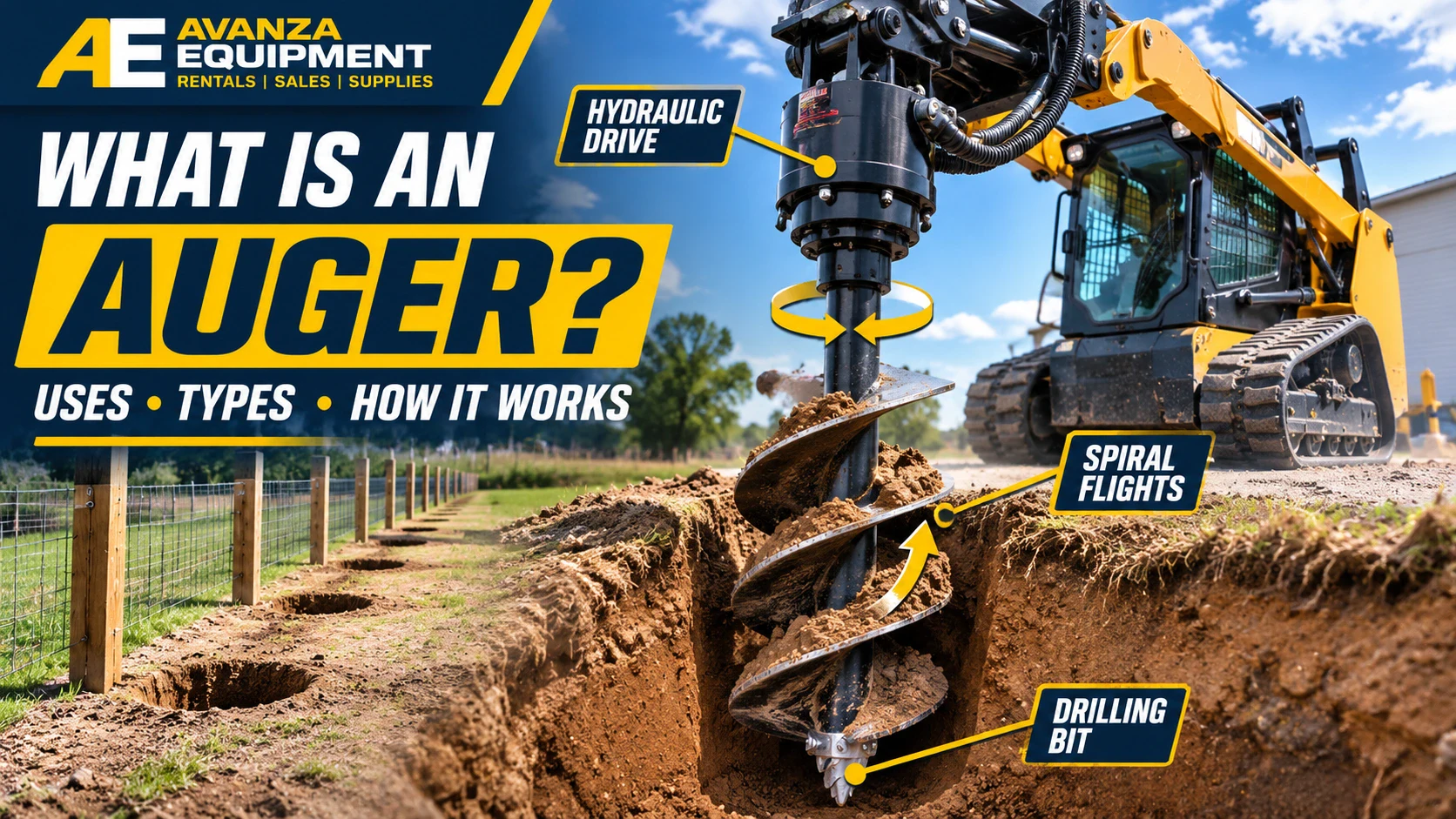
An auger is a drilling or material-moving tool that commonly uses a rotating helical, or spiral-shaped, component. Earth augers bore holes in soil, wood auger bits cut holes in timber, plumbing augers help address certain drain blockages, and grain augers move agricultural materials.
The exact design depends on the job. A handheld earth auger, hydraulic auger attachment, drain snake, and grain auger all use related principles, but they are not interchangeable tools.
For construction and landscaping, augers are especially useful for post holes, planting, signs, fencing, and other jobs requiring relatively defined holes in the ground.
What Is an Auger?
An auger is a tool or mechanism designed to bore holes or move material using rotation. Many augers use a central shaft surrounded by helical flighting. As the auger rotates, its cutting end penetrates material while the spiral can help move loosened material away from the cutting area.
The term covers several distinct tool families.
An auger may be:
- Turned manually
- Driven by an electric or gasoline-powered unit
- Powered hydraulically by construction equipment
- Used as a drill bit for wood
- Built around a flexible cable for plumbing
- Designed as a conveyor for grain
For earth drilling, the drive system and auger bit work together. The drive provides rotation and torque, while the bit determines the hole diameter and interacts directly with the soil.
What Does an Auger Look Like?
A typical earth auger resembles a large spiral drill bit.
Its main features may include:
- A central shaft
- Helical flighting wrapped around the shaft
- A pilot or cutting point at the bottom
- Cutting teeth or blades
- A connection at the top for a manual handle or powered drive
Machine-mounted systems also include a drive unit, mounting arrangement, hydraulic connections, and a compatible coupler or output shaft.
Cat, for example, offers auger attachments for compatible skid steers, compact track loaders, mini excavators, backhoe loaders, and compact wheel loaders, with separate drive units, bits, extensions, and adapters.
Plumbing and grain augers can look very different. A toilet auger may use a flexible cable inside a protective tube, while a grain auger is essentially a screw conveyor used to move material.
How Does an Auger Work?
For an earth auger, the basic operating principle is straightforward:
- A manual, electric, gasoline, or hydraulic drive provides rotational force.
- That force turns a shaft connected to the auger bit.
- The cutting point and teeth engage the soil.
- As soil loosens, the helical flighting helps move cuttings upward and away from the bottom of the bore.
- The operator or carrier machine controls drilling progress within the equipment manufacturer’s operating limits.
On hydraulic attachments, hydraulic flow and pressure influence the drive system’s speed and torque. Bobcat describes hydraulic fluid driving a motor that turns an output shaft connected to the auger bit, while the spiral flighting helps channel loosened material upward.
Actual drilling performance also depends on:
- Torque
- Rotational speed
- Bit geometry
- Cutting teeth
- Soil type
- Moisture
- Rock or debris
- Bit diameter
- Carrier and attachment compatibility
A larger hole does not simply require a larger bit. The drive system must also be capable of operating that bit under the actual ground conditions.
What Is an Auger Bit?
An auger bit is the cutting component that enters the material and establishes the nominal hole diameter.
An earth-auger bit usually includes a shaft, helical flighting, a cutting point, and replaceable or fixed cutting components. A wood auger bit is much smaller and is designed for boring timber rather than soil.
The bit is not necessarily the entire auger system.
For example:
Drive unit → supplies rotation and torque
Auger bit → cuts the material and determines the hole size
Flighting → helps move loosened material
Drive connection → joins the bit to the powered system
Manufacturers offer numerous bit diameters and different cutting designs. Cat currently lists standard, industrial, tree, and rock-oriented auger bits in multiple diameters, while Little Beaver offers earth augers from small soil-sampling sizes through larger nursery augers.
What Is an Auger Used For?
If you’re asking what is an auger used for, the answer depends on the auger category.
Construction and Fencing
Earth augers are commonly used to create holes for:
- Fence posts
- Deck footings
- Pergola posts
- Signposts
- Bollards where project requirements allow
- Other post and support installations
Cat specifically identifies fencing, footings, signs, and tree planting among applications for its construction-equipment augers.
The required hole dimensions should come from the project design, applicable code, soil conditions, and equipment capabilities—not a universal post-hole formula.
Landscaping and Gardening
Augers can reduce manual digging for tasks such as:
- Tree planting
- Shrub planting
- Garden preparation
- Landscaping posts
- Property-improvement projects
Smaller garden augers may be driven by handheld equipment, while larger planting holes may require a heavier earth drill or machine-mounted attachment.
Agriculture
Agricultural augers serve more than one purpose.
Earth augers may support fencing and planting tasks, while grain augers use rotating screw-type mechanisms to move grain through storage and handling systems. Grain-handling augers are specialized material-conveying equipment rather than post-hole drills.
Woodworking
A wood auger bit bores holes in timber.
These bits are commonly driven by a compatible drill or drilling machine and use cutting geometry designed for wood rather than soil.
Plumbing
A plumbing auger or drain snake uses a flexible cable and specialized end to reach certain obstructions inside drains.
It is fundamentally different from an earth auger.
Specialized Foundation Construction
Large construction drilling systems can use specialized augers for foundation and geotechnical work.
These systems should not be confused with ordinary post-hole augers. Engineered foundation drilling may require purpose-built rigs, specialized tooling, project engineering, and trained drilling crews.
Different Types of Augers and Their Uses
| Auger Type | Main Purpose | Typical Application |
| Earth Auger | Bore holes in soil | Posts, planting, signs |
| Hand Auger | Manual soil boring | Small-scale digging or sampling |
| Gas-Powered Auger | Powered earth drilling | Fencing and landscaping |
| Electric/Battery Auger | Powered drilling | Suitable smaller drilling tasks |
| Hydraulic Auger Attachment | Machine-powered earth drilling | Construction and demanding post-hole work |
| Plumbing Auger | Reach drain obstructions | Toilets, sinks, drains |
| Wood Auger | Bore timber | Carpentry and construction |
| Ice Auger | Bore ice | Ice fishing and specialized work |
| Grain Auger | Convey granular material | Agricultural material handling |
Hydraulic augers deserve particular attention for contractors because they can be mounted to compatible skid steers, compact track loaders, and excavators.
Compatibility is essential. Hydraulic flow, hydraulic pressure, carrier mounting, couplers, drive unit, shaft type, and bit requirements all need to match the equipment. Bobcat specifically notes that hydraulic flow and pressure influence auger speed and torque output.
What Is an Auger for Plumbing?
A plumbing auger is a drain-cleaning tool used to reach and help clear certain obstructions inside drains or plumbing fixtures.
Instead of drilling earth, it typically uses a flexible cable that travels through a pipe or fixture. The cable may be turned manually or powered, depending on the tool.
Common categories include:
- Drain auger
- Drain snake
- Toilet auger
- Closet auger
- Powered drain-cleaning machine
RIDGID’s toilet auger, for example, uses a flexible inner-core cable and is specifically intended for toilets and urinals, while its sink machines use rotating cable systems for appropriate sink, tub, shower, and other small drain lines.
A plumbing auger should not be confused with an earth-drilling auger, and one drain-cleaning tool is not appropriate for every fixture or blockage.
Common Auger Sizes and How to Choose the Right One
Auger diameter affects the nominal width of the hole, while bit length, extensions, and the drilling system influence how the equipment can meet depth requirements.
Manufacturer offerings demonstrate how broad the size range can be. Little Beaver currently offers standard earth augers from 1.5 to 16 inches in diameter, while Cat offers compatible auger bits from 4 inches through much larger construction sizes on selected drive systems.
| Example Diameter Class | General Selection Consideration |
| 2–4 in. | Narrow drilling, sampling, or small-hole applications |
| 6–9 in. | Medium-diameter earth drilling |
| 12 in. | Larger post or planting-hole requirements |
| 18 in. and larger | Larger holes requiring a compatible drive and carrier |
These are examples—not universal application rules.
Choose the bit according to:
- Required hole diameter
- Required depth
- Post or foundation design
- Soil conditions
- Drive-unit capability
- Carrier compatibility
- Bit style
- Manufacturer recommendations
Extensions may increase drilling reach on compatible systems, but available extensions and allowable drilling depth vary by equipment. Never assume an extension or bit fits a drive simply because the nominal diameter looks appropriate.
Handheld Auger vs. Skid Steer or Excavator Auger
Handheld and machine-mounted augers solve different drilling problems.
| Factor | Handheld Earth Auger | Machine-Mounted Hydraulic Auger |
| Configuration | Manual or self-contained power unit | Attachment plus compatible carrier |
| Best suited to | Smaller or accessible drilling projects | More demanding construction drilling |
| Power source | Manual, gasoline, electric, battery, or dedicated hydraulic unit | Carrier hydraulic system |
| Site access | Can reach areas inaccessible to larger equipment | Requires room for carrier |
| Main considerations | Handling, reaction torque, ground resistance | Hydraulic compatibility, mounting, torque, bit selection |
| Operator needs | Training for specific equipment | Carrier and attachment competence |
Hydraulic attachments may be fitted to compatible skid steers, compact track loaders, or excavators, but not every auger attachment works with every carrier or every bit. Cat’s own auger range lists different carrier compatibility and drive-unit/bit combinations.
For projects involving multiple equipment needs, Avanza’s construction equipment rentals page provides the broader commercial context for available rental categories.
Choosing an Auger for Clay, Gravel, and Rocky Soil
Ground conditions can change drilling resistance dramatically.
Clay Soil
Clay may become sticky, especially as moisture changes. Cuttings can build around the flighting, and dense or hard clay can increase drilling resistance.
Manufacturers offer different cutting points and blade systems for harder materials. Little Beaver, for example, identifies carbide options for hard clay and hardpan conditions.
Compacted Ground
Dense, compacted soil may demand more torque and a cutting system suited to the material.
A bit that works effectively in loose soil may perform differently in compacted fill.
Gravel and Rocky Soil
Stones can interrupt the cutting path and increase impact loads.
Rocky soil may require heavy-duty or rock-oriented tooling. That does not mean a standard earth auger can drill through solid bedrock.
Tree Roots
Roots can interfere with an earth auger’s point and cutting teeth. Their size, location, and the surrounding project requirements determine whether another tool or method is more appropriate.
Sandy Soil
Loose sand may drill easily but can introduce borehole stability concerns because unsupported soil may fall back into the hole.
The useful relationship is:
Ground conditions → drilling resistance → bit and drive requirements
Auger vs. Drill vs. Post Hole Digger
An auger is a specialized boring or material-moving tool. In earthwork, it commonly uses a helical bit to create a relatively defined hole.
A drill is the power tool or drilling machine that supplies rotation to a compatible bit. Some ordinary drills can drive wood or garden auger bits, but a hydraulic skid-steer auger is an entirely different system.
A manual post hole digger generally uses two opposing blades or jaws to loosen and remove soil through repeated manual digging.
A trencher performs another task entirely: it excavates a continuous trench. An ordinary earth auger creates individual boreholes rather than a continuous trench.
Auger Safety and Underground Utility Considerations
Augers combine rotating equipment with excavation hazards, so equipment selection and training matter as much as drilling capability.
Before ground disturbance, contact 811 or the applicable state one-call system and follow the requirements for that jurisdiction. PHMSA identifies 811 as the nationwide number for requesting underground utility location before excavation; required advance notice and excavation rules can vary by state.
Important hazards include:
- Underground gas, electric, communication, and other utilities
- Rotating equipment and entanglement
- Unexpected reaction torque or kickback
- Buried debris
- Insecure attachments or connections
- Bystanders entering the operating area
OSHA has documented severe and fatal accidents involving entanglement with rotating augers, including hazards from clothing and hidden landscape fabric.
Operators should follow the manufacturer’s instructions, perform required pre-operation inspections, verify attachment security, use appropriate PPE, and keep people clear of rotating components.
This guide is not a substitute for equipment-specific operator training.
Should You Rent or Buy an Auger?
Renting may make practical sense when the equipment is needed for:
- A one-time fencing project
- Seasonal landscaping
- Occasional post-hole drilling
- Temporary construction work
- A project requiring specialized drilling equipment you do not use regularly
Buying may make more sense when the equipment supports frequent, recurring work and ownership can justify maintenance, storage, transport, and attachment costs.
Before renting, define:
- Number of holes
- Required diameter
- Required depth
- Ground conditions
- Project duration
- Available jobsite access
- Carrier compatibility
- Required bit and drive unit
- Transportation requirements
Houston-area customers researching earth-drilling equipment can review Avanza Equipment’s auger rental options in Houston. Because inventory and compatibility can vary, confirm the complete equipment requirement rather than assuming a specific auger, bit, or carrier is available.
For project-specific rental questions, contact Avanza Equipment.
Frequently Asked Questions About Augers
What does an auger look like?
A typical earth auger has a central shaft with spiral-shaped flighting wrapped around it, plus a cutting point and cutting teeth or blades at the bottom. The top connects to a manual or powered drive. Other augers can look very different; plumbing augers use flexible cables, while grain augers resemble screw conveyors.
What is another name for an auger?
The name depends on the application. An earth auger may be called an earth borer, post-hole auger, or boring tool. In plumbing, terms such as drain auger and drain snake are common. These names are not universally interchangeable because they describe different types of equipment.
What’s the difference between an auger and a drill?
A drill generally refers to the powered tool or machine that supplies rotational force. An auger may refer to the helical cutting bit or to an entire auger system. A suitable drill can power certain auger bits, but construction-equipment augers often use dedicated gasoline, electric, or hydraulic drive systems instead.
What is the difference between an auger and an auger bit?
An auger bit is the component that directly cuts or bores into the material. The word auger can refer to that bit, the complete drilling tool, or even a material-conveying mechanism depending on context. On a hydraulic earth auger, the drive unit and auger bit are separate components that work together.