


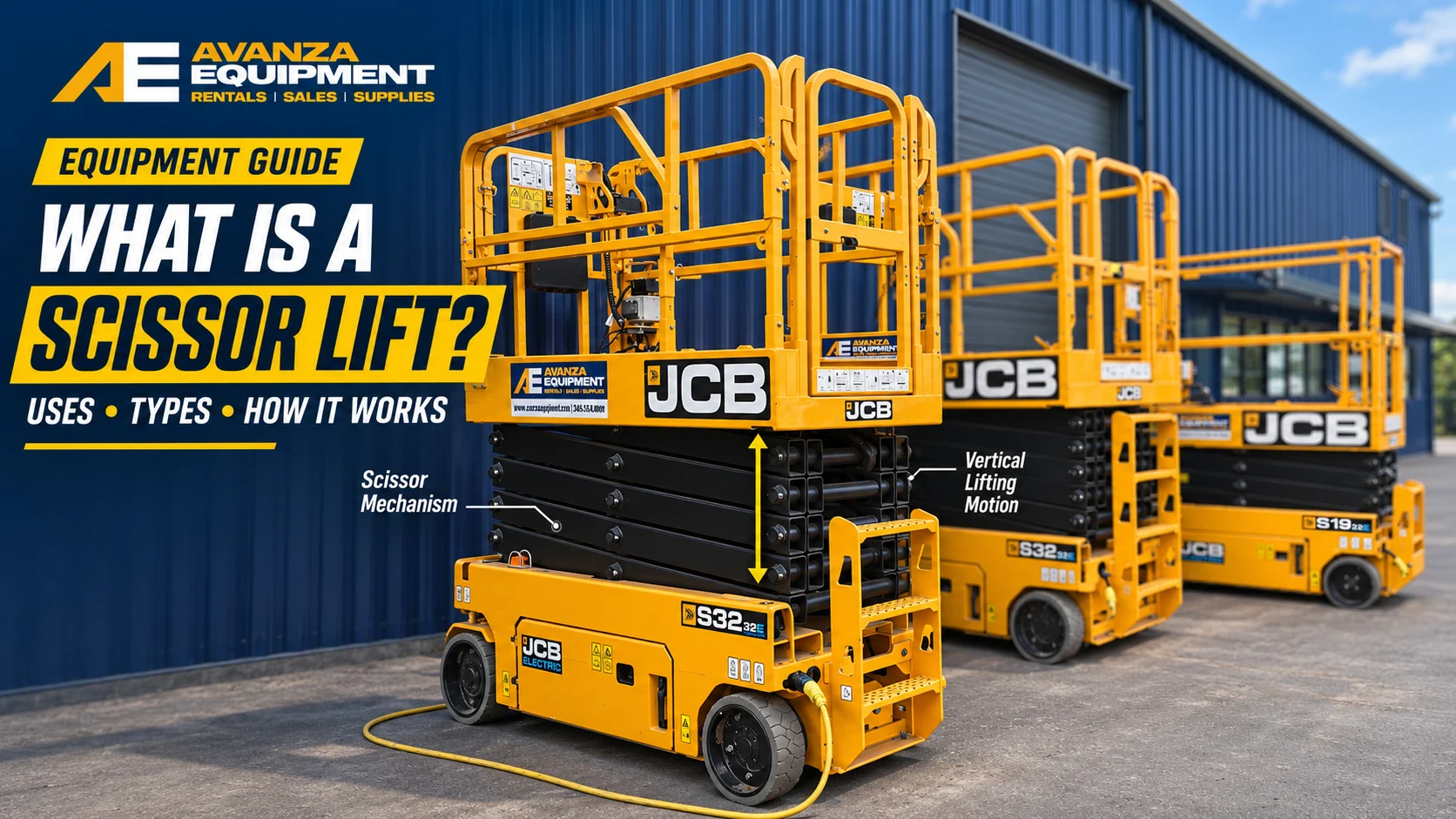
A Scissor Lift is an elevated work-platform machine designed primarily to raise workers, tools, and appropriate materials vertically. Its name comes from the crossed support arms beneath the platform, which open in a scissor-like pattern as the platform rises.
Scissor Lifts are commonly used for overhead maintenance, lighting, installation, construction, and facility work. They range from compact electric machines to larger rough-terrain models, and the right choice depends on required elevation, platform capacity, access, surface conditions, machine dimensions, and the work being performed.
What Is a Scissor Lift?
A Scissor Lift is a mobile or stationary elevated work platform built around a folding crossed-support mechanism.
The basic relationship is:
Scissor Lift → elevated work platform → primarily vertical movement → workers and tools at elevation
The platform typically includes guardrails and operator controls. Beneath it, a series of crossed arms expands upward when the lifting system is actuated.
In equipment-industry terminology, Scissor Lifts are frequently grouped with aerial work platforms (AWPs) and mobile elevating work platforms (MEWPs). ANSI/SAIA A92.20 covers certain mobile elevating work platforms designed to position personnel, tools, and materials at work locations.
However, equipment-industry terminology should not be confused with OSHA regulatory classification. OSHA states that Scissor Lifts are not treated as aerial lifts under the construction aerial-lift provision in §1926.453; they meet OSHA’s scaffold definition and are subject to applicable scaffold and mobile-scaffold requirements.
How Does a Scissor Lift Work?
The Scissor Lift gets its name from the crossed support arms beneath the platform.
At a conceptual level:
- The machine’s lifting system applies force to the scissor assembly.
- The crossed supports expand.
- As the supports open, they push the work platform upward.
- Reversing the lifting action closes the supports and lowers the platform.
Different machines can use different combinations of electric motors, hydraulic systems, cylinders, batteries, engines, and controls.
JLG, for example, describes modern powered Scissor Lifts as using hydraulic, electric-plus-hydraulic, or all-electric power-distribution approaches depending on the machine.
Main Scissor Lift Components
Common components include:
- Work platform: Carries authorized workers, tools, and materials within rated limits.
- Guardrails and platform gate: Help protect workers from falls.
- Scissor stack: Crossed support structure that raises and lowers the platform.
- Chassis: Base containing major machine systems.
- Lift system: Provides the force needed to extend the scissor mechanism.
- Drive and steering system: Allows movement on self-propelled models.
- Controls: Used to operate permitted machine functions.
- Power source: May include batteries, electric motors, internal-combustion engines, hydraulics, or combinations depending on model.
- Wheels or tires: Selected according to the machine’s intended environment and configuration.
The exact mechanism should always be verified from the specific machine’s manual rather than assumed from its general Scissor Lift classification.
What Is a Scissor Lift Used For?
A Scissor Lift is used when workers need primarily vertical elevated access and the machine can be positioned appropriately below or near the work.
Common applications include:
- Ceiling work
- Lighting installation and replacement
- Electrical work
- Mechanical installation
- Facility maintenance
- Warehouse maintenance
- Commercial-building maintenance
- Interior finishing
- Construction
- Retail-facility work
- Appropriate signage work
- Suitable exterior maintenance
OSHA notes that Scissor Lifts are used in industries including construction, retail, entertainment, and manufacturing.
The application alone does not determine the right machine.
A maintenance job inside a finished building creates different requirements from exterior construction on an unimproved surface. Access width, machine weight, rated capacity, required height, surface conditions, and power configuration all matter.
Main Types of Scissor Lifts
Scissor Lift categories can overlap.
For example, one machine may be both:
Electric + Compact + Slab-oriented
while another could be:
Electric + Rough Terrain
That is why power source, footprint, terrain capability, and lifting mechanism should not be treated as mutually exclusive classifications.
Electric Scissor Lifts
Electric Scissor Lifts use electric power for some or all machine functions, depending on the design.
They are common in current rental fleets and can be appropriate for many indoor and outdoor applications when the exact model is approved for those conditions.
Electric does not automatically mean:
- Indoor-only
- Non-marking tires
- A specific battery runtime
- A certain platform capacity
- A universal width
- Suitable for every floor or surface
For example, JLG’s ES1932 is an electric model with a published 19-ft platform height, 507-lb platform capacity, and 3,450-lb machine weight. Those specifications apply to that model—not all Electric Scissor Lifts.
Avanza Equipment has verified listings labeled:
- 19′ Scissor Lift – Electric
- 19′ Scissor Lift – Electric – Micro
- 26′ Scissor Lift – Electric
- 32′ Scissor Lift – Electric
Those listing labels should not automatically be interpreted as working heights, platform heights, capacities, or machine dimensions without model-level verification.
Compact and Micro Scissor Lifts
Compact and Micro Scissor Lifts are designed around a smaller physical footprint than many full-size machines.
They can be useful where crews must evaluate:
- Doorway clearance
- Narrow aisles
- Elevator access
- Restricted working space
- Machine turning area
- Floor-loading constraints
Skyjack’s Micro series shows how model specifications can differ even within one compact product family. Its SJ3213 Micro and SJ3219 Micro have different platform heights and machine weights despite sharing the same Micro family.
Do not assume that a machine labeled “Micro” will fit a particular doorway or elevator. Verify actual width, length, height, weight, and access-route limits.
Slab Scissor Lifts
“Slab” generally describes Scissor Lifts intended primarily for firm, relatively level surfaces.
Genie, for example, categorizes its GS slab Scissor Lifts for firm, level indoor or outdoor worksites.
Many slab machines in major rental fleets are electric, but “slab” is better understood as a surface/jobsite classification rather than a universal power-source definition.
Avanza’s supplied listings have not been independently verified as “Slab Scissor Lifts,” so that classification should not be applied to them automatically.
Rough Terrain Scissor Lifts
Rough Terrain Scissor Lifts are built for jobsite conditions requiring greater terrain capability than typical slab-oriented equipment.
Selection can depend on:
- Ground condition
- Tire configuration
- Drive system
- Machine stability
- Available positioning space
- Grade and surface condition
- Manufacturer operating limitations
Do not assume every Rough Terrain model is diesel, uses outriggers, has four-wheel drive, or uses the same tire configuration.
Genie’s GS-3369 RT, for example, is a diesel, four-wheel-drive Rough Terrain model weighing 7,599 lb with a 1,000-lb platform capacity. Those are specifications for that particular machine, not the category as a whole.
Genie also offers an electric-drive GS-3369 DC in its Rough Terrain range, demonstrating why Rough Terrain does not automatically mean diesel.
Diesel Scissor Lifts
Diesel Scissor Lifts use diesel engines as their power source.
They are found in larger and Rough Terrain equipment classes, particularly where the machine is designed for construction-oriented outdoor applications.
However, diesel alone does not define:
- Lift height
- Platform capacity
- Tire type
- Four-wheel-drive capability
- Outrigger configuration
- Terrain suitability
All of those remain model-specific.
Avanza has not supplied verified Diesel Scissor Lift inventory for this article.
What About Hydraulic and Pneumatic Scissor Lifts?
“Hydraulic” often describes how a lifting or machine function is actuated, rather than a rental-market class comparable with “Electric” or “Rough Terrain.”
Modern powered Scissor Lift designs may use hydraulic, electric-hydraulic, or all-electric systems.
“Pneumatic Scissor Lift” is also a valid term, but current manufacturer examples commonly apply it to industrial lift tables powered by shop air rather than self-propelled construction-access machines.
For that reason, Hydraulic and Pneumatic are not treated here as equivalent mainstream mobile-rental categories.
Scissor Lift Types Compared
| Type / Configuration | Typical Environment | Main Selection Factor | Important Limitation |
| Electric | Indoor or outdoor where model is approved | Power and work environment | Charging and model-specific limitations |
| Compact / Micro | Restricted-access areas | Machine footprint and access route | Reach and capacity vary by model |
| Slab | Firm, relatively level surfaces | Surface and maneuverability | Not intended as a universal rough-terrain solution |
| Rough Terrain | Construction-oriented or uneven jobsite conditions | Terrain capability | Larger footprint and weight may affect access and transport |
| Diesel | Often outdoor construction applications | Power configuration and jobsite | Exhaust, noise, size, and model requirements |
How to Choose the Right Scissor Lift
Start with the work requirement—not a model number.
Required Elevation
Determine where workers need to perform the task.
Then verify the machine’s actual:
- Platform height
- Working height
- Overall height
- Maximum approved operating height
Horizontal Reach
Scissor Lifts primarily raise the platform vertically.
If the platform must reach outward, over equipment, around a structure, or beyond an obstacle, compare a Boom Lift instead.
Platform Requirements
Determine:
- Number of workers
- Tools
- Materials
- Required platform space
- Rated platform capacity
Never estimate platform capacity from machine size alone.
Access Route
Measure:
- Doors
- Gates
- Aisles
- Corners
- Elevators where applicable
- Machine staging area
Then compare those dimensions with the exact machine.
Surface and Terrain
A firm finished floor, compact outdoor area, gravel surface, and uneven construction site create different equipment requirements.
The machine must be approved for the actual surface and operating conditions.
Platform Height vs. Working Height
These terms are not interchangeable.
Platform height generally describes how high the platform itself can be elevated.
Working height is a manufacturer- or supplier-defined figure intended to describe an approximate work level above the platform.
The relationship can vary by manufacturer and market.
Skyjack, for example, publishes separate platform height and work height figures for its Micro models.
Also distinguish those from:
Overall machine height → the physical height of the equipment.
A product listing labeled “19′,” “26′,” or “32′” should not automatically be interpreted as any one of these measurements.
Always verify the exact machine specifications before renting.
How Much Does a Scissor Lift Weigh?
There is no single answer to how much a Scissor Lift weighs.
Machine weight varies by:
- Model
- Height class
- Chassis
- Batteries or engine
- Terrain configuration
- Platform design
- Options and accessories
Current manufacturer examples illustrate the difference.
A Skyjack SJ3213 Micro is published at about 1,897 lb, while JLG’s ES1932 electric model weighs 3,450 lb. Genie’s GS-3369 RT Rough Terrain machine is substantially heavier at 7,599 lb.
Those are model examples, not generic weight ranges.
Machine Weight vs. Platform Capacity
These are completely different specifications.
Machine or operating weight
→ how much the Scissor Lift itself weighs.
Rated platform capacity
→ how much load the platform is designed to carry within manufacturer limits.
Workers, tools, and materials count toward rated platform loading.
JLG’s ES1932, for example, weighs 3,450 lb but has a rated platform capacity of 507 lb.
This distinction matters for both safe platform loading and building or floor planning.
How Much Does a Scissor Lift Cost?
Scissor Lift cost depends on the size, configuration, rental duration, geographic market, and availability.
As one current provider example:
| Published Rental Class | Daily | Weekly | Monthly |
| 19 ft Electric | $125 | $250 | $375 |
| 26 ft Electric | $160 | $360 | $515 |
| 32 ft Electric | $215 | $395 | $725 |
| 40 ft Electric | $250 | $550 | $1,150 |
These are provider-specific published rates, not national averages.
Avanza’s separate published examples include:
- 19′ Electric: $155/day, $375/week, $745/4 weeks
- 19′ Electric – Micro: $155/day, $375/week, $745/1 month
- 26′ Electric: $195/day, $495/week, $975/4 weeks
- 32′ Electric: $255/day, $625/week, $1,275/4 weeks
The distinction between 4 Weeks and 1 Month is intentional and should be preserved.
For detailed national research by machine size and rental duration, see Avanza’s dedicated Scissor Lift rental cost guide.
How to Operate a Scissor Lift Safely
Learning how to operate a Scissor Lift requires training on the actual machine.
At a high level, a trained and authorized operator should:
- Review the manufacturer’s instructions for the exact model.
- Complete the required pre-use inspection.
- Inspect the work area.
- Confirm that the surface and terrain are suitable.
- Verify rated platform capacity and loading.
- Check overhead, electrical, fall, and collision hazards.
- Confirm guardrails and gates are properly configured.
- Use platform and ground controls according to manufacturer instructions.
- Maintain safe positioning during travel, elevation, and lowering.
- Follow the machine-specific shutdown and parking procedure.
This overview is not a substitute for hands-on training, employer procedures, or the operator manual.
What Does OSHA Say About Scissor Lifts?
OSHA describes Scissor Lifts as mobile supported scaffold work platforms that move workers vertically using crossed beams. OSHA distinguishes them from aerial lifts for regulatory purposes.
For construction, applicable OSHA requirements include scaffold provisions such as §1926.451, mobile-scaffold requirements in §1926.452(w), and training requirements in §1926.454.
OSHA’s Scissor Lift guidance emphasizes:
- Worker training
- Guardrails
- Stable positioning
- Worksite hazard assessment
- Equipment maintenance
- Manufacturer instructions
- Electrical-hazard awareness
- Tip-over prevention
- Fall-hazard control
Industry terms such as MEWP and AWP are commonly used for equipment classification, but those terms do not replace the applicable OSHA regulatory requirements.
For additional safety information, review the official OSHA Scissor Lift guidance.
Scissor Lift vs. Boom Lift
The simplest distinction is reach direction.
Scissor Lift
→ primarily raises workers vertically.
Boom Lift
→ provides vertical elevation plus substantial horizontal or outward reach depending on the machine.
If work is directly above a suitable positioning area, a Scissor Lift may fit.
If the platform must reach over machinery, roofs, walls, landscaping, or another obstacle, compare a Boom Lift.
See Avanza’s dedicated boom lift vs. scissor lift guide for a more detailed equipment comparison.
Should You Rent or Buy a Scissor Lift?
Rental may make sense when:
- Equipment is needed for a specific project.
- Usage is intermittent.
- Different projects require different height or machine classes.
- The business does not want to maintain and store an occasionally used machine.
Buying may make sense when utilization is frequent enough to justify ownership, maintenance, storage, charging or fueling, transport, inspections, and capital cost.
Neither option is automatically less expensive.
Scissor Lift Selection Checklist
Before choosing a machine, confirm:
- Required platform height
- Required working height
- Need for horizontal reach
- Number of workers
- Tools and materials
- Rated platform capacity
- Platform dimensions
- Work area
- Doorway clearance
- Aisle width
- Access route
- Elevator limitations where relevant
- Overall machine dimensions
- Machine weight
- Floor or surface suitability
- Indoor or outdoor use
- Terrain
- Power configuration
- Rental duration
- Current availability
Frequently Asked Questions
What does OSHA say about Scissor Lifts?
OSHA treats Scissor Lifts as mobile supported scaffold work platforms rather than aerial lifts under the construction aerial-lift rule. Employers must address applicable scaffold requirements, training, guardrails, stability, positioning, equipment condition, manufacturer instructions, and workplace hazards.
Can I use a Scissor Lift in my house?
Possibly, but never assume a residential building can accommodate one. Check doorway and access dimensions, machine weight, floor-loading suitability, ceiling height, electrical hazards, ventilation, surface conditions, and manufacturer-approved use. Structural suitability should be verified for the specific building and machine.
What is a Scissor Lift used for?
Scissor Lifts provide primarily vertical elevated access for tasks such as ceiling work, lighting, electrical installation, construction, facility maintenance, warehouse maintenance, and other overhead work where the machine and surface are appropriate.
What brand Scissor Lift is best?
There is no universally best brand. Established manufacturers include JLG, Genie, Skyjack, Snorkel, and others. Compare exact models by required height, platform capacity, dimensions, weight, terrain capability, power configuration, service support, parts availability, and rental availability rather than choosing by brand alone.
How high can a Scissor Lift go?
Height varies substantially by model. Compare the manufacturer’s published platform height and working-height information with the actual work requirement rather than choosing equipment from a category name alone.
How much weight can a Scissor Lift hold?
Rated platform capacity is model-specific. Workers, tools, and materials all contribute to platform loading. Check the exact machine’s data plate and manufacturer documentation rather than relying on a generic capacity range.
What is a Micro Scissor Lift?
A Micro Scissor Lift is a compact Scissor Lift designed around a smaller machine footprint. The term does not define one universal height, weight, width, or capacity. Verify the exact model’s dimensions, access requirements, rated capacity, and working-height information.
Can Scissor Lifts be used outdoors?
Some can. Outdoor suitability depends on the model, surface, terrain, environmental conditions, and manufacturer limitations. Electric does not automatically mean indoor-only, and Rough Terrain does not automatically mean one particular power configuration.
Check Scissor Lift Rental Options
Avanza Equipment has published rental listings for:
- 19′ Electric Scissor Lift
- 19′ Electric Scissor Lift – Micro
- 26′ Electric Scissor Lift
- 32′ Electric Scissor Lift
Avanza Equipment is based in Houston, Texas, so these listings should not be interpreted as nationwide inventory.
For a project-specific rental, Check Availability, Get Rental Pricing, or Contact Avanza Equipment with your required elevation, access restrictions, surface conditions, rental dates, and work requirements.