


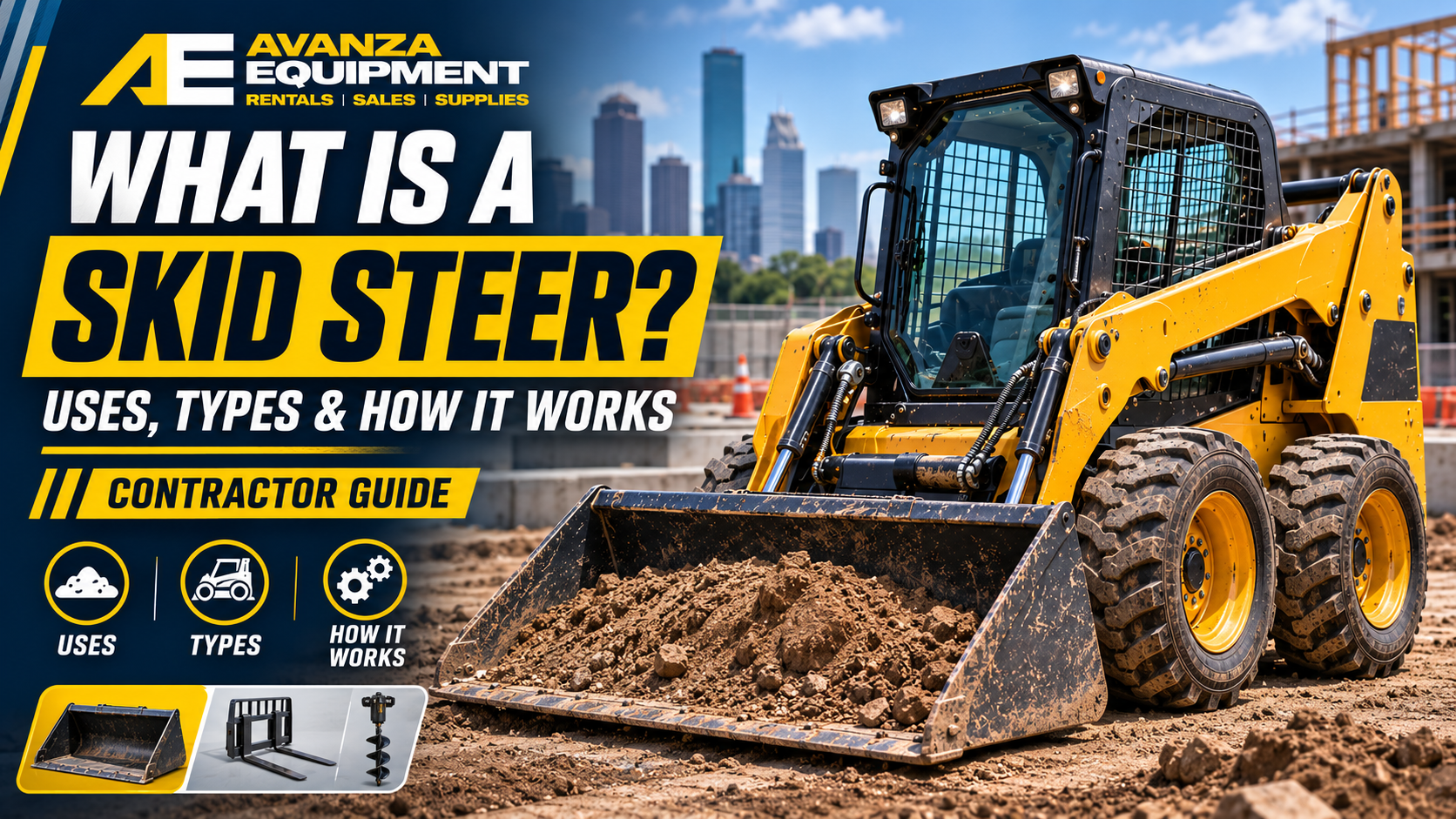
A skid steer is a compact, typically four-wheeled construction loader that turns by driving its left and right wheels at different speeds. Its hydraulic lift arms and interchangeable attachments allow it to handle grading, loading, digging support, material handling, and site preparation.
Unlike larger construction loaders, a skid steer can maneuver within confined work areas and turn with very little space. Contractors, landscapers, agricultural workers, and property maintenance crews use these machines for tasks that require both mobility and material-handling capability.
Understanding how skid steers work, their lift configurations, hydraulic systems, and operating limitations helps determine whether one is suitable for a particular job.
What Is a Skid Steer Loader?
A skid steer loader is a type of compact construction equipment designed primarily for loading, moving materials, and performing attachment-based tasks.
A typical skid steer includes four rubber tires, an enclosed or partially enclosed operator compartment, hydraulic loader arms, and a front-mounted bucket or other attachment.
Its defining feature is the steering system. Instead of turning through a conventional steering axle, the machine changes direction by controlling the wheels on opposite sides independently.
This allows operators to work in tight areas where larger loaders may struggle to maneuver.
Skid steers are commonly used in construction, landscaping, agriculture, demolition support, and property maintenance.
Although a skid steer belongs to the broader loader category, it differs from a conventional wheel loader. Many larger wheel loaders use articulated steering, where the machine’s front and rear sections pivot relative to each other. Skid steers instead turn by varying the movement of their left and right wheels.
How Does a Skid Steer Work?
A skid steer works by using a powered drive system to move the wheels on each side independently, while hydraulic cylinders operate its loader arms and attachments. Different wheel speeds create the steering action, and hydraulic pressure provides the force needed for lifting and material handling.
On a typical engine-powered skid steer, the operating process involves six basic functions:
- Power generation: A diesel or gasoline engine supplies power to the machine’s drive and hydraulic systems. Some newer machines use electric power.
- Wheel movement: A drive system, commonly using hydrostatic transmission technology, controls movement on the left and right sides.
- Steering: When the wheels on one side travel faster or in a different direction than those on the other side, the machine turns.
- Loader arm operation: Hydraulic cylinders raise and lower the loader arms and control bucket positioning.
- Operator controls: Joysticks, hand controls, or foot controls manage travel, lifting, and attachment functions, depending on the model.
- Attachment operation: Auxiliary hydraulic circuits supply power to compatible hydraulic attachments.
When the wheels on opposite sides rotate in opposite directions, the loader can make a near-zero-radius pivot turn. This is especially useful when repositioning in confined work areas.
The exact transmission, control layout, and hydraulic arrangement vary between manufacturers and models.
Why Is It Called a Skid Steer?
The term skid steer describes how the machine changes direction.
Because the wheels generally remain aligned with the machine’s body, they do not pivot sideways like conventional steering wheels. Instead, the tires skid or scrub across the ground as the two sides move at different speeds.
This steering method gives the machine its distinctive turning ability.
How Does the Hydraulic System Work?
The skid steer hydraulic system converts mechanical or electrical power into controlled hydraulic force.
Hydraulic pumps move pressurized fluid through the system. That fluid operates hydraulic cylinders responsible for raising the loader arms and tilting the bucket.
The same hydraulic system can also supply auxiliary hydraulic flow to attachments such as augers, trenchers, and brush cutters.
For example, a hydraulic auger uses fluid power to rotate its drilling mechanism, while a loader bucket primarily relies on hydraulic cylinders for lifting and positioning.
Hydraulic attachments must match the machine’s available flow, operating pressure, and connection requirements. Standard-flow and high-flow systems support different attachment demands.
What Is a Skid Steer Used For?
Skid steers are used for moving materials, preparing surfaces, loading trucks, supporting excavation work, landscaping, and maintaining properties.
The answer to what a skid steer loader is used for depends on the attachment installed, the machine’s operating capacity, and the conditions where it will work.
Construction and Site Preparation
Construction crews commonly use skid steers to move soil, spread aggregate, grade surfaces, backfill excavations, and remove loose construction debris.
For example, a loader bucket can move gravel from a stockpile to a prepared work area before final leveling.
Landscaping and Ground Preparation
Landscapers use skid steers to distribute topsoil, move mulch, prepare planting areas, and support grading work.
Compatible brush cutters and grapples can also assist with vegetation management and debris handling.
Material Handling
With suitable pallet forks, a skid steer can transport palletized construction materials within its approved capacity.
Buckets are useful for loading loose materials, while grapple attachments help handle irregular debris.
Agricultural Applications
On suitable agricultural properties, skid steers can assist with moving feed, handling bulk materials, cleaning work areas, and maintaining access routes.
Attachment selection and surface conditions determine which agricultural tasks are appropriate.
Property Maintenance
Property maintenance crews use skid steers for debris removal, surface preparation, sweeping, and seasonal cleanup.
The machine can support several activities, but it does not replace specialized excavation, lifting, or demolition machinery in every situation.
Types of Skid Steers: Radial Lift vs. Vertical Lift
Skid steer loaders are commonly classified by their loader-arm lift paths: radial lift and vertical lift.
These configurations influence how an attachment moves as it rises and where it provides useful forward reach.
Radial Lift Skid Steers
A radial lift skid steer moves its loader arms through a curved arc.
This configuration is often useful for digging support, grading, backfilling, and material handling at lower or intermediate heights.
Depending on the machine, radial lift can provide useful forward reach around truck-bed height.
Vertical Lift Skid Steers
A vertical lift skid steer uses a linkage system that moves the attachment along a more nearly vertical path.
This configuration is often preferred for placing pallets, loading higher-sided trucks, and handling materials at greater lift heights.
Vertical lift designs can provide advantageous reach near maximum lift height.
Radial Lift vs. Vertical Lift Comparison
| Feature | Radial Lift | Vertical Lift |
| Lift path | Curved arc | More nearly vertical |
| Common uses | Grading, digging support, backfilling | Truck loading, pallet placement |
| Forward reach | Often useful at intermediate heights | Often advantageous near full lift |
| Selection priority | Lower-level work and reach | Higher loading and placement |
| Key consideration | Reach throughout the lift arc | Lift height, reach, and capacity |
Neither configuration is universally better.
A radial-lift loader may fit a grading project, while a vertical-lift loader may better accommodate frequent high-sided truck loading. Compare the actual lift height, dump clearance, forward reach, and rated operating capacity of the models involved.
Common Skid Steer Attachments and Their Uses
One major advantage of a skid steer is its ability to work with interchangeable attachments.
Many machines use a quick-attach coupler that allows compatible tools to be mounted and secured using an attachment locking system.
Common skid steer attachments include:
| Attachment | Typical Use |
| General-purpose bucket | Moving soil, gravel, sand, and loose debris |
| Pallet forks | Handling suitable palletized materials |
| Auger | Drilling holes for posts, fencing, and foundations |
| Trencher | Cutting narrow trenches for suitable utility or irrigation work |
| Grapple bucket | Handling branches, demolition debris, and irregular materials |
| Brush cutter | Cutting vegetation and maintaining overgrown areas |
| Hydraulic breaker | Breaking suitable concrete and other hard materials |
| Sweeper | Cleaning paved surfaces and work areas |
Attachment compatibility involves more than fitting the mounting plate.
Hydraulically powered attachments require appropriate auxiliary hydraulic flow and pressure. Their weight, operating characteristics, control requirements, and any additional hydraulic connections must also match the loader.
Always verify approved machine-and-attachment combinations using manufacturer documentation.
Read Also: Skid steer rental cost guide
What Is a Case Drain on a Skid Steer?
A case drain is a hydraulic connection that carries internal leakage oil from certain hydraulic motor housings back toward the hydraulic reservoir through a suitable low-pressure path. It helps control pressure inside the motor housing and protects components such as shaft seals from excessive case pressure.
This connection is particularly relevant when using some hydraulically powered attachments.
Why Do Hydraulic Attachments Need a Case Drain?
Hydraulic motors have internal clearances that allow small amounts of fluid to move into the motor housing.
On motors designed for a separate case drain, that fluid must leave through a designated drainage connection.
Without the correct drainage path, excessive pressure can develop inside the housing, potentially damaging seals or other motor components.
A hydraulic motor may therefore have three distinct connections:
- Pressure line: Supplies working hydraulic fluid to drive the motor.
- Return line: Carries the main working fluid back through the designated hydraulic return circuit.
- Case drain line: Carries internal leakage fluid through a specified low-pressure drainage path.
Example: A Hydraulic Mulcher
Certain skid steer mulchers use hydraulic motors that require a dedicated case-drain connection.
For these attachments, a blocked, improperly connected, or excessively restricted drain can create damaging case pressure.
However, not every hydraulic attachment requires a separate case drain. Some motor and attachment designs use different internal drainage arrangements.
Before installing a hydraulic mulcher or another powered attachment, consult the manufacturer’s operating manual and confirm the required connections, hydraulic flow, pressure, and allowable backpressure.
Never assume that matching hose fittings establish proper hydraulic compatibility.
Skid Steer vs. Compact Track Loader: What’s the Difference?
The primary difference between a skid steer and a compact track loader is the undercarriage.
A skid steer typically travels on four rubber tires, while a compact track loader (CTL)uses continuous tracks.
Both machines can perform loading, grading, material handling, and other attachment-based tasks. However, the undercarriage affects traction, ground pressure, mobility, and maintenance.
| Feature | Wheeled Skid Steer | Compact Track Loader |
| Undercarriage | Rubber tires | Rubber tracks |
| Ground pressure | Generally higher | Generally lower |
| Firm surfaces | Often well suited | Also capable |
| Soft ground | More likely to lose traction | Often better flotation and traction |
| Surface disturbance | Tire scrubbing during turns | Track scuffing during turns |
| Maintenance | Tire inspection, wear, and repairs | Tracks, rollers, idlers, and undercarriage |
| Common applications | Paved-site work, loading, cleanup | Soft-ground grading, landscaping, earthmoving |
Compact track loaders generally distribute their weight across a larger contact area. This can reduce ground pressure and improve flotation on softer soil.
However, lower ground pressure does not make a track loader immune to sinking, rutting, sliding, or tipping. Track loaders can also damage turf during aggressive turns.
A wheeled skid steer may be a practical choice for work dominated by pavement or compacted surfaces, while a compact track loader may be preferable when softer ground affects traction.
The correct choice depends on soil bearing capacity, slopes, material weight, surface protection requirements, and individual machine specifications.
Read Also: Track loader vs. skid steer comparison
Advantages and Limitations of Skid Steer Loaders
Skid steers combine compact dimensions with useful material-handling capabilities.
Advantages
- Compact design: Useful where access and maneuvering space are limited.
- Tight turning ability: Helps reposition the machine within confined work areas.
- Attachment versatility: Allows one compatible machine to support different tasks.
- Material handling: Useful for transporting loose material and approved palletized loads.
- Firm-ground performance: Wheeled models are often practical on paved and compacted surfaces.
Limitations
- Ground disturbance: Skid steering can scuff pavement, disturb soil, and damage turf.
- Tire wear: Frequent sharp turning and abrasive surfaces increase tire wear.
- Soft-ground performance: Tires may lose traction or sink in saturated conditions.
- Capacity restrictions: Loads must remain within manufacturer-approved operating limits.
- Hydraulic limitations: Not every machine can power every attachment.
- Visibility restrictions: Loader arms, attachments, and carried loads can create blind spots.
These limitations should be considered before choosing a skid steer for a project.
How to Choose the Right Skid Steer
Choosing a skid steer starts with the materials being handled, the work area, and the required attachments.
1. Rated Operating Capacity and Tipping Load
Rated operating capacity (ROC) is a manufacturer-established working load rating under specified conditions.
Tipping load is the load associated with reaching a defined forward tipping threshold during standardized testing.
For many wheeled skid steers, ROC is established at approximately 50% of the rated tipping load under the applicable test method.
However, these figures are not interchangeable, and neither authorizes an operator to exceed manufacturer limits. Attachment weight, load position, machine configuration, and operating conditions must be considered.
2. Machine Weight and Dimensions
Operating weight affects transportation planning and ground loading.
Measure entry widths, access routes, overhead clearances, and available turning space. Confirm the machine’s dimensions with the intended attachment installed.
3. Lift Height and Dump Clearance
Compare the loader’s maximum lift height, dump height, and forward reach with the truck, container, or placement location.
A machine that can lift a load may still lack the necessary clearance to position it correctly.
4. Hydraulic Capabilities
Check whether the machine offers standard-flow or high-flow auxiliary hydraulics and whether its pressure, flow, and electrical controls match the intended attachment.
5. Terrain and Transportation
Evaluate soil conditions, slopes, surface sensitivity, and travel routes.
For transportation, verify the combined weight and dimensions of the loader, attachments, and any other equipment against the towing vehicle and trailer ratings.
Buyers should also consider maintenance requirements, expected utilization, and total ownership costs. Rental customers should focus on matching verified machine specifications to the project and expected duration.
Skid Steer Safety and Operator Training Basics
Skid steer loaders require proper operator instruction and adherence to manufacturer operating procedures.
Their compact dimensions do not eliminate hazards associated with moving machinery, hydraulic lift arms, elevated loads, or unstable ground.
Important safety practices include:
- Obtain appropriate operator training and demonstrate competence before operating the equipment.
- Review the manufacturer’s operating manual and approved attachment instructions.
- Inspect tires, hydraulics, controls, safety systems, and attachment connections before use.
- Use the required seat belt, restraint system, and interlocked safety controls.
- Keep rollover protective structures (ROPS) and applicable falling-object protective structures (FOPS) properly maintained.
- Use designated entry and exit procedures, and never enter beneath unsupported raised lift arms.
- Keep travel loads appropriately low and within the machine’s operating limits.
- Maintain safe clearance from bystanders, structures, overhead hazards, and unstable ground.
- Follow manufacturer requirements for parking, shutdown, inspection, and maintenance.
The National Institute for Occupational Safety and Health (NIOSH) specifically emphasizes operator restraints, functioning safety devices, stable surfaces, and keeping workers clear during lifting operations.
A written guide can explain equipment fundamentals, but it cannot replace machine-specific training or practical qualification.
Frequently Asked Questions About Skid Steers
Why do they call it a skid steer?
It is called a skid steer because the machine turns by varying the speed or direction of its left and right wheels. The tires skid across the ground during turning instead of pivoting through a conventional steering mechanism.
This allows the loader to make very tight turns.
Can you drive a skid steer without a license?
In the United States, operating a skid steer on a private jobsite generally does not require a standard driver’s license or a universal federal heavy-equipment operator license solely because the machine is a skid steer.
However, that does not mean an untrained person can operate one safely or that employers have no training obligations.
OSHA explains that skid steers used primarily for earthmoving in construction are not subject to its powered-industrial-truck operator training rule under 29 CFR 1910.178(l). Nevertheless, employers must provide appropriate hazard training under 29 CFR 1926.21(b)(2) and allow only workers qualified by training or experience to operate equipment under 29 CFR 1926.20(b)(4).
Jobsite policies, rental agreements, state and local requirements, and specific equipment applications may impose additional conditions.
Driving machinery on public roads may also involve separate vehicle registration, licensing, and transportation rules.
What is the difference between a skid steer and a Bobcat?
A skid steer is a category of compact construction machinery, while Bobcat is an equipment manufacturer and brand.
Bobcat manufactures skid steer loaders, but companies including Caterpillar, CASE Construction Equipment, John Deere, New Holland, and Kubota also produce compact loader equipment.
Therefore, not every skid steer is a Bobcat, although the brand name is sometimes used informally when referring to compact loaders.
Is a skid steer the same as a loader?
A skid steer is a specific type of loader, but not every loader is a skid steer.
The broader loader category includes wheel loaders, compact track loaders, and other material-handling machines.
Skid steers are distinguished by their compact design, typically four-wheeled undercarriage, and skid-steering mechanism.
Larger conventional wheel loaders generally use different steering arrangements and are designed for different operating scales.
Finding the Right Equipment for Your Project
A skid steer can be a practical choice when a project involves material movement, grading, site preparation, or attachment-based work within a limited operating area.
The most effective equipment selection starts with the job requirements—not simply the machine category.
Compare operating capacity, hydraulic compatibility, lift configuration, access restrictions, and ground conditions before renting or purchasing.
If you’re planning an equipment rental, explore Avanza Equipment’s construction equipment rental options and contact the team to discuss suitable machinery and current availability.