


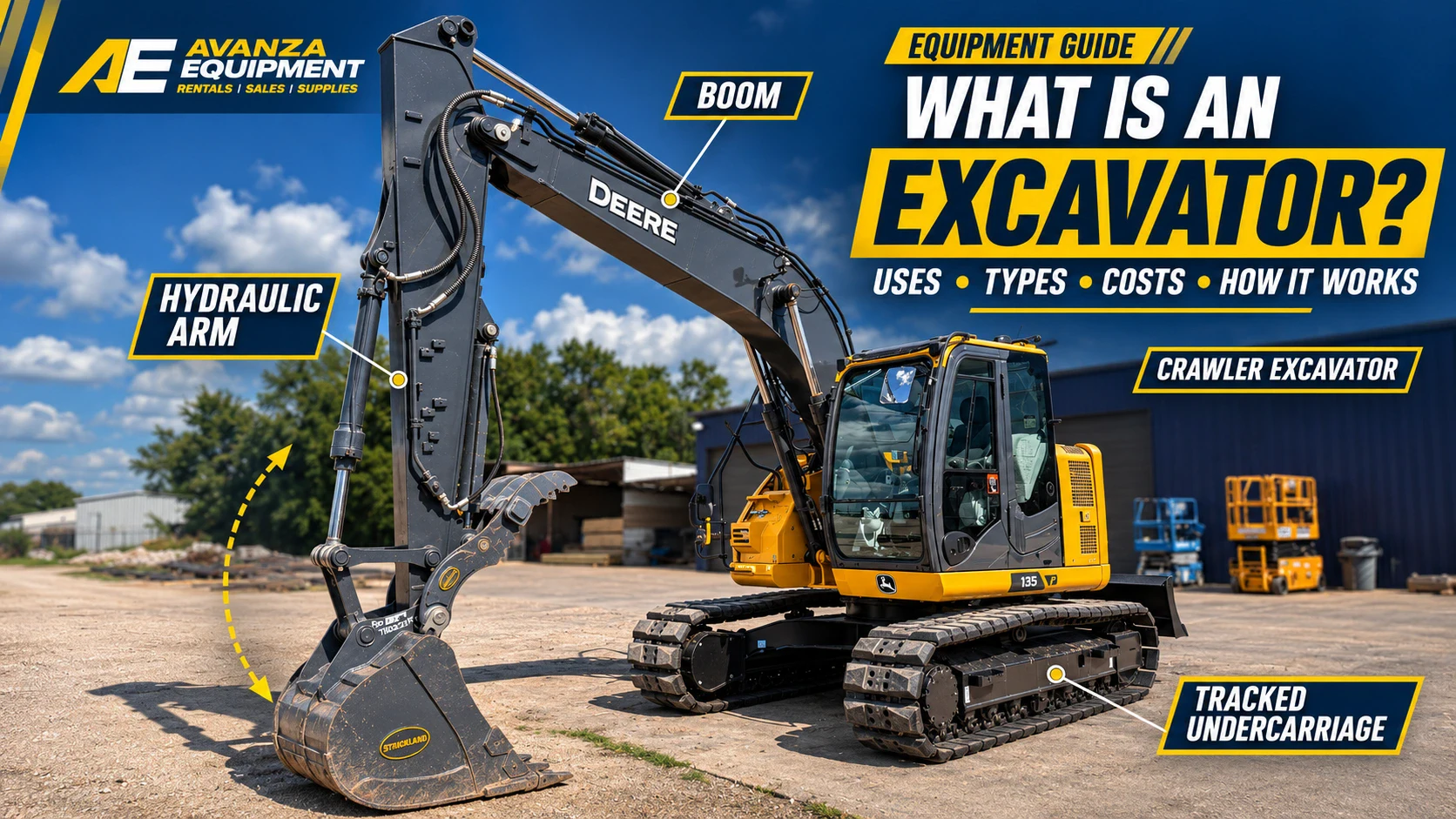
An excavator is heavy construction equipment that uses a boom, stick, and bucket or compatible attachment to dig, move, and handle material. Most modern construction excavators use hydraulic systems to control the front linkage, travel functions, and rotation of the upper structure relative to the undercarriage.
Excavators are used for trenching, foundations, earthmoving, site preparation, material handling, demolition, landscaping, and utility work. They range from compact mini excavators for restricted sites to large machines built for high-volume excavation.
What Is an Excavator?
An excavator consists of a mobile undercarriage, a rotating upper structure—often called the house—and front linkage used to position a bucket or other attachment.
The main front components are:
- Boom: The first large structural section extending from the upper structure.
- Stick or dipper arm: Connects the boom to the bucket or attachment.
- Bucket: Digs, scoops, and carries material.
- Upper structure: Contains the operator station and major power and hydraulic components, depending on machine design.
- Undercarriage: Supports and moves the machine using tracks or wheels.
- Counterweight: Helps balance forces created by the boom, attachment, and load.
Unlike a skid-steer loader, an excavator is built around a dedicated digging linkage and rotating upper structure. Unlike a backhoe loader, a conventional excavator does not combine a front loader bucket and rear digging boom on a tractor-style chassis.
What Does Excavating Mean?
To excavate means to dig out, remove, or displace earth or other material from a location.
In construction, excavation can include:
- Removing soil for a building foundation
- Cutting a utility trench
- Digging drainage structures
- Removing unsuitable material from a site
OSHA formally defines an excavation as a man-made cut, cavity, trench, or depression in the earth’s surface formed by earth removal.
How Does an Excavator Work?
Most conventional excavators rely heavily on hydraulics.
The basic process is:
- An engine or electric power system drives one or more hydraulic pumps.
- The pumps move hydraulic fluid through the system.
- Control valves direct that flow to the required actuator.
- Hydraulic cylinders extend or retract to move the boom, stick, and bucket.
- Hydraulic motors provide rotary movement for functions such as house swing and machine travel.
- Auxiliary hydraulic circuits can power compatible attachments.
A hydraulic pump primarily produces flow. Pressure develops as the hydraulic system encounters resistance, and control valves regulate where the fluid travels.
Caterpillar documentation shows this relationship clearly: excavators use hydraulic pumps, main control valves, cylinders, swing motors, travel systems, and auxiliary hydraulic circuits to perform different machine functions. Exact hydraulic architecture varies by model.
Main Parts of an Excavator
The machine can be understood as three major assemblies.
Undercarriage
The undercarriage supports the machine and handles travel. Crawler excavators use tracks, while wheeled excavators use tires and a different chassis configuration.
Tracked machines can provide useful mobility and ground contact on many construction sites, but track type alone does not guarantee suitability for soft soil, finished surfaces, slopes, or every terrain condition.
Upper Structure
The upper structure contains the cab, counterweight, power system, hydraulic equipment, and swing system on a typical excavator.
A swing motor drives rotation of the upper structure relative to the undercarriage.
Front Linkage
The boom, stick, bucket linkage, and attachment form the working end of the excavator.
Hydraulic cylinders position these components to dig, lift, place, grade, or manipulate material.
What Is an Excavator Used For?
Excavators are versatile because the digging linkage can perform different movements and compatible attachments can change what the machine does.
Trenching and Utility Installation
Excavators are commonly used to dig trenches for suitable:
- Drainage systems
- Water lines
- Sewer work
- Utility installations
- Pipeline projects
The required trench depth, width, soil conditions, and available working area influence machine selection.
Foundation and Basement Excavation
Excavators can remove soil for footings, foundations, basements, retaining structures, and other construction work.
Machine selection should consider not just excavation depth but also spoil placement, reach, access, nearby structures, and the volume of material being moved.
Site Preparation and Earthmoving
Excavators can strip material, reshape areas, load trucks, move soil, and prepare areas for later construction stages.
They are not automatically a substitute for dozers, loaders, graders, or proper compaction equipment. Each machine category solves a different part of site development.
Demolition
With compatible attachments, excavators can support demolition work.
Examples include:
- Hydraulic breakers
- Grapples
- Pulverizers
- Shears on suitable machines
Attachment compatibility and machine guarding must be verified for the actual demolition application.
Material Handling and Loading
Buckets, grapples, and thumbs allow excavators to handle soil, aggregate, demolition debris, logs, pipe, and other suitable materials.
Lift capacity changes with machine configuration, load position, attachment weight, and operating radius. Do not treat an excavator’s operating weight as its lifting capacity.
Landscaping and Land Clearing
Mini and standard excavators are often used for:
- Drainage work
- Tree and shrub removal
- Landscape renovation
- Pond work
- Grading preparation
- Stump and root work
- General property improvement
Specialized Applications
Long-reach excavators can be configured for projects requiring greater reach. Specialized machines are also used for dredging, demolition, material handling, and infrastructure work.
Vacuum or suction excavation is a separate method that removes material using air or water combined with suction rather than a conventional boom-stick-bucket digging cycle.
Different Types of Excavators
| Excavator Type | Main Characteristics | Common Applications | Main Considerations |
| Mini / Compact | Small footprint and lower operating weight | Utilities, landscaping, residential work | Access, reach, attachment capability |
| Crawler | Tracked undercarriage | General excavation, foundations, earthmoving | Transport, ground conditions, machine size |
| Wheeled | Rubber-tired chassis | Urban or developed work areas | Ground conditions, mobility, local road requirements |
| Long-Reach | Extended boom/stick configuration | Dredging, slope work, specialized excavation | Stability and working envelope |
| Demolition | Purpose-built or configured for demolition | Structural demolition | Guarding, attachment compatibility, reach |
| Specialized | Dragline, walking, electric, hybrid and other designs | Application-specific work | Highly model- and project-dependent |
Mini Excavators
A mini excavator, also called a compact excavator, is a smaller hydraulic excavator designed for suitable lower-volume or access-restricted work.
Common uses include:
- Residential drainage
- Utility trenches
- Landscaping
- Small foundations
- Property maintenance
Compact excavators may use conventional, reduced, or zero-tail-swing configurations depending on the model.
“Zero tail swing” does not mean the entire machine remains inside the track footprint in every position. Always check the manufacturer’s exact dimensional specifications.
Bobcat currently organizes its compact excavators into weight classes from approximately 1–2 metric tons through 9–10 metric tons, demonstrating that even the term “compact excavator” covers a broad range of machine sizes.
Crawler Excavators
Crawler excavators use tracks and are common across general construction, earthmoving, utility, and site-preparation work.
Their operating weight can range from compact machines to extremely large excavators.
Wheeled Excavators
Wheeled excavators replace the tracked undercarriage with a wheeled chassis.
They can offer useful mobility on suitable developed surfaces, but their travel, transport, and public-road requirements depend on the machine and jurisdiction.
Long-Reach and Demolition Excavators
These machines use specialized boom, stick, counterweight, guarding, or attachment configurations.
A standard excavator should not automatically be treated as a long-reach or high-reach demolition machine simply because an extended attachment can physically be installed.
Excavator Types and Sizes Explained
There is no single universal industry classification for mini, small, medium, and large excavators.
Manufacturers organize their equipment differently.
For example, Caterpillar currently describes its Mini Excavator range as extending from under 1 metric ton to approximately 10 metric tons, while its Medium Excavator category covers roughly 20–35 metric tons. Cat identifies large excavators separately.
John Deere uses its own Compact, Mid-Size, and Large categories. Its current guide lists Compact models around 3,800–13,500 lb, Mid-Size models from approximately 16,500–90,000 lb, and Large models from approximately 103,500–188,750 lb. These are John Deere classifications, not universal industry thresholds.
What Is a Mini Excavator?
The practical advantage of a mini excavator is not simply lower weight.
A compact machine may offer:
- Smaller transport dimensions
- Easier access to restricted areas
- Reduced tail-swing options
- Lower ground loading than some larger equipment
- Attachment versatility
But a mini excavator still needs enough digging depth, reach, hydraulic capability, lifting capacity, and stability for the actual project.
For example, Bobcat’s current E55 specification lists an operating weight of 11,357 lb, 11.4-ft digging depth, and 19.4-ft ground-level reach. Those figures belong specifically to the E55 and demonstrate why operating weight, dig depth, and reach should be checked separately.
How Deep Can an Excavator Dig?
An excavator’s digging capability is defined by several different measurements.
Maximum digging depth
The deepest position the bucket can reach in a specified machine and attachment configuration.
Ground-level reach
How far the linkage can reach horizontally near ground level.
Dump height
The maximum published height at which the bucket can discharge material under the specified configuration.
Operating weight
The machine’s weight under the manufacturer’s defined operating configuration.
Bucket capacity
The volume the specified bucket is designed to hold.
Lift capacity
How much the machine can lift at defined positions, orientations, and configurations.
Maximum digging depth does not mean the machine can reach that depth at every horizontal distance.
Manufacturers publish working-range diagrams because the boom and stick move through an arc.
Example: Drainage Trench Beside a Building
Suppose a contractor needs to excavate a drainage trench beside a commercial building.
The machine must meet the required trench depth, but the contractor should also ask:
- How far must the excavator sit from the trench?
- Can the bucket reach the required depth from that setup position?
- Is there enough access width?
- Will the counterweight clear the building during swing?
- Can the ground support the machine?
- Where will excavated material be placed?
A machine with sufficient maximum digging depth can still be unsuitable if it lacks reach or setup clearance.
Common Excavator Attachments and Their Uses
| Attachment | Typical Purpose |
| Digging / trenching bucket | Excavation and trench work |
| Grading bucket | Cleanup, shaping and finish work |
| Hydraulic breaker | Breaking concrete or suitable rock |
| Auger | Drilling holes |
| Grapple | Handling debris or material |
| Hydraulic thumb | Gripping material against the bucket |
| Ripper | Loosening compacted or difficult material |
| Mulching attachment | Suitable vegetation-processing applications |
Attachment compatibility depends on:
- Excavator operating class
- Coupler system
- Attachment weight
- Hydraulic flow
- Hydraulic pressure
- Auxiliary circuit configuration
- Machine stability
- Manufacturer approval
Cat and Bobcat both offer multiple attachment families for excavators, but not every tool is compatible with every machine.
Mini Excavator vs. Standard Excavator
A mini excavator is usually selected when access and maneuverability matter more than moving the largest possible volume of material.
Residential Drainage Work
A contractor needs to dig a backyard drainage trench through a restricted side access.
A compact excavator may be the logical starting point because machine width, tail swing, and transport requirements could determine whether the equipment can physically reach the work.
The contractor still needs to verify digging depth and reach.
Houston-area readers comparing compact equipment can review Avanza’s mini excavator rental options.
Commercial Site Excavation
A contractor removing larger volumes of soil from an open commercial site may consider a heavier excavator with greater bucket capacity, reach, and production capability.
That does not mean the largest machine is automatically the most economical choice. Transportation, fuel, truck loading, available space, ground conditions, and project volume all affect productivity and cost.
How Much Does an Excavator Cost?
The excavator price depends heavily on machine size, configuration, attachments, manufacturer, condition, and whether the equipment is purchased or rented.
New Excavator Prices
Current published pricing illustrates the scale of the market.
Bobcat currently publishes suggested prices of approximately:
- E48 compact excavator: $77,377
- E55: $85,176
- E60: $94,376
- E88 Long-Arm: $141,406
These are current manufacturer-published suggested prices, not guaranteed transaction prices.
For a larger machine, current dealer listings for 2026 John Deere 210 P-Tier excavators include asking prices around 245,000–256,537 depending on configuration. These are dealer asking prices, not a national average. Listings were checked November 23, 2026.
Used Excavator Prices
Used pricing depends on:
- Age
- Operating hours
- Service history
- Undercarriage condition
- Hydraulic condition
- Attachments and couplers
- Machine configuration
- Local resale demand
Current examples checked November 23, 2026 include a 2021 John Deere 17G mini excavator with 1,637 hours advertised at $21,500, and a 2022 Cat 320 with 2,229 hours advertised at $156,000. These are seller asking prices, not completed sale values.
Excavator Rental Costs
Rental pricing also changes by machine class and market.
Summit Rentals in Phoenix currently publishes:
- 4,000-lb John Deere 17G: $242/day, $755/week, $1,700/4 weeks
- 8,000-lb Kubota U35-4: $260/day, $795/week, $1,970/4 weeks
National Dispatching currently lists a 24,000–28,000-lb excavator at $770/day, $2,232/week, and $5,368/month, while larger classes cost more. These are provider-specific published rates, not national averages.
For more rental-specific planning, see Avanza’s excavator rental cost guide.
| Option | Typical Cost Basis | Major Price Factors | Suitable Situations |
| New purchase | Manufacturer/dealer price | Size, configuration, attachments, technology | Frequent long-term utilization |
| Used purchase | Seller asking price | Hours, age, condition, maintenance | Buyers able to assess used equipment |
| Rental | Day, week, 4 weeks or provider term | Machine class, market, duration, transport | Temporary or project-specific work |
Should You Rent or Buy an Excavator?
Renting may be practical when:
- The machine is needed for one project
- Different jobs require different excavator classes
- Utilization is intermittent
- Transport and storage are easier to outsource
- A specialized attachment is needed temporarily
Ownership may make more sense when utilization is frequent enough to justify financing or capital cost, maintenance, inspections, transport, storage, depreciation, and eventual resale.
The correct comparison is not simply rental rate vs. purchase price. It is the total cost of having the correct machine available when the work requires it.
How to Choose the Right Excavator for Your Project
Before requesting a rental or purchase quote, confirm:
- Job type: trenching, foundation work, grading preparation, demolition, material handling, or another application.
- Required depth and reach: check both—not only digging depth.
- Access: measure gates, working width, overhead restrictions, and transport route.
- Tail swing: confirm clearance around buildings, vehicles, workers, and property lines.
- Ground conditions: consider clay, mud, soft soils, rock, slopes, and bearing capacity.
- Attachment requirements: confirm bucket, thumb, breaker, auger, or other tool compatibility.
- Material volume: match the machine and bucket to the work without simply choosing the heaviest option.
- Transportation: verify machine dimensions and hauling requirements.
- Rental duration: compare the actual project schedule with day, week, or longer-term rates.
- Availability: confirm the required machine and attachment for the dates needed.
Houston-area contractors comparing larger machine classes can review Avanza’s excavator rentals in Houston. Avanza currently publishes separate standard-excavator and mini-excavator rental pages; availability and exact specifications should be confirmed for the project.
Excavator Safety and Jobsite Preparation
Excavator work combines heavy equipment hazards with the hazards created by the excavation itself.
Before digging, identify underground utilities. OSHA §1926.651 requires employers to determine the estimated location of underground utility installations before opening an excavation and to contact utility companies or owners before work begins. OSHA’s excavation compliance guidance identifies 811 as the nationwide number used to initiate utility-location requests, while actual notice periods depend on state and local requirements.
Other important considerations include:
- Trained equipment operators
- Pre-operation equipment inspections
- Keeping workers away from suspended or handled loads
- Controlling access to the machine’s swing area
- Ground stability near excavation edges
- Safe spoil placement
- Nearby structures
- Water accumulation
- Trench access and egress
- Required protective systems
- Competent-person inspections
OSHA requires daily competent-person inspections of excavations where employee exposure can reasonably be anticipated and requires protective measures for cave-in and related hazards under Subpart P.
This article is an equipment-selection guide, not a substitute for operator training, an excavation safety plan, OSHA compliance responsibilities, or the manufacturer’s manual.
Frequently Asked Questions About Excavators
Is a mini digger an excavator?
Yes. Mini digger is an informal term for a mini or compact excavator. It uses the same general boom, stick, attachment, upper-structure, undercarriage, and hydraulic concepts as larger excavators, but in a smaller machine class intended for suitable compact or restricted-access work.
What is another name for an excavator?
Common terms include digger, hydraulic excavator, and excavating machine. Terminology varies by region and context. A backhoe loader is not an exact synonym because it uses a different machine configuration with a loader on one end and digging equipment on the other.
What are excavators used for?
Excavators are used for digging foundations, trenching, utility work, earthmoving, site preparation, loading material, demolition, landscaping, drainage work, land clearing, and other construction tasks. Compatible attachments can expand their applications, but the machine and attachment must be matched to the specific job.
What do Americans call excavators?
Excavator is the standard equipment term used by U.S. manufacturers, contractors, and rental companies. Digger is also used informally. Americans may sometimes casually say “backhoe,” but a backhoe loader and a conventional excavator are different machine configurations and should not automatically be treated as the same equipment.
How deep can an excavator dig?
It depends on the exact machine, boom, stick, and attachment configuration. Manufacturer specifications publish maximum digging depth separately from ground-level reach. For example, Bobcat’s E55 currently lists an 11.4-ft dig depth and 19.4-ft ground-level reach; other excavators differ substantially.
How much does it cost to rent an excavator?
Rental cost depends on machine size, rental period, market, attachments, and transportation. Current provider examples range from about $242/day for a compact 4,000-lb machine at one Phoenix provider to $770/day for a 24,000–28,000-lb excavator from another provider. Local quotes can differ.
What size excavator do I need?
Start with required digging depth, horizontal reach, access width, tail-swing clearance, soil conditions, material volume, attachment requirements, and transportation. Operating weight helps describe machine size, but it should not be used alone to choose an excavator.